Read also:
How to Watch FX Live Without CableHow To Watch AMC Without CableHow to Watch ABC Without CableHow to Watch Paramount Network Without CableTo know me is to know I enjoy a good heist story AND adore a storytelling gimmick. So 12 12 12 is stepping to the plate with a full count and runners on. But does the Apple TV series end up satisfying like last week’s How to Rob a Bank? Or does it waste the gimmick like Kaleidoscope did with its similarly twisted timeline storytelling? The bad news for audiences and Apple is that its newest series is quite similar to Kaleidoscope in not just hook, but quality.
The gimmick that inspires the series’ title comes from a set of three “rules” for large robberies. They sound plausible at first blush but deteriorate under further analysis. First, it takes a team 12 months to plan a big-time heist. Second, it takes 12 hours to execute that heist. Third, if law enforcement doesn’t catch the crew in 12 days, they likely won’t. The fact that the first two principles are presented as absolutes while the third is a “well, almost certainly…kind of…let’s say most likely” may annoy structuralists, but it is the least of the show’s problems.

The first misstep is immediately clear. While the show divides its storytelling into thirds—the months are A, the hours are B, and the days are C—creators Dudi Appleton and Jim Keeble still elect for the whole work to unfold linearly. Episode 1 tells the story of Month 1, Hour 1, and Day 1. Episode 2 tackles Month 2, Hour 2, and Day 2. And so on. That ensures all but the dimmest or least observant viewers won’t get confused. Alas, it also immediately hobbles the premise’s creativity. The show has created a storytelling complication without benefit. Hour 1 erases the tension of the planning year, while Day 1 reveals the end result of the heist hours.
Thus, not only does the triplicate storytelling not give the show the caffeinated giddiness you might expect, but it frequently undercuts any surprises. Yes, there is some fun to be found in the details. Still, if you effectively just tell the story in order anyway, why bother with a gimmick that spoils the twists and turns that are the delight of most heist tales? That the plot is ultimately a fairly cookie-cutter affair of a brilliant criminal trying to go straight, pulled back in by a screw-up associate he can’t shake while being chased by a cop with a yen for revenge only makes the whole affair feel all the more ill-conceived.

The criminal in question is Paul Galvin (Jamie Dornan), a master planner. He escaped to France after an FBI Agent was unintentionally killed during his last robbery. With remarkable timing, his ne’er-do-well brother Bobby (Jack Kesy) shows up as Paul prepares to ask his newly pregnant girlfriend Severine (Agathe Rousselle) to marry him. Bobby’s got a raft of gambling debts. His creditors think blackmailing him and his brother back into the robbery game is the best way to get whole. With no other choice, Paul agrees. He assembles a team including his future father-in-law Serge (José Garcia), a driller with a fondness for Marxism. Paul’s half-hearted return to crime catches the attention of Jack Strickland (Anthony Mackie), the partner of the slain agent from the Galvin brothers’ previous job. Yes, it is his job to stop such miscreants, but, as they often say, “This time it is personal.”
The series is at its best when focused on the hours of heist time. In that segment, the storytelling is at its most entertaining and attention-grabbing. It is also the only section where Dornan seems to have a spark. As an actor, Dornan is happiest and most compelling playing weirdos whose strangeness can’t quite eclipse their improbable hunkiness. Making him a serious guy—like here—or a brooding BDSM enthusiast—as in the Fifty Shades films—and the life evaporates from his eyes. But during the heist itself, he gets to be cool, scared, annoyed, and impulsive. Before it he’s a drip. After he’s utterly miserable.
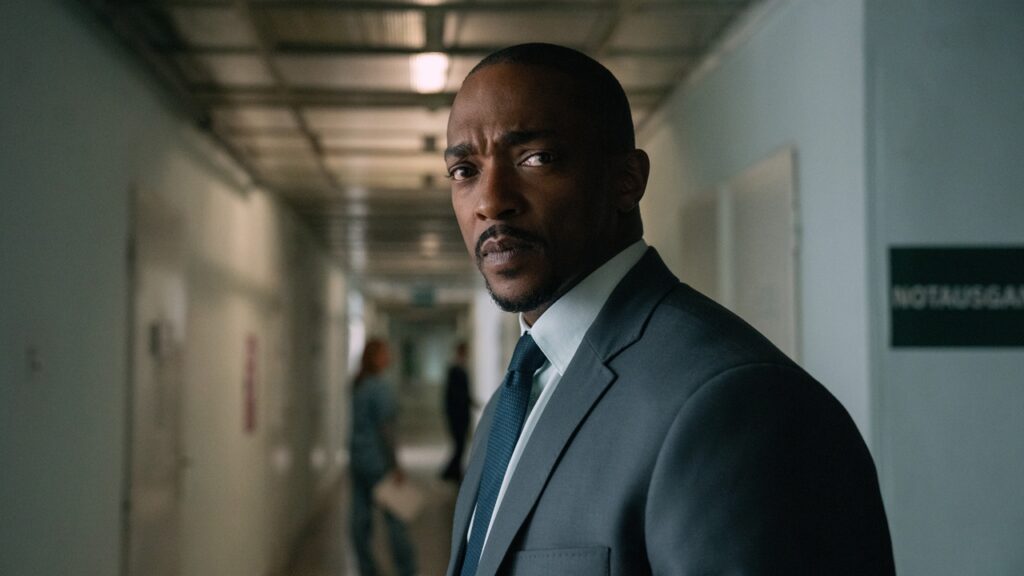
The plot does something similar. A year proves a lot more ground to cover than 12 hours or days. As a result, the planning section fast-forwards through some of the usual heist planning delights while often dwelling on less entertaining details. The 12 days, on the other hand, feel interminable. Despite being chased by multiple interests, each with plenty of desire to hurt the team, the last third feels slack. It is a lugubrious at best chase that reveals most characters as paper-thin. Cinematographer David Raedeker gives the series a nice, slick (but not too slick) sheen and really sells the Budapest and Texas locations as several countries. But the people and action so often feel flat that the pretty packaging highlights the show’s shortcomings, not masks them.
The characters with depth, namely Dornan’s Paul and Mackie’s Strickland, get hamstrung by the show’s rigid insistence on placing them in a noble criminal Valjean/driven cop Javert dynamic. Their relationship should be something thornier and harder to grasp, but 12 12 12 can’t seem to hold that kind of complexity for long. This is especially frustrating when the theft at hand is no mere loaf of bread but rather the life of a respected colleague.
As the series shuffles to its conclusion, it will likely leave audiences feeling a bit like both Paul and Strickland—exhausted and eager for the ordeal to be over with top notes of righteous indignation.
12 12 12 drills into Apple TV on November 13.