Read also:
How to Watch FX Live Without CableHow To Watch AMC Without CableHow to Watch ABC Without CableHow to Watch Paramount Network Without CableI’ve always said clichés aren’t bad. What’s frustrating is clichés delivered lifelessly. Great movies make conceptually predictable plot points or character beats feel fresh through richly specific execution. The recent Club Kid, for instance, takes a familiar narrative template and uses it as a springboard for profoundly specific characters, performances, and camerawork. You can make old tricks new again. Unfortunately, that reality makes movies rigidly playing the greatest storytelling hits more frustrating.
I Play Rocky, screenwriter Peter Gamble and director Peter Farrelly’s retelling of Sylvester Stallone trying to get Rocky made, suffers from this issue. There’s minimal energy or distinctive personality here as Farrelly and company lurch from one standard biopic movie beat to another. I Play Rocky aims for Rocky and Creed’s compelling underdog auras. In execution, it mostly echoes forgettable music biopics like Bob Marley: One Love.
If there’s a surprise here, though, it’s that Gamble’s script opts to frame Stallone like the ceaselessly tormented protagonist of a Vittorio De Sica or Mel Gibson directorial effort. Long before he’s hollering “YO ADRIAN!” on the big screen, I Play Rocky depicts Stallone (Anthony Ippolito) sleeping amidst the trash in New York City, getting laughed at in auditions, and wistfully recounting the times his dad beat him so hard he was knocked unconscious. Later on, the camera lingers on the actor breaking his tibia and knuckles to film key Rocky scenes. Was this guy a movie star or a martyr?
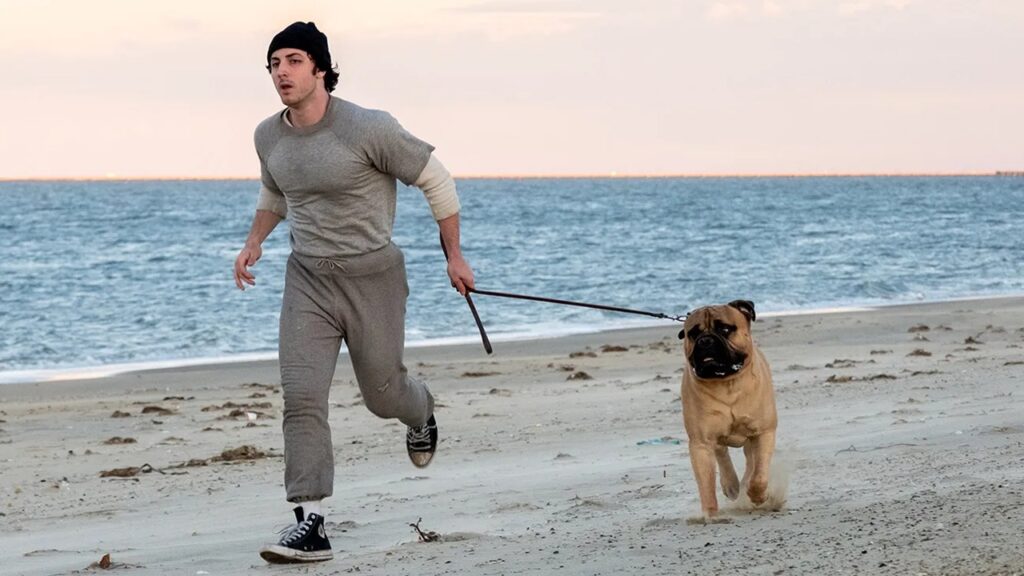
Stallone endures such misery whilst wanting to thrive as a serious artist. On the advice of his loyal wife Sasha Czack (AnnaSophia Robb), Stallone writes his own script based on boxer Chuck Wepner. Producers Irwin Winkler (P.J. Byrne) and Robert Chartoff (Toby Kebbell) sense immense potential in this screenplay and want to make it into a movie. There’s one problem: Sly refuses to back down as the film’s leading man. This total unknown wants to play Rocky (hence that title). Life keeps counting Sly out. Now, after writing the quintessential underdog movie, he isn’t backing down from inhabiting Rocky Balboa.
I Play Rocky characters keep talking about how shooting Rocky is a doomed enterprise or other behind-the-scenes drama. However, none of the visuals reflect any desperation or jagged struggles. Everything’s shot in a static fashion with little variation in lighting or camerawork. Farrelly deploying an early Dutch angle to capture Sly going up some creaky New York stairs proves an anomaly in a movie otherwise utilizing very straightforward angles. Like A Complete Unknown two years ago, shooting I Play Rocky digitally deprives the feature of period-era tactility. Even New York’s grimy 70s streets look squeaky clean in this visual scheme.
Basic is the name of the game here. That extends to Gamble’s script, which takes a one-in-a-million true story and realizes it with distracting predictability. For instance, there’s an early scene where Sly and Sasha plop down on the couch together. Instantly, it’s clear (without the film incorporating intentional foreshadowing) that Sasha is about to tell Sly she’s pregnant. Every detail about the sequences harkens back to similar scenes in other movies involving news about imminent younglings. Such derivative visual and narrative impulses make several other I Play Rocky sequences similarly predictable.
That familiarity wouldn’t be a problem if Gamble and Farrelly filtered it through potent characters, intriguing social commentary, or anything substantive. Instead, I Play Rocky is a routine, linearly told biopic. There’s no showmanship to make conceptually familiar segments enthralling. Plus, there’s little else on its mind beyond just rehashing specific events in Stallone’s life and Rocky’s creation. This is why I Play Rocky’s most entertaining stretch involves United Artists executive Sandy Maddox (Tracy Letts) constantly trying to pay off Stallone so he doesn’t anchor Rocky.
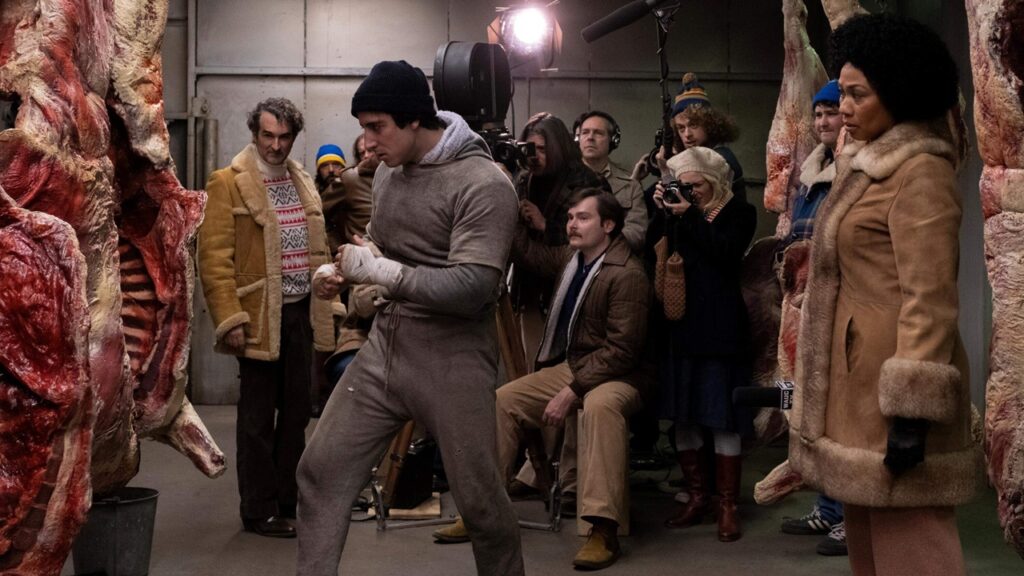
A guy living out of a broom closet refusing hundreds of thousands of dollars is immensely amusing on its face. Moments like Maddox watching a Lords of Flatbush screening and only realizing afterwards he doesn’t know which actor in the film was Stallone are both humorous and lean into the inherent absurdity of this story. Stallone’s ascent from unknown to Rocky leading man isn’t just an underdog narrative. On paper, it’s absolute madness, the story of a guy bending reality and the rigid film industry to his will. This I Play Rocky stretch’s ludicrous gags (like valet driver Stallone having to be told that he shouldn’t let Maddox see him at his day job) entertainingly lean into this reality.
Plus, Maddox constantly being seconds away from popping a blood vessel gives him a more distinctive personality than most other I Play Rocky characters. Letts is an absolute riot depicting this executive hissing “Fuck Paramount, fuck Barry Diller!” while aggressively cutting into a steak. Alas, eventually Stallone secures the role and I Play Rocky returns to rudimentary biopic impulses. Though characters reference Rocky’s financial and practical constraints, everything on-screen is clean and tidy.
Even the greatest conflicts, like Stallone’s tibia injury, the firing of a boxing choreographer, or grave budget problems, vanish within a single scene. Few hardships deliver long-term ripple effects after surfacing. This dissonance between what’s said and shown keeps I Play Rocky from reaching the entertaining highs of superior movies about filmmaking. Brigsby Bear, Ed Wood, American Movie, or Living in Oblivion (among many others) get viewers invested in all the jagged challenges, compromises, and joys of artistic creation. I Play Rocky, meanwhile, is a frustratingly cozy waltz down memory lane. Uncluttered montages wash away the sweat and tears going into art.
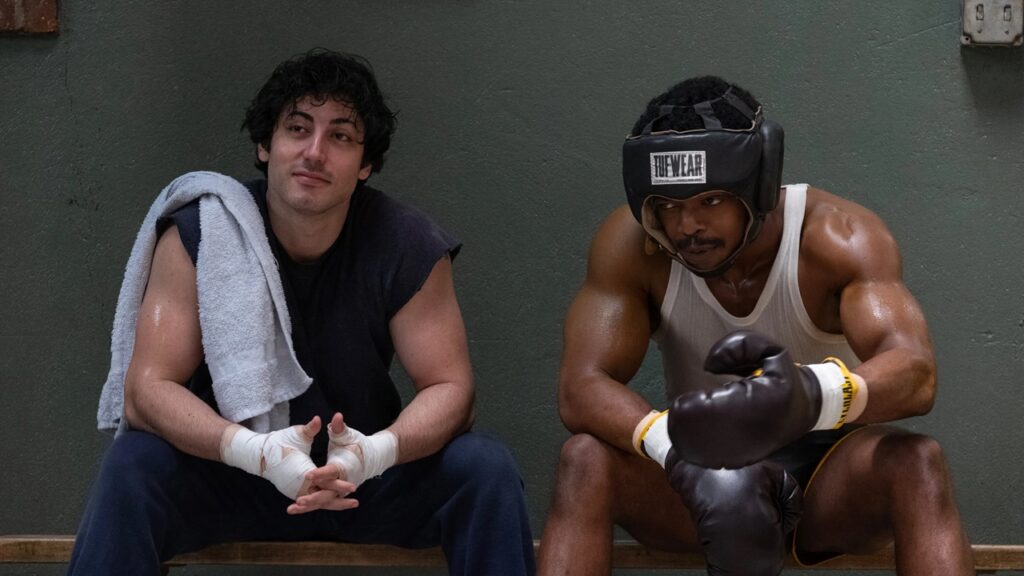
On-set problems aren’t the only I Play Rocky elements this feature struggles maintaining from one scene to the next. A big show is made about introducing Stallone’s co-star Carl Weathers (Stephan James). James plays Weathers with engrossing larger-than-life confidence. Unfortunately, after two more appearances, he vanishes. There’s no greater arc between him and Stallone. Nor does he deliver further entertaining lines that steal the show. He’s the centerpiece of one sequence and then disappears. This awkward Carl Weathers treatment epitomizes I Play Rocky’s troubles utilizing key Rocky elements beyond surface-level references and recreations.
If there’s any I Play Rocky aspect emerging as impressive, it’s Anthony Ippolito’s lead performance. Impersonating Stallone isn’t necessarily hard. Actually making that impression feel like a human being, that’s tricky. Ippolito does just that, though. His accuracy to the real actor is remarkable, but his conveying Stallone’s aching yearning is what really makes the performance click together. I Play Rocky as a film remains shallow. Ippolito’s work, though, communicates the internal desperation and conviction fueling Stallone’s desire to prove the world wrong.
I Play Rocky‘s acting is generally fine, including AnnaSophia Robb trying her best wringing depth out of a quintessential biopic wife character. This archetype, seen in titles like Hitchcock, American Sniper, The King’s Speech, and so many others, has no interior life unto herself. She just exists to tell a famous white man from history that “”sometimes it is the people who no one imagines anything of, who do the things no one… can imagine” or “God must be a painter. Why else would we have so many colors?”.
In I Play Rocky, Sasha fulfills that purpose. She has no friends. She has no real drive beyond reminding her husband, “you have a voice, write your own script!” I doubt she exists whenever she’s not on-screen. AnnaSophia Robb gives this Jersey lady all she can, but Gamble’s script is frustratingly content to leave Sacha half-realized. She’s a microcosm of I Play Rocky failing to deliver knockout punches in deeply human storytelling
I Play Rocky expands into theaters everywhere on November 20.