Read also:
How to Watch FX Live Without CableHow To Watch AMC Without CableHow to Watch ABC Without CableHow to Watch Paramount Network Without CableIn 2015, Carly Rae Jepsen changed music forever with her song “Boy Problems.” This Emotion track is a bouncy ditty excelling on countless levels, lamenting the rigidity and reliably disappointing nature of men. It’s also got an irresistible chorus where Jepsen declares that breaking up with her boyfriend recently is nothing compared to her other, more daunting issues. “Boy problems, who’s got ’em?/I’ve got ’em too/Boy trouble, we’ve got double/Don’t know what to do”, I’m tapping my toes just typing out these sensational lyrics.
The Hunger Games: Sunrise on the Reaping doesn’t necessarily have “boy problems.” But it does have an adjacent issue. “Prequel problems.” Who’s got ‘em? Director Francis Lawrence and writers Billy Ray and Michael Lesslie, apparently. Those issues hamper what’s otherwise one of the stronger Hunger Games movie adaptations.
Since it’s time for another Hunger Games movie, you know what that means. It’s time for this franchise to venture forth into the dystopian future of Panem. Here, these films must uncover another conventionally attractive white protagonist from impoverished circumstances. Some traditions never cease. This time around, the focus is on young Haymitch Abernathy (Joseph Zada). His birthday coincides with the annual Reaping (where two children from each district are chosen to fight in those Hunger Games). On this particular year, he and fellow District 12 denizens Maysilee (Mckenna Grace), Wyatt (Ben Wang), and Louella (Molly McCann) are selected.

Now it’s time for the reluctant quartet to get gussied up. They must navigate the pageantry, interior politics of The Capital (the bougie realm controlling Panem), training, and all the other factors determining whether you live or die in the Hunger Games. Abernathy quickly gets President Snow’s (Ralph Fiennes) bad side. Now he just knows he’ll die in this year’s Quarter Quell. This is a special version of the Hunger Games where twice as many adolescent tributes navigate an especially spectacle-laden tournament. Abernathy’s convinced death soon awaits him.
Yet others around him, like Plutarch Heavensbee (Jesse Plemons) or Beetee Latier (Kelvin Harrison Jr.), keep instilling thoughts of rebellion in his ear. Is there a way to fight back against this machine?
I doubt anyone watching a sixth Hunger Games movie theatrically will enter the theater and not know Lucy Gray from Rue. Still, Sunrise on the Reaping often struggles working as a standalone film. Immense momentousness given to Muppet Babies versions of Effie Trinket (Elle Fanning) or Wiress (Maya Hawke) won’t make a lick of sense without seeing other films. Heck, it registers as clumsy even for someone who’s seen those titles. There’s also too much didactic dialogue poking audiences in the ribs about teasing future Hunger Games adventures. Trinket uttering the word “mahogany”, for instance, is groan-worthy. Too often, Sunrise on the Reaping defaults to treating its characters like chess pieces being moved about for future matches rather than engaging figures in the here-and-now.
Thankfully, other Sunrise on the Reaping segments do work despite constant“prequel problems.” This includes the production’s lush, gorgeous visuals. It’s often interesting to see how (or even if) long-running movie sagas improve on flaws in their earlier installments. For The Hunger Games, the shaky-cam, dim lighting, and subdued colors of the inaugural 2012 movie are a distant memory. Lawrence and company now embrace grander tableaus littered with vibrant hues. The Capitol’s incessant decadence comes through tenfold through such elegance.
Part of those enjoyable visuals from production designer Uli Hanisch and prop maker Lotje van Ginneken (among other artists) embracing Sunrise on the Reaping occupying Panem’s equivalent of the 1970s. Every camera looks chunky and boxy. The televised Hunger Games ceremonies hosted by Caesar Flickerman (deliciously played by Kieran Culkin) have colors and visual schemes evoking 70s game shows like The Dating Game. Lush interior environments (like a library Heavensbee often resides in) feature architecture immediately harkening back to this decade.
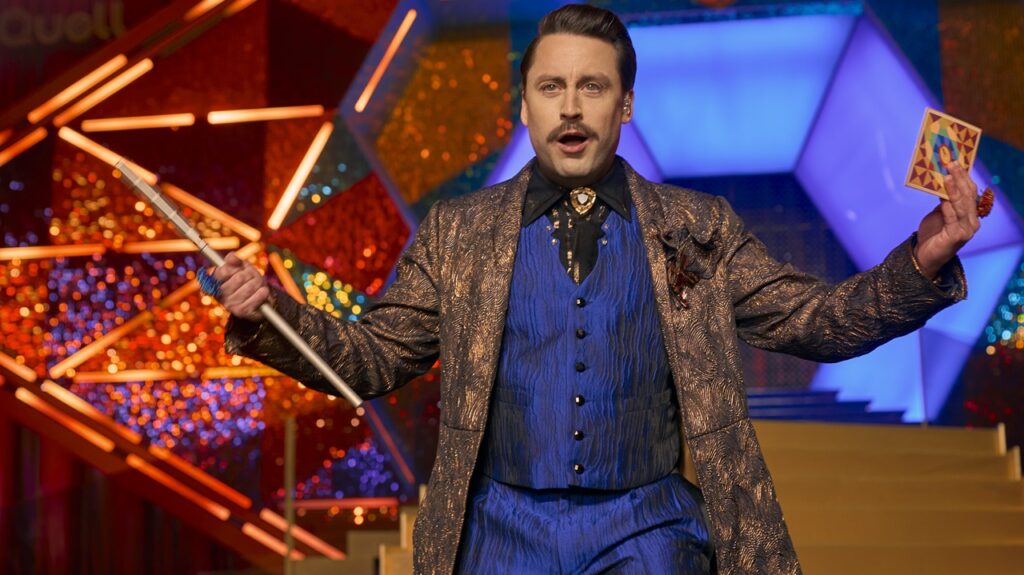
Everyone in the sets, costumes, and props departments ate and left no crumbs in delivering wonderful period-appropriate touches. They “didn’t just come here to dance,” as Carly Rae Jepsen would say.
This dedication to a vintage aesthetic also happily leads to an influx of color in the proceedings. When Haymitch’s stuck in a room before entering the tournament, he’s trapped in a bright red space ripped straight out of a Jacques Demy movie. Helicopters appear draped in purple and golden colors. Even gigantic water tanks in an unflashy Panem section are drenched in bright green. There’s also consistently crisp camerawork and editing in capturing even the most chaotic Quarter Quell developments. Sunrise on the Reaping certainly delivers visually.
Just as gripping as the sharp images are the best Sunrise on the Reaping performances. Jesse Plemons is the movie’s MVP. That’s an unsurprising development given how engrossing he’s proven as an actor doing everything from threatening Jesse Pinkman to arguing with a bumblebee. Even so, just like Carly Rae Jepsen delivering another knockout album after so many great collections of music, a gifted artist always makes their talents impactful no matter how familiar they are. Plemons perfectly channels Philip Seymour Hoffman’s energy as Plutarch, but never in a distracting way. He’s not doing a caricatured impression of this Boogie Nights legend. He’s taking the man’s aura and translating it through acting only Plemons could deliver.
Joseph Zada isn’t quite as successful as this film’s Haymitch. However, he does admirably commit to Sunrise on the Reaping’s various depictions of Haymitch in deeply externalized emotional agony. This Hunger Games fixture goes through enough misery here to make Elem Klimov or Aeschylus proud. Zada proves solidly believable and appropriately heartbreaking depicting that anguish. As Culkin and Glenn Close (the latter playing Drusilla Sickle) clearly had a blast embodying maximalist evil. Meanwhile, Kelvin Harrison Jr. astonishes with his exceptional impression of Jeffrey Wright’s iconic voice.

Just as the sharp visual instincts and strong performances seem destined to lift The Hunger Games: Sunrise on the Reaping beyond Catching Fire as this saga’s creative peak, those “prequel problems” rear their head once again and drag things down. This artistic push-and-pull is perfectly embodied in Sunrise on the Reaping’s final 15 minutes. This section starts with the movie’s best sequence, a raw conversation between Haymitch and Plutarch.
Here, the proceedings effectively evoke Andor or Everybody to Kenmure Street, emphasizing individual rebellious actions existing in a larger tapestry of subversiveness against fascism. Then, Lawrence swerves into an epilogue full of dumb “You should use your full name, I like that name…Robin” energy. Here, Sunrise on the Reaping epitomizes how fan service keeps poking holes in its greatest standalone qualities. Then there are other frustrating flaws, like the excessively static camerawork in dialogue-heavy sequences or the engrossing Whitney Peak getting wasted as Haymitch’s romantic interest, Lenore.
Perhaps Sunrise on the Reaping’s creative tug-of-war fits a film series often at war with itself. After all, how many motion picture sagas both evoke #FreePalestine rhetoric while depicting a Fox News anchor’s vision of Hell where men with painted fingernails and women with blue hair rule the world? The Hunger Games: Sunrise on the Reaping generally works solidly, and its visual impulses are top-notch. However, its slavish devotion to past Hunger Games adventures keeps it from reaching its fullest potential in the present.
In other words, succumbing to “prequel problems” keeps it from being as consistently excellent as Carly Rae Jepsen’s Emotion (though, in all fairness, what movie is that good?).
The Hunger Games: Sunrise on the Reaping hits theaters on November 20.