Read also:
How to Watch FX Live Without CableHow To Watch AMC Without CableHow to Watch ABC Without CableHow to Watch Paramount Network Without CableLike Anatomy of a Murder, Catch Me If You Can, or The Cremator, Jane Schoenbrun’s Teenage Sex and Death at Camp Miasma immediately alerts viewers they’re about to watch a classic through an extraordinary opening credits sequence. The typical “cinematography by” and “directed by” credits transpire against shots of newspaper clippings, toys, VHS covers, and other objects. All these items reflect the highs and lows of the in-universe Camp Miasma horror franchise.
Glimpses at a glitzy Camp Miasma arcade cabinet or the saga’s serial killer mascot Little Death being drawn all cutesy for an anti-drug PSA immediately convey various stages of the public’s connection to this horror universe. Once a VHS cover for direct-to-video entry Miasma 3000 and an online news article announcing a Camp Miasma Quibi series has collapsed, it’s clear this brand name’s a modern punchline. This dialogue-free sequence ingeniously uses cleverly realized visuals to communicate the entire history of a film series. It’s the perfect, deeply creative kick-off for the wonders yet to come.

After this sequence, Teenage Sex and Death at Camp Miasma’s protagonist, filmmaker Kris Williams (Hannah Einbinder), is introduced. She’s been hired to helm a Camp Miasma reboot. Before she charts this horror saga’s future, though, she wants to meet the face of its past. On a snowy Tuesday, Kris travels to visit Billy Presley (Gillian Anderson). She’s the woman who headlined the very first Camp Miasma installment. Now, Billy lives a reclusive life at the campground where that initial film was shot.
From the moment Kris and Billy two meet, Schoenbrun’s script and camera fuse bittersweetness with playful sensuality into their interactions. The latter element permeates their very first meal together. Here, the pair dip chicken strips into sauces (an action framed in extreme close-ups) in a most suggestive fashion. These playful visuals communicate potential sensual tension so amusingly. However, wider images of moments like Billy warmly insisting the withdrawn and shy Kris stay at her cabin overnight potently bring that wistful energy. In these unblinking segments, Schoenbrun captures two often adrift souls possibly making steps toward finding solace in one another. Keeping the camera so far back poignantly accentuates their smallness.
Immense visual and narrative care underlining Billy and Kris encapsulates Schoenbrun’s gift for transmogrifying the past into fresh art. That gift is more vital than ever in the current pop culture landscape. We live in an age of endless fan-service and reruns. Harold Ramis and Christopher Reeve don’t have to die. They can still make people clap their hands and point at the screen through creepy CGI resurrection. Living actors, meanwhile, reappear rehashing lines they uttered decades earlier. 80s nostalgia’s consumed our culture for what seems like an eternity. So often, the past isn’t a springboard to new creations. It’s quicksand trapping us all in yesteryear media.
Teenage Sex and Death at Camp Miasma, like Schoenbrun’s I Saw the TV Glow, has a much more fascinating relationship with older media. Characters name-dropping Jason Blum and Pamela Springsteen makes it clear Schoenbrun knows horror cinema like the back of their hand. However, Teenage Sex and Death at Camp Miasma goes deeper than repeating familiar buzzwords. Instead, the production emphasizes concepts like how art that shapes us molds our sexual desires. Rather than just repeating what audiences have seen before, Shoenbrun uses the domain of 80s/90s slasher fare as a key unlocking deeply raw (and profoundly specific) interior vulnerabilities in Kris and Billy.
In a current status quo where mainstream cinema scrambles to remove sex and nudity whenever possible, such beautifully realized openness about sexuality and yearning is a balm for the soul. Specific dialogue about which slasher film archetypes Kris images herself as, for instance, prove moving because of how they relate to her as a character rather than simply referencing old famous motion pictures. Figures like trans serial killer Little Death, meanwhile, are given rich new layers compared to the characters they’re pastiches of. Schoenbrun doesn’t just have Little Death remind audiences of Buffalo Bill or Angela from The Silence of the Lambs and Sleepaway Camp, respectively, and call it a day. Larger pop culture legacies are just one corner of these characters who’ll prove captivating even to those who’ve never seen a vintage slasher feature.
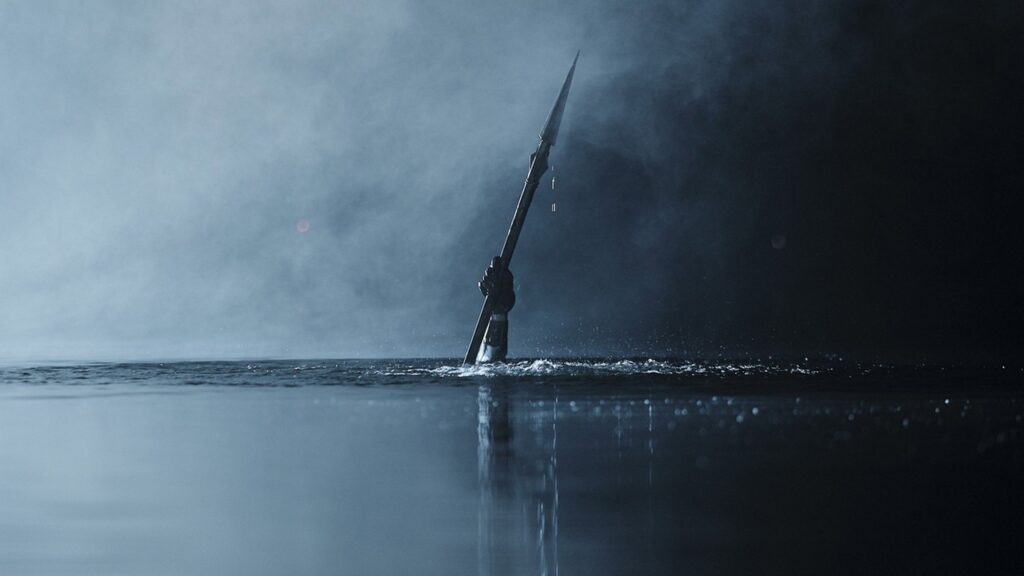
Even this title’s sumptuous visuals subvert rather than regurgitate typical 80s/90s slasher movie aesthetics. Billy’s campground home is a snow-covered realm with pinks and blues littering the sky. These tableaus materialize through gorgeous matte paintings. Pervasive beauty and ornate blocking here make it apparent why Camp Miasma’s leads love this domicile. These hand-crafted realms evoke Kwaidan more than Friday the 13th. Similarly, Alex G.’s orchestral score often sounds as if it’s about to segue into Catherine Feeny’s “Mr. Blue” rather than John Carpenter’s Halloween score.
Accompanying those eye-popping visuals is a bevy of memorable performances. That includes Hannah Einbinder in her first major movie role after her star-making turn headlining the show Hacks. Einbinder instantly cements herself here as a movie star. From the get-go, she demonstrates a gift for wringing maximum laughs out of dorky line deliveries. Her instinctual uttering of “oh, this scene’s transphobic!” while revisiting Camp Miasma with Billy had me in stitches. When Shoenbrun pulls the camera closer, though, for more raw and intimate sequences involving Kris, Einbinder still excels as a fully dramatic performer.
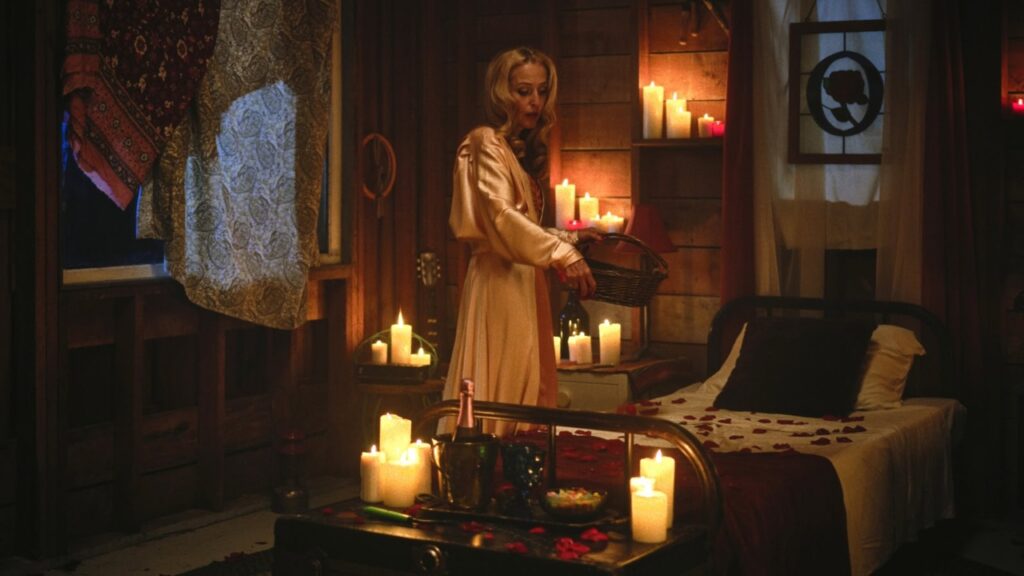
There’s an immediate believability to her portrayal of Kris quietly elucidating her conflicted psyche. Whether she’s portraying Kris going super outsized in a Zoom call in her car or quieter tender conversations about her sexual identity against a crackling fire, Einbinder is engrossing. Equally absorbing is Gillian Anderson, who’s an absolute blast delivering her character’s Southern drawl and seductively mysterious aura. Never before in the history of cinema has somebody made listing off cereal brand names as hysterical as Anderson.
Major props, too, for a critical Teenage Sex and Death at Camp Miasma performer, Jack Haven. In their last Schoenbrun collaboration in I Saw the TV Glow, Haven’s work relied heavily on dialogue, especially in their shattering climactic monologue. Here, portraying Little Death, that same performer inhabits an entirely physical role devoid of verbal communication. Even while lacking grand soliloquies, this Schoenbrun veteran remains magnificent. Their facial expressions are just so vividly memorable, ditto their physicality both in and out of the Little Death costume.
This recurring filmmaker/actor pairing is already proving as richly rewarding as Akira Kurosawa and Toshiro Mifune or Kelly Reichardt and Michelle Williams. May it last for ages to come.
Jack Haven’s Little Death is the centerpiece of one of the most memorable Teenage Sex and Death at Camp Miasma sequences. This unforgettable segment combines the unblinking camerawork of Touch of Evil’s opening scene, the bloodshed of both Oldboy’s hallway skirmish and an Itchy & Scratchy cartoon, and an ingenious mid-90s needle drop. I’ve never seen a slasher movie scene operate like this one. Nor has slasher carnage rarely wielded such bittersweet energy. This triumphant piece of filmmaking doesn’t just showcase Haven’s acting chops. It’s also a microcosm of Teenage Sex and Death at Camp Miasma constructing idiosyncratic imagery and atmospheres from the bedrock of vintage horror films.
Such idiosyncrasies intertwine with various specific, confidently outspoken details littered throughout Camp Miasma. What other movie this year has Kevin McDonald dramatically whipping out a dusty DVD player? Similarly, few other features deliver such creative and visually pleasing uses for brightly colored candy wrappers. Then there’s all the wondrous touches in scenes where Kris and Billy lie or stand next to each other. Schoenbrun wisely refuses to barrel past these tender segments radiating queer women intimacy and fascinatingly complicated emotions. There’s joy in their interactions, but also Kris’s hesitancy and self-criticism. Just as gazing upon a snowy tableau can be beautiful and uncomfortably chilly, Camp Miasma’s romance-driven sequences command nuanced emotions.
Few things are as delicious as quality gummy candy. Similarly, the perfect fusion of a pop song needle drop and a movie scene is utterly wondrous. And, of course, getting caught up in the glorious harmony of love is transcendent. Jane Schoenbrun understands these realities as well as they grasp classic slasher movies. Masterfully alternating between gore-covered mayhem and bittersweet sapphic affection, Teenage Sex and Death at Camp Miasma embodies the three F’s: flesh, fluids, and phenomenal (I know how to spell phenomenal…branding, though). Do not miss this masterpiece that, among countless other accomplishments, ensures Shrek 2 is no longer the only movie featuring an iconic scene set to a Counting Crows ditty.
Teenage Sex and Death at Camp Miasma is now playing in select theaters and expands to theaters everywhere on August 21.