Read also:
How to Watch FX Live Without CableHow To Watch AMC Without CableHow to Watch ABC Without CableHow to Watch Paramount Network Without CableIf you are Gen X or a Millennial, chances are good you’ve encountered some piece of “Kill Barney” “humor” over the years. Perhaps a quick-and-dirty reworking of “I Love You” or something even more obvious. Regardless of the version, they were part of life in the late 90s/early naughty aughties. Haters, drawn in from the moment he first proclaimed himself a dinosaur “from our imagination,” seemingly couldn’t help themselves. It’s no wonder such fascinating revulsion caught filmmakers’ imaginations. 2002’s Death to Smoochy attempted to use it, with decidedly mixed results, to power a dark showbiz satire. Buddy takes that energy in a decidedly different direction.
Director Casper Kelly, working from a script by him and Jamie King, asks what if that legion of haters were right to wish death upon Barney. What if he only looked like a man in a mascot costume but was actually something more supernatural and even monstrous? What if the whole time everyone was joking about killing him, he was slaying any of his “friends” the moment they dared step out of line?
Unlike Barney, Buddy the Unicorn (voiced by Keegan-Michael Key, embodied by Sergey Zhuravsky and Jonathan Yurco) is not a mainstream success. He’s something more like a creepypasta, by both his and the film’s design. He’s half-remembered, if at all, by blessedly few. His show is a world unto itself, unfolding not on a set, but in some kind of a pocket dimension. There are storylines, songs, and lessons, and everyone does play to the cameras until the credits roll. Except there don’t really appear to be any cameras. “It’s Buddy” sure isn’t broadcast on any conventional channel or streaming service. And those credits are just a short break before the next episode immediately begins.
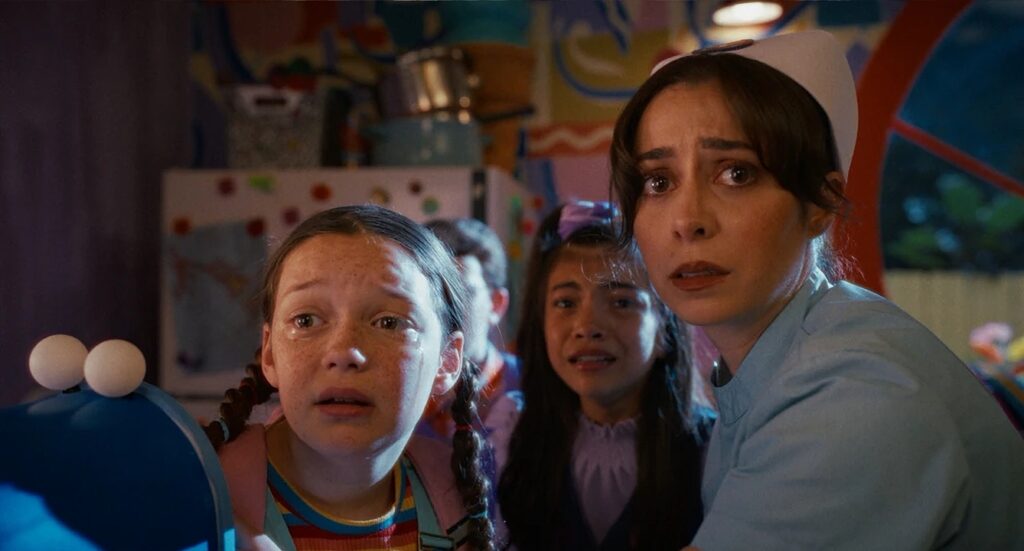
Like the proverbial frog in the boiling pot, the “cast” seems not to notice. That is, until Josh (Luke Speakman) refuses to join a dance party—a plot almost directly lifted from Barney. That inflexibility incurs Buddy’s wrath. When the bloodlust fades, the unicorn quickly hides the evidence and brings in a new “castmate,” Hannah (Madison Skyy Polan), to distract. However, things are out of place just enough that Freddy (Delaney Quinn) and Wade (Caleb Williams) begin to question their entire reality.
Meanwhile, in the “real” world, Grace (Cristin Milioti) becomes convinced her two children should be a hat trick and that she has a missing daughter. Her husband Ben (Topher Grace) can’t bother to figure out what she’s going through. And then one night, she catches a glimpse of a beckoning Buddy on her TV screen.
Buddy smartly doesn’t attempt to balance out the time we spend in that real world with the time in Buddy’s plane of existence. By only briefly touching reality, much of the need for rules—or understanding them—falls by the wayside. The audience gets enough to understand that It’s Buddy is an endless TV show starring children who can’t remember anything but being part of the show. To explore it any further would be, to paraphrase another film, risk the need for building models out of straws to understand the intricacies.
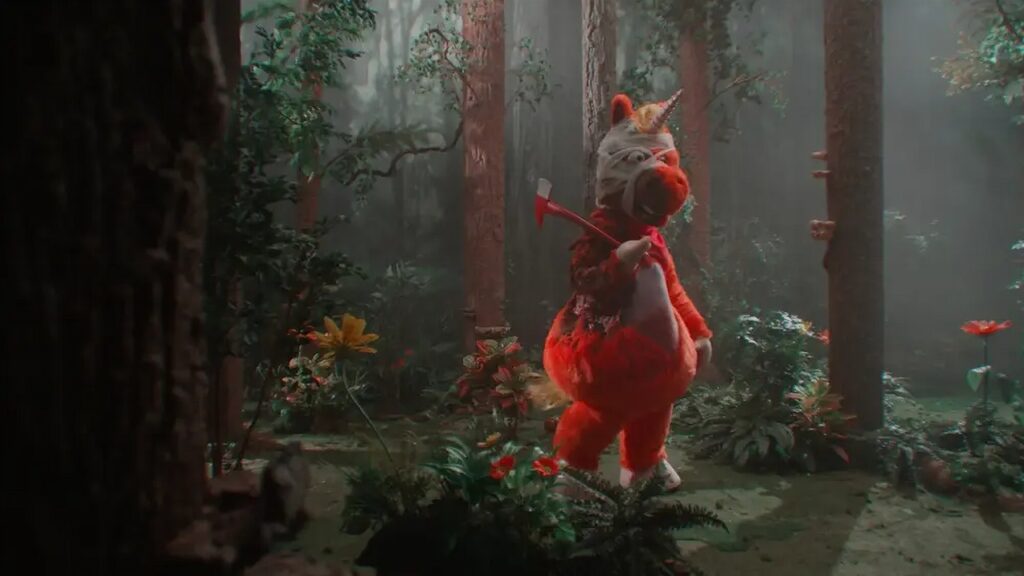
Another clever choice is that the film doesn’t settle for a one-to-one palette swap with its dino predecessor. While clearly inspired by Barney in numerous ways, it allows itself to diverge in ways that deliver both more laughs and conditions for mayhem. Buddy’s home boasts some talking furniture, an obvious nod to Pee-Wee’s Playhouse. The human characters—a mailman and a nurse—also evoke Pee-Wee. Freddy’s Strappy (voiced by Patton Oswalt) is a cowardly monolingual version of Dora’s Backpack. Nods to Hee-Haw, Blue’s Clues, and more are also there for the noticing. It furthers the idea of It’s Buddy as some vaguely remembered show. Its interactions with reality are so fleeting and fuzzy that it has, in essence, been “recorded” over by elements of more memorable children’s programming.
It’s excellent world-building and a queasy delight. But once the world is built, the film sort of loses any narrative propulsion. It still has moments. There’s George (Clint Howard), and his puppet friend Willie (Michael Shannon), for instance. George was a kid when he escaped an earlier version of It’s Barney and has grown up in the world that surrounds Buddy’s yard with Willie in two. They are genuinely unnerving presences in the film. Their brief appearance crawls inside the audience’s head in a way that Buddy’s Karo-syrup-splattered rampages never do. Buddy as a threat to children AND adults is another well-done and nausea-inducing reveal. But ultimately, once the world is established, Kelly and company struggle to find a plot worthy of it.
As a result, the final product is entertaining, but frustrating, curiosity. Unlike Kelly’s Too Many Cooks, Buddy can’t quite get away without a plot. It can’t simply be a joke that runs until it reaches dada levels of dark absurdism. The kind of vaguely recalled show marked by unnerving details works wonders for creepypastas, certainly. However, for a feature film, the storytelling needs something more substantial. It can’t just point to the faded, incomplete world. It has to take the audience on a journey through it.
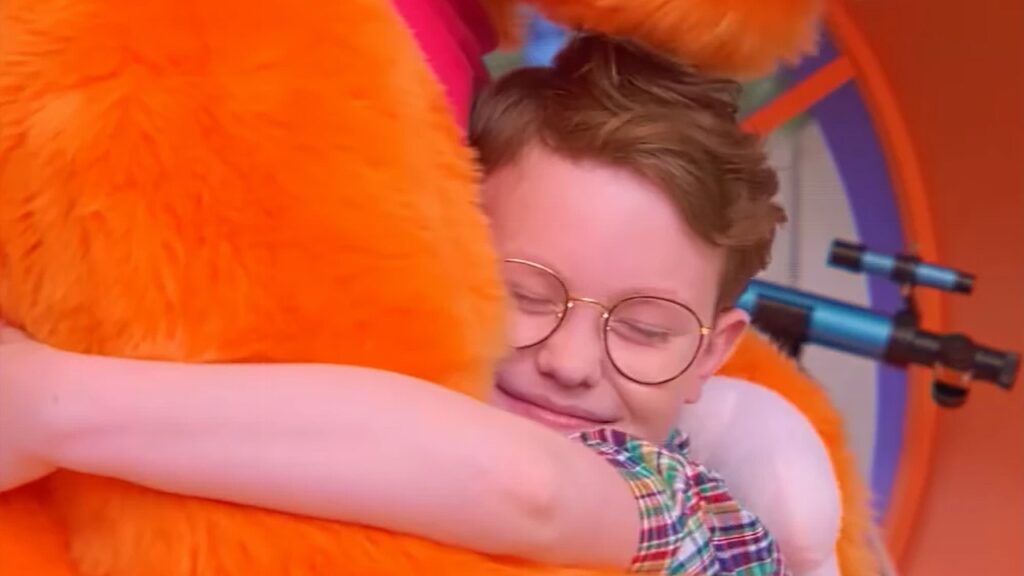
Similarly, its storytelling concerns are not so removed from expectation that Kelly can pull something as he did with the Yule Log specials for Adult Swim, where the plot came as a welcome bonus. With only the barest of plots, what was surreal, unnerving, and wacky devolves into little more than running through a variety of sets. At times, it feels like eating in a restaurant that fully invested its energies in the décor, the music, the wait staff, and the lighting and then spends the entire meal telling you to hurry up already.
For the world it creates and a Milioti who earnestly commits, it’s worth a watch. But with such a fully realized alternate reality, it’s a shame the plot feels like an inconvenience to be dealt with only when there’s no other choice.
Buddy has a song for you in theatres starting August 28.