Read also:
How to Watch FX Live Without CableHow To Watch AMC Without CableHow to Watch ABC Without CableHow to Watch Paramount Network Without CableOne of the harder things to accept as a comic book fan is that your favorite character is going to be different depending on where they show up. Yes, they have some core qualities and a power set that will likely stay put. When done right, the similarities provide a foundation and the differences lend spice. When done poorly…oof. The Nicolas Cage-voiced character from Spider-Man: Into the Spider-Verse was an absolute delight, a silly straight man that went serious when necessary without it feeling forced. Could that high-wire act translate from an animated ensemble film to a live-action solo TV series? Could Cage sell superheroics in the flesh as a 62-year-old man as well as he did with just his voice? Was any of this a good idea or just a misguided overextension of a brand? These questions had me approaching Spider-Noir with some anxiety.
Color me (or not; more on that later) pleased then that Spider-Noir makes the transition with aplomb. Rather than attempt a note-for-note replication, the series developed by Oren Uziel and run alongside Steve Lightfoot, goes the essence route. The Spider (Cage), as he’s known in this universe, is no longer an odd duck speaking in noir patois while surrounded by contemporary people. Here, his manner of speech is lingua franca from Mayor Morris (Michael Kostroff) on down. But he’s still a Cage character, so he remains plenty odd.
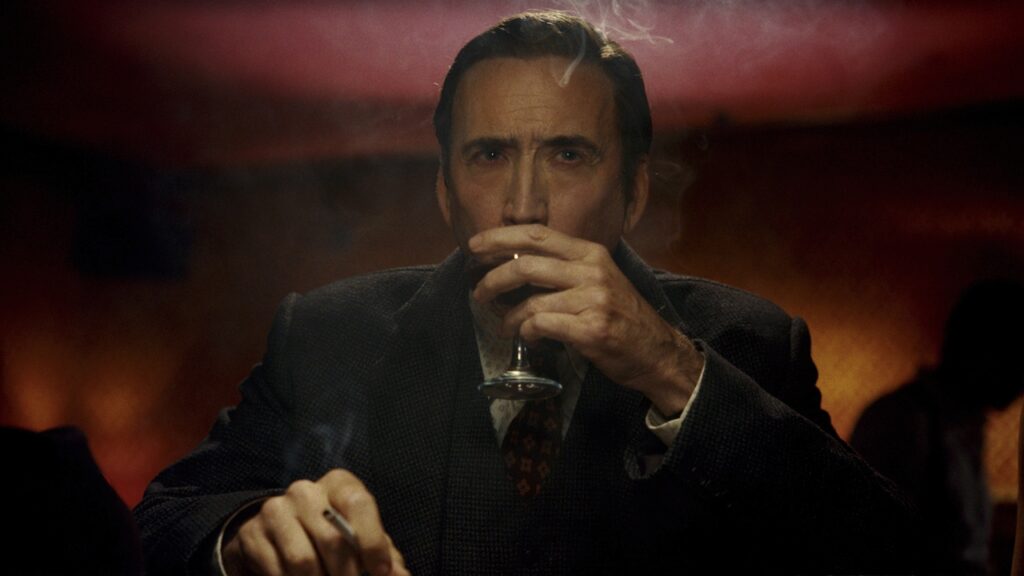
The humor—and the show is frequently funny—isn’t born of the contrast but rather the character’s innate weirdness. And the more natural habitat means Cage gets to develop even more shades (no pun intended…maybe) of his performance. This isn’t the actor at his most revved up, but it is perhaps one of his slyer efforts. The noir setting also doesn’t demand he hide his physicality. Given the history of detective films, him as an aging guy who can still throw and take a punch feels right. He can still turn on the mania, but his calmer moments aren’t Bangkok Dangerous dull. He’s still performing, just at a different rhythm, one that works best for setting and character. The moments when he does go full Cage—a drunken barroom brawl, an impromptu serenade of a villain—they really pop, a release for actor, character, and audience all at once.
The Spider has retired following the death of his love. Now he’s just Ben Reilly, PI. In his absence, Silvermane (a scary Brendan Gleeson) has become the kingpin of the Prohibition Era Big Apple. Without his only natural predator, The Spider, he sits comfortably atop the food chain. But peace hasn’t mellowed him. It made him itchy for a fight. So, when Jimmy Addison (Jack Mikesell) tries to burn down Silvermane’s mansion with pyrokinetic powers, the boss doesn’t take the attempted murder lying down. He goes on a rat hunt, one that pulls the whole City in its wake. How long can a retired superhero stay retired under those circumstances?

Viewers, before they watch one minute, will face a decision: color or black-and-white. Or to match the ad copy for Spider-Noir, “Authentic Black and White” and “True-Hue Full Color”. I, as your handy critic, am here to help them make that choice. And I say: Well, both are kind of great. As someone who took German film and film noir classes in college, I quite like the black-and-white rendering, especially given that the opening credits play as heavily influenced by German Expressionist filmmaking. Seriously, it’s like someone took German film credits from the thirties and tossed a James Bond song (Kirby’s “Saving Grace”) over the top. A couple of episodes—a flashback to a WWI POW camp raid and one taking place in an underground lab—pair quite nicely with that B&W vibe too.
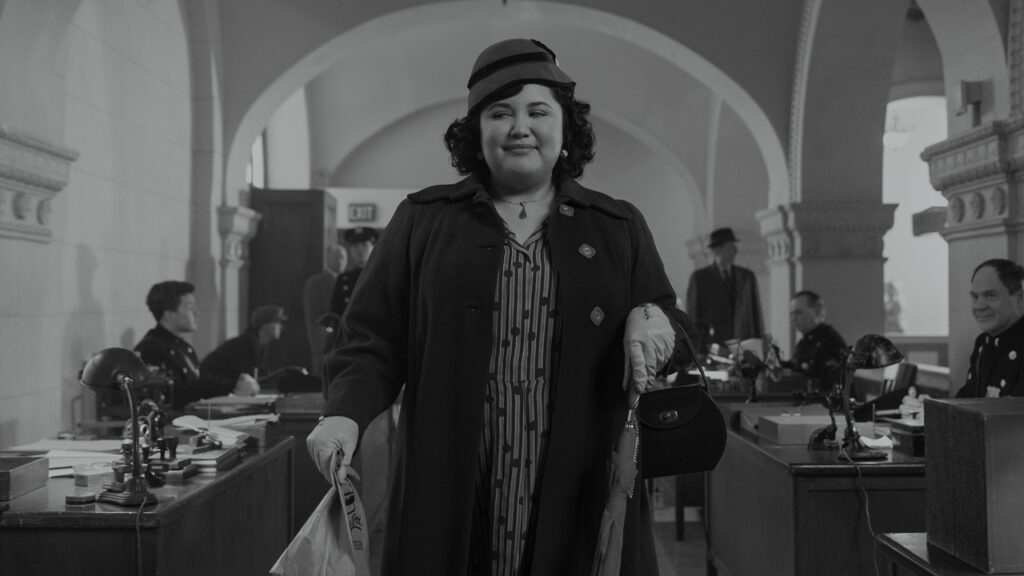
On the other hand, the full color is sumptuous. It isn’t quite Technicolor, but it probably shares a zip code with that technique. At a time when we frequently—and rightly—decry bland colors and muddy, unappealing blacks, this series wields a wonderful palette. Black and white might be “authentic,” but the color is no mere Ted Turner job. I guess my best advice is you do what I did and watch it both ways. Take a look at the photos in this review to see how both versions are visual treats.
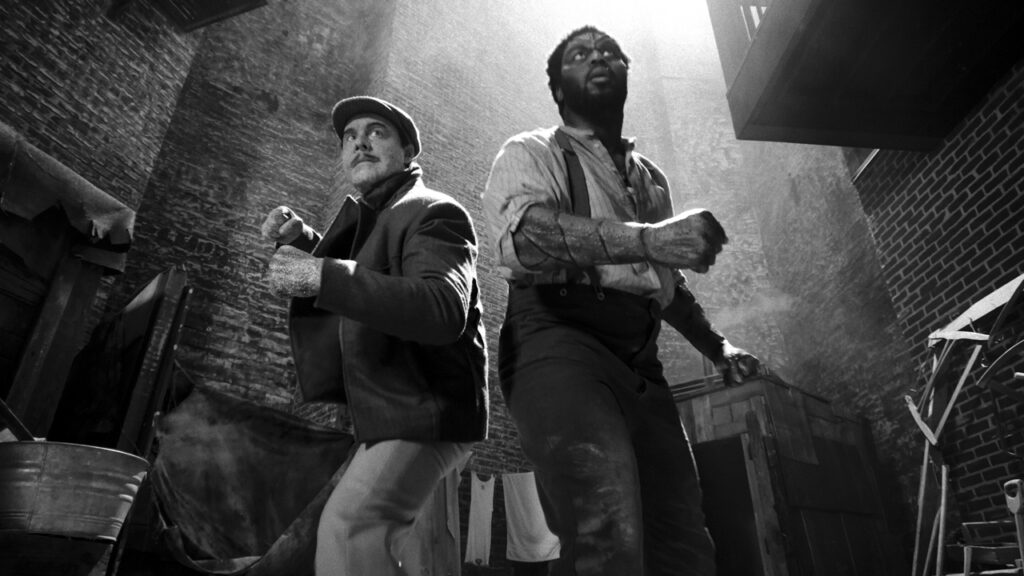
On the plot front, the show moves. At eight episodes, it doesn’t feel draggy or clipped. This is the rare streaming series that feels like the right amount of story for the time it has. Action sequences that match the world’s tone enliven the plot. There’s no incredible fight choreography or dizzying editing, but there’s an energy and zip to each chase and fight. The smaller scale matches the noir world well.
The show also doesn’t steer away from silence and pause, an aspect that really gives Cat Hardy (Li Jun Li)—this story’s femme fatale and world’s Felicia Hardy, the Black Cat—space to define herself. While there’s a lot of fun, there’s plenty to be somber about in this tale, a fact the show doesn’t run from. Therefore, we get glimpses of segregated New York, Hoovertowns in alleyways, and soldiers abandoned to graft and worse by their government.
An added bonus of Cage operating at a quieter decibel is that it gives his costars plenty of space. Morris is great as Robbie Robertson, an unusual, serious turn for him that still utilizes his comedic charisma. Karen Rodriguez as Reilly’s secretary, Janet Ruiz, could’ve been a one-note turn, but the actor invests her with so much that she sparks every time she’s on-screen. And I have to shout out Andrew Lewis Caldwell as Dirk Leyden, a superpowered train operator who’s obsessed with show business. He’s plenty happy to play to the back row while Cage shows restraint.
Spider-Noir understands that adaptation demands change, so The Spider can’t just be a carbon copy of his animated self. Because of that, Cage is an excellent person to bring both to voice and live-action life. He has the versatility to go full comic book in some moments, while toeing the noir line with a smirk at others. He’s unembarrassed by either play or, refreshingly, by his own aging body, allowing him to find the kind of bone-deep exhaustion that underpins so much good noir. Taken in full, what could’ve been a dashed-off IP exercise proves one of the more interesting interpretations of Marvel superheroes of late, proof positive that there’s juice left in the genre for those willing to play a bit.
Wherever Spider-Noir goes, the wind follows. And the wind smells like rain. Starting May 27, Prime Video smells like rain.