Read also:
How to Watch FX Live Without CableHow To Watch AMC Without CableHow to Watch ABC Without CableHow to Watch Paramount Network Without CableI’ve been watching Christopher Nolan movies in theaters for a little over half of my life. His movies have often proven surprising, whether it’s the cheekily ambiguous Inception ending, Oppenheimer’s audacious visual sensibilities, or giving Tom Hardy’s Bane that iconic voice. However, with so many Nolan’s titles under my belt, I was certain he couldn’t startle me with the unexpected. Surely, I knew what his vision of The Odyssey would look like. How naïve I am.
A few minutes into The Odyssey, I astonishingly discovered Nolan’s screenplay introducing Odysseus (Matt Damon) in a Rashomon-style fashion. Different people, like his son Telemachus (Tom Holland) or loyal farmer Eumaeus (John Leguizamo), keep imparting stories about this man who’s been absent from home for decades. Audiences only see fragments of Odysseus and how other people perceive this “legendary” figure. Everybody’s talking about this warrior. However, how much do they really know about him?
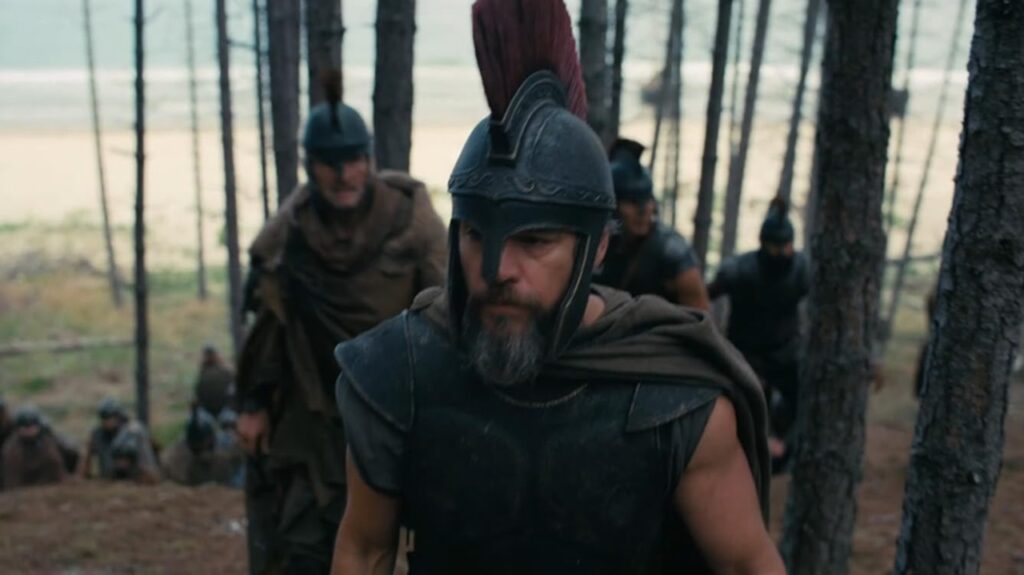
It’s an inspired and classically Nolan non-linear kick-off to this adaptation. Here, both Odysseus’s legacy and The Odyssey’s larger fascination with storytelling are vividly established. How dare I believe I knew what the Interstellar mastermind had in store for me.
As these yarns transpire, Telemachus stews over so many suitors invading his father’s Ithaca home. Abrasive men like Antinous (Robert Pattinson) yearn for the hand of Queen Penelope (Anne Hathaway) and, more importantly, ruling Ithaca. After all, Odysseus hasn’t returned in the decades since he set off to fight Troy. Surely he’s dead…right? As Telemachus scrambles to find information about his missing papa, audiences witness the endless struggles Odysseus and his men endured on their oceanic voyage home. On this journey, he and warriors like Eurylochus (Himesh Patel) encounter harrowing obstacles on every island they stop at.
Many weighty ideas underpin Nolan’s adaptation of The Odyssey. One fascinating chief theme, though, is a concept also preoccupying Oppenheimer: control. Odysseus and his men are warriors preoccupied with conquest and carnage. Every challenge they come to, their first response is to draw out swords and draw blood. Yet their encounters with Odyssey fixtures like the Cyclops (Bill Irwin), the Sirens, and Circe (Samantha Morton) reinforce how small they ultimately are. Their illusions of commanding this world are constantly punctured.
This thematic fascination lends compelling uncontrollable terror to what could’ve been familiar retreads of classic Odyssey set pieces. Rather than channeling 300, Nolan’s filmmaking in these scenes evokes Lost Highway or The Texas Chain Saw Massacre. These horror films perfectly recreate entrapment in a nightmare you can’t wake up from. That ambiance permeates The Odyssey’s depiction of Odysseus and company stumbling onto the Cyclops or those towering Laestrygonians.
Even when one of these warriors stabs or defeats a foe in these spaces, there’s no catharsis. Nolan’s so effectively depicted these humans existing in overwhelmingly unpredictable tableaus that one “victory” just feels like using a teaspoon to get water out of the sinking Titanic.
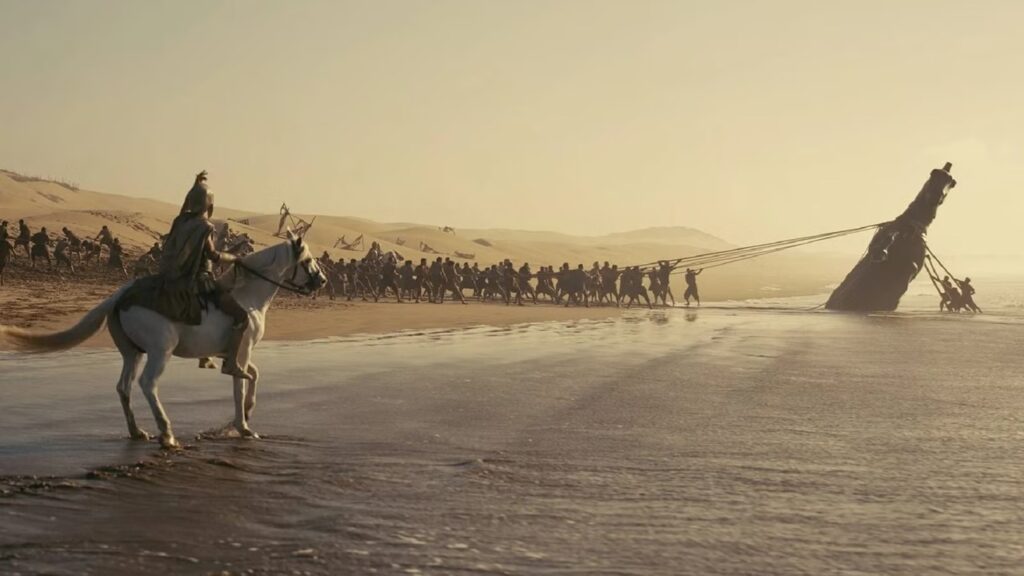
Committing to this aesthetic produces a barrage of suspenseful set pieces guaranteed to make your teeth clench and pulse quicken. Like the best adaptations, Nolan’s artistry in these Odyssey sequences makes it feel like you’re huddled around a campfire experiencing this story for the first time. These scenes and every other corner of The Odyssey also benefits from incredibly rich visual splendor. Costume designer Ellen Mirojnick alone makes the feature a must-see with her achievements. Everyone’s immediately tactile outfits look fantastic.
Meanwhile, Nolan and cinematographer Hoyte van Hoytema frame those outfits, the luscious practical locales, and most dizzying sights with such visual precision. Their blocking persistently ensures The Odyssey’s staggering scale is palpable. Best of all, they realize that scale primarily in bright daytime, which makes it even easier to process these feats. Imagery-based feats get their impact amplified via Jennifer Lame’s editing. Set pieces like Odysseus and his army invading Troy after escaping the Trojan Horse especially benefit from Lame’s impeccable timing. She’s a master at cuts that keep audiences on the very edge of their seats.
Watching these feats on a massive IMAX 70mm screen consuming every inch of your vision is often miraculous. This projection canvas provides a fittingly colossal mirror to The Odyssey’s scope and craftsmanship making old-school Hollywood epics proud.
However, this isn’t just hollow scale wearing outs its welcome halfway through the runtime. Whenever Nolan zooms the camera in for more intimate sequences, there’s a haunting aching quality reminding viewers human beings anchor all this fantasy storytelling. Locations like Circe’s hut, for instance, feel immediately lived in. Decades of weary existence drip off this domicile’s every corner. Intimate flashbacks to Odysseus and Penelope days before the former character heads to war, meanwhile, radiate anguish over unavoidable impending despair.
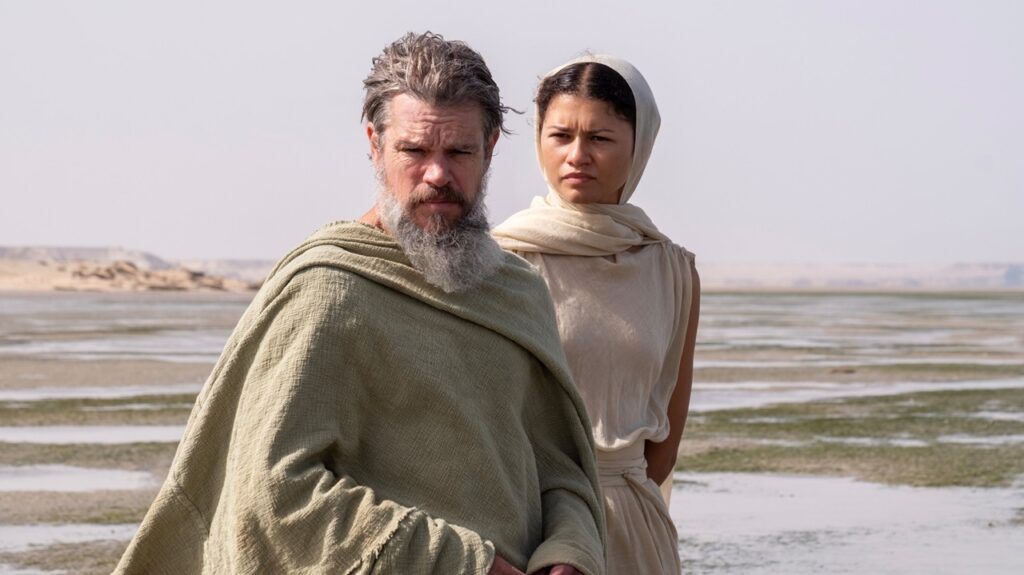
The Odyssey inhabits a battered world with equally rattled humans. These characters can try “controlling” everything if they want. Their unavoidable vulnerability drives this film’s most tight-knit sequences.
This production’s sprawling cast proves vital in accentuating this quality and the underlying character drama driving the script. Nolan and casting director John Papsidera have assembled a collection of performers adept at committing to grandiose material with nary a trace of irony. Anne Hathaway, for instance, imbues immensely moving conviction in her fiercest line deliveries. Tremendous palpable urgency underlines her words. It’s impossible not to get invested in Penelope’s desires. Similarly, Lupita Nyong’o’s (playing two roles, Helen of Troy and Clytemnestra) captivating screen presence commands your attention even when she’s just silently sitting.
Matt Damon’s famous for putting his whole Dam-ussy into even belting out “Scotty Doesn’t Know” in EuroTrip, so making him the Odyssey’s anchor is inspired. For me, though, the three best performances here (in a cast that’s pretty much top-notch) are Himseh Patel, John Leguizamo, and Samantha Morton. Leguizamo’s depiction of Eumaeus remaining loyal to Odysseus absolutely shattered my heart. Morton, meanwhile, is absorbing in her haunted vision of Circe. One look into her eyes and you achingly feel the agony Circe has witnessed.
The Odyssey is a showcase for the chops of both all these talented actors (hell yeah Elliot Page, crushing his supporting role!) and the various craftspeople assembled for Nolan’s mad (complimentary) vision. It takes an army to realize any movie. This particular battalion excels within epic confines. From Ludwig Göransson’s creative score (which features a track that sounds like the world’s first EDM trap tune) to the costumes to the luscious practical locations, The Odyssey rivets.
In 2026, advertisements and press releases touting the “value” of A.I. technology are inescapable. Silicon Valley tech-bros everywhere champion removing humans from the equation and leaving “art” to algorithms. With The Odyssey, Christopher Nolan didn’t just surprise Nolan cinema veterans. He’s created a quintessential and deeply tactile creation refuting these technological scourges. Just try watching this movie (especially in IMAX 70mm) and believing a Mark Zuckerberg-approved doohickeys could replicate this artistry. Human beings artistically collaborating are capable of incredible feats, including making top-shelf epics like The Odyssey.
The Odyssey is now setting sail in theaters everywhere.