Read also:
How to Watch FX Live Without CableHow To Watch AMC Without CableHow to Watch ABC Without CableHow to Watch Paramount Network Without CableFour years after Don’t Worry Darling, Olivia Wilde’s previous directorial effort, it can be tempting to view The Invite as some sort of comeback effort. It was certainly a film met with its share of brickbats—even as it earned nearly three times its budget—so it makes a sort of sense. And who knows, perhaps even Wilde was thinking of this new effort in those terms. Comeback narrative or not, though, Wilde’s direction here feels confident and assertive. Whatever inner monologue she may have had in making it, it’s abundantly clear she certainly wasn’t playing scared.
The opening scenes give The Invite a distinct 70s feel with extended opening credits, a slightly degraded film-stock look, and multiple split screens that capture Joe’s (Seth Rogen) journey home while his wife, Angela (Wilde), preps for a social gathering. Paired with Devonté Hynes’ score, it creates an immediate “world.” For fans of the talky relationship dramas of that New Hollywood era, the effect is immediately grabbing.
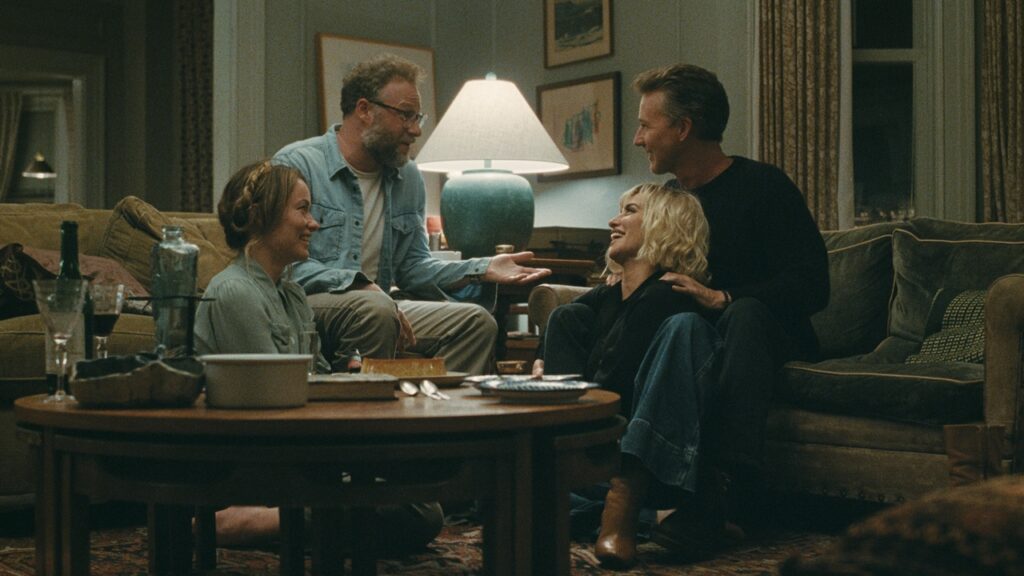
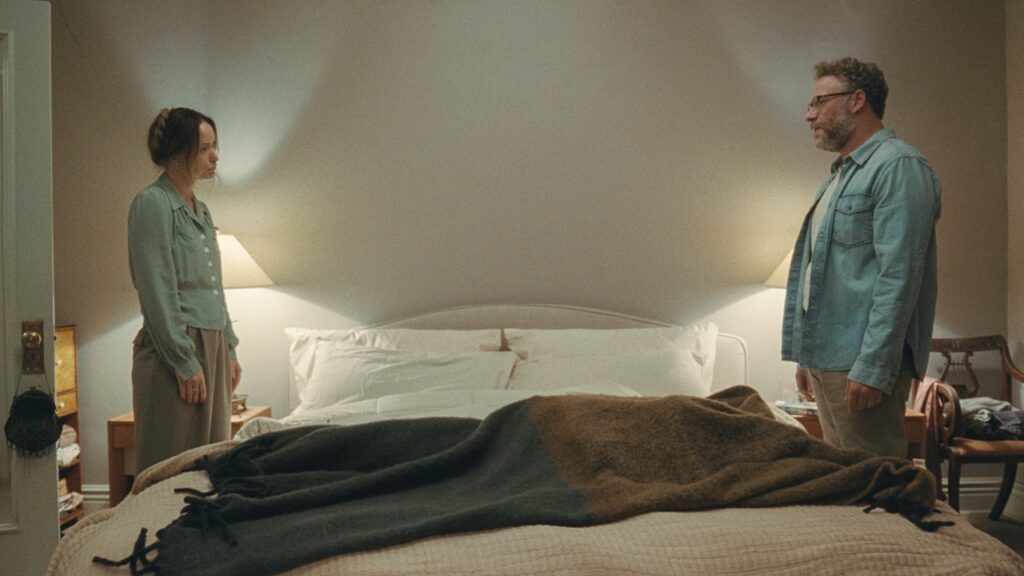
The gender dynamics between the struggling married couple admittedly feel of an earlier era as well. He works. She manages the home in nearly every way one could mean. Still, it isn’t an only half-heartedly updated stale narrative. The script by Will McCormack and Rashida Jones (an adaptation of the 2020 film The People Upstairs, based on a Spanish play) takes a story that could’ve been told at any number of times and it makes it feel undeniably current without the need for screaming signposts. With only glancing mentions of the “apps” or text messaging, it conveys its modernity through its characterization.
And what characters they are. Joe and Angela are playing host to their neighbors, Pina (Penélope Cruz) and Hawk (Edward Norton). Joe, who has only just become aware they are coming over, is spoiling for a fight. Hawk’s desire for deeper than the usual neighborly chit-chat during elevator encounters is annoying, but the real problem is the couple’s sex life. They are loud, long, and at it late into the night. Joe reads it as a form of aggression. Angela, meanwhile, a mix of impressed and enamored, is concerned that any complaints about it will ruin Pina’s impressive orgasms and any chance of making a new set of couple friends. As the married couple prepares for the night of charcuterie and conversation, it becomes clear this is not the only point of contention in their relationship.
Pina and Hawk, on the other hand, sweep into the apartment, seeming very in sync with each other. Slightly older, they bring a vaguely unnerving, hypnotic energy. They both have an almost honeyed purr to their voices as they slip between English and Spanish right in front of the hosts. They’re not threatening, but they are disruptive.
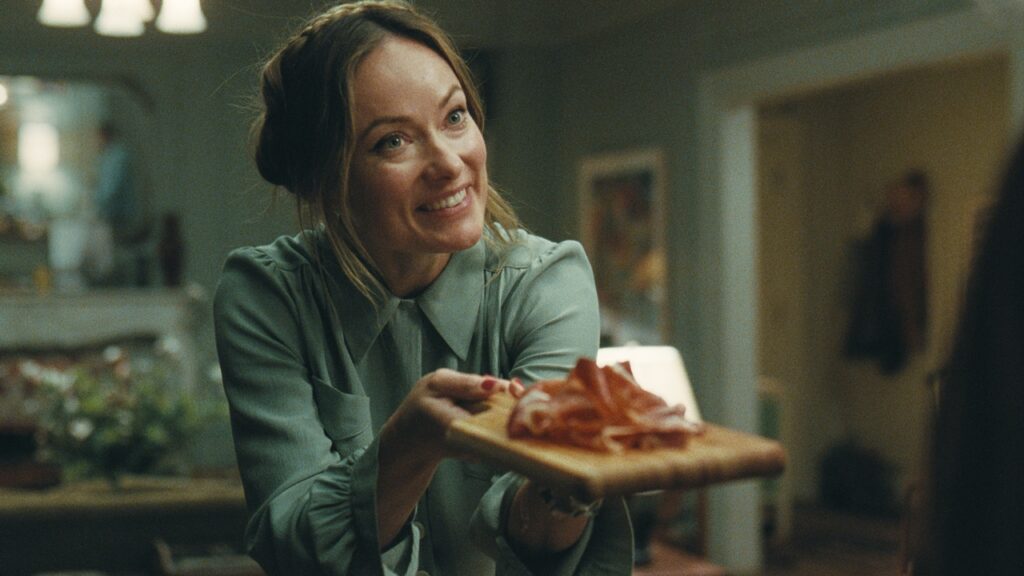
The always-in-control stay-at-home mom is an archetypal figure in film and television by now. But Wilde’s take on Angela doesn’t feel flattened or cliché. There’s something alive and panicked behind her eyes. She makes the audience immediately jittery, even before the gathering begins to slip away from her. The moments when genuine emotion overrules her attempts to be the perfect hostess—whether erotic curiosity, anger, or self-recrimination—are wonderful. Silly, delightful, bracing, and uncomfortable, often within seconds of each other. It’s been a bit since Wilde had a role this prominent on-screen, and it’s clear she hasn’t lost her edge. If anything, she’s grown as a performer.
By now, one can’t act as though Rogen doesn’t have dramatic chops. Turns like 2011’s Take This Waltz, 2015’s Steve Jobs, and 2022’s The Fabelmans make that very clear. Here, though, there’s a weaponized stubbornness that curdles his typical persona more than those other roles. He wields his trademark laugh as an act of aggression. Each crackle of that distinctive guffaw a sharp elbow to the ribs, indicating derision as often as amusement, if not more so. Beneath that, there’s woundedness, suggesting a guy who’s more sick of himself than anyone else is.
Norton and Cruz, as the wild cards, get to play a bit looser with things. Norton delights in playing Hawk as a consummate flirt, every line out of his mouth carrying the air of a come-on. That is, until a key monologue where he somehow pivots on a dime and absolutely delivers on tearjerker vibes while still feeling just a touch too “I only wear organic deodorant”. Cruz is playing her part in a lower register, so her big moment is less of a flip. That said, the way she absolutely takes control of the movie for about six minutes stands up against any of her work in the past 15 years.
The tonal shift in a largely comedic film can be a killer one. Too abrupt, and the work falls apart. Too slow and the pathos withers. The Invite hits it just right in part because it is never not earnest. While Rogen frequently deploys needling sarcasm, it’s emphasizing his feelings rather than burying them. The pain, frustration, and miscommunications are initially played for humor, but they still feel immediately authentic. Thus, when they “become” serious, it feels of a piece with what’s come before, not some unearned swerve.
The Invite’s success is born of never confusing absurdity for emotional distance. Rarely would a struggling married couple find itself in exactly this situation, of course. However, Angela and Joe begin with the recognizable frustrations of long-married couples, grounding everything that follows. Each new turn that ups the stakes remains emotionally relevant and revelatory. Wilde has made a comedy that grows deeper, not broader, as it unfolds. The result is a film as uncomfortable as it is funny, as honest as it is humane.
The Invite is bringing a flan to theatres everywhere starting July 10.