Read also:
How to Watch FX Live Without CableHow To Watch AMC Without CableHow to Watch ABC Without CableHow to Watch Paramount Network Without CableHollywood will infamously adapt anything into a movie. Yet, outside of the Christian movie scene (where I Can Only Imagine and God’s Not Dead reign supreme), motion pictures based on chart-topping tunes are scarce. Perhaps 1980s misfires like The Night the Lights Went Out in Georgia and Rhinestone are to blame. That’s understandable; a couple of those are enough to put an industry off the idea permanently.
Whatever the reason, musician Hayley Kiyoko is refusing the conventional wisdom. She’s adapted her hit 2015 tune “Girls Like Girls”—which also spawned a 2023 novel—into her feature film directorial debut. 1935’s The Man Who Broke the Bank at Monte Carlo, make room for your latest peer!
Set in 2006, Girls Like Girls protagonist Coley (Maya da Costa) is going through a lot. Nursing the grief of losing her mom, she now lives with her father, Curtis (Zach Braff), forcing a move from San Diego to a small town. He’s been absent much of Coley’s life, a situation she’d be happy with continuing. Withdrawn, the teen isn’t eager for attention from anyone, including her father. Then Sonya (Myra Molloy) enters the picture.
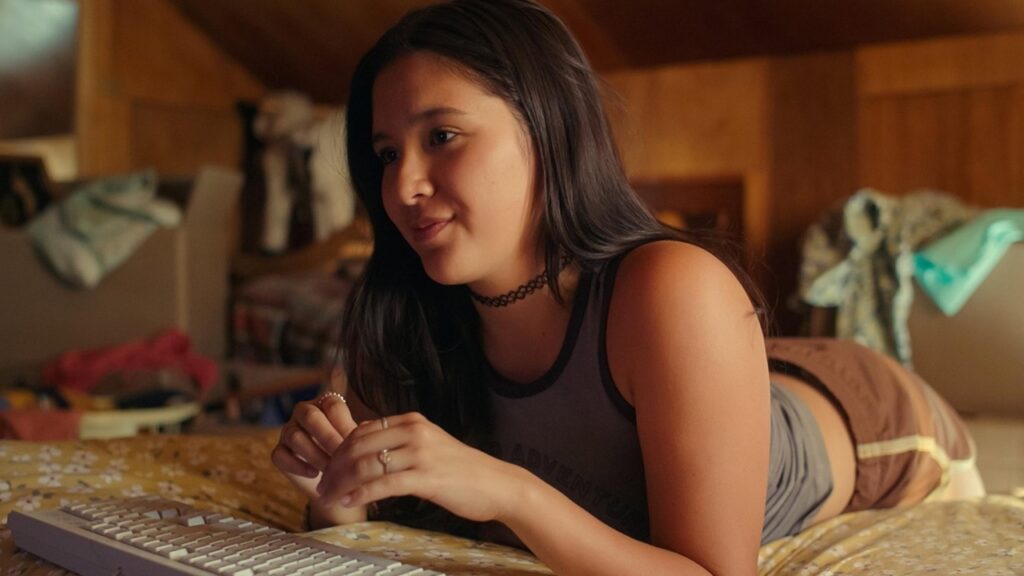
An outgoing and confident soul, Sonya inspires our tragedy-plagued protagonist to push life’s boundaries through classic teen transgressions like shoplifting liquor. She also inspires some serious heartache as she’s already with someone else, Trenton (Levon Hawke). Worse still, Sonya isn’t great at consistent communication. Or even mutual respect, really. After so much tragedy, can Coley open her heart up to anyone? Or is she doomed to just sit in silence and ignore everyone who challenges her to be vulnerable?
That all this unfolds during the summer makes sense. Summertime ennui hits differently. When everything’s so sunny and every pool looks glisteningly blue, internal agony seems extra devastating by comparison. Kiyoko (also the film’s co-writer with Stefanie Scott) leans into this reality in creating a fittingly angst-ridden enterprise. The lighting and atmosphere radiate the warmth of a toasty July day, constantly emphasizing the aching emotions. Kiyoko and cinematographer Sonja Tsypin’s use of tender close-up shots further accentuates this atmospheric intent.
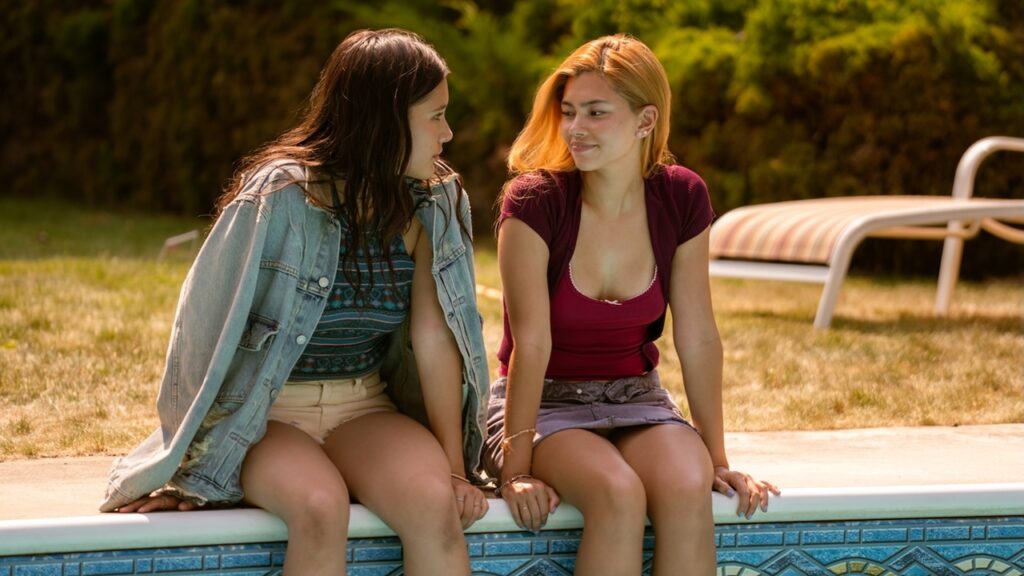
That camerawork often lingers on da Costa in her terrific debut performance. She serves as a sturdy anchor for the larger dramatic proceedings to swirl around. No matter what new teenage angst the script throws at this leading lady, she handles it capably. Watching her portray Coley slowly become more externalized and cozy around Sonya really hits home because of how believably she realized the character at her most withdrawn. Hollywood, please don’t let Girls Like Girls be her last starring role.
Other pervasive elements, unfortunately, outnumber the idiosyncrasies of da Costa’s work. The understated visual qualities, for instance, are sometimes a curse and a blessing. On the one hand, opting for restraint on Coley tracing her fingers across Sonya’s bedroom shelves and trophies is inspired. Its muted quality suggests wandering through a cozy memory. Other shot compositions, though, are simplistic. Standard blocking and framing doing nothing to highlight or elevate a subdued aesthetic.
Meanwhile, Kiyoko and Scott’s script struggles to give certain subplots the breathing room they require. Curtis and his daughter’s relationship, especially, has several complicated ridges reduced to breathless, clunky expository dialogue. The other teens surrounding Coley and Sonya, similarly, are vaguely defined background objects. That is, at least, until they are called on to deliver exposition. Speaking of Sonya, her more toxic attributes sometimes threaten to capsize the movie she inhabits. In a film often channeling The Way, Way Back vibes, someone with the aloofness and flagrant red flags of Alexander Skarsgård in Pillion doesn’t quite fit.
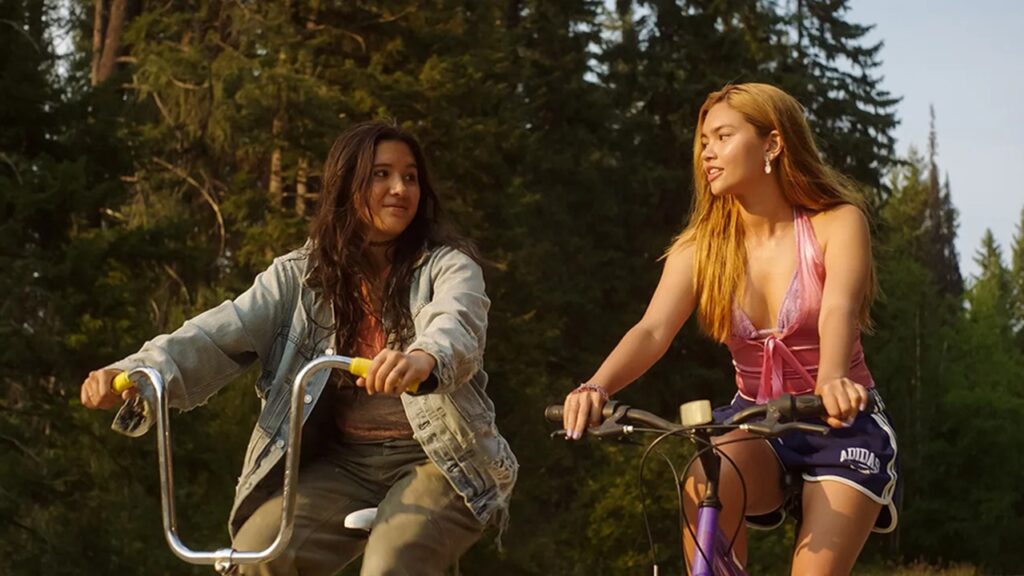
Kiyoko finds greater success following Coley and Sonya being cute together. Scenes of the pair hanging out on abandoned railroad tracks, surrounded by luscious green and yellow foliage, for example, radiate with transfixing, unspoken heartache. There’s also enjoyable ambiguity in their early scenes, where Sonya’s actions can easily be read as either platonic or flirty. Costa and Molloy’s respective acting chops reinforce the strength of the most intimate Girls Like Girls segments.
Fellow lesbian cinema connoisseurs hoping for the next Watermelon Woman, Desert Hearts, or D.E.B.S. would be better off rewatching those classics. However, there are charms here in this solid directorial debut. The lead performances and smallest-scale moments especially excel. Plus, Girls Like Girls breaks solid artistic ground for feature films adapted from songs. I’m personally hoping we next get a movie adaptation of Maddie Ross’s rocking and very lesbian cover of the Eurotrip ditty “Scotty Doesn’t Know.”
Girls Like Girls is yearning like crazy in theaters everywhere now.