Read also:
How to Watch FX Live Without CableHow To Watch AMC Without CableHow to Watch ABC Without CableHow to Watch Paramount Network Without CableIn one of Fjord’s most evocative images, any recognizable human characters basically vanish. This immensely wide shot instead captures a trio of lakeside homes covered in snow and ice, with various piers in the foreground. Initially, there’s silence on the soundtrack before a conversation between Lisbet Gheorghiu (Renate Reinsve) and her elderly, wheelchair-bound neighbor Åke (Øyvind Venstad Kjeksrud) is faintly heard. This shot, which lasts for a minute or two, eventually features Lisbet and Åke strolling slowly on the sidewalk, but they’re far off in the deep background.
This image doesn’t just effectively evoke similarly sprawling frames in titles like Werkmeister Harmonies. It establishes a crucial element for Fjord. These characters are often dwarfed by larger forces. Here, sprawling winter landscapes reinforce Lisbet and Åke’s tininess. They barely register as visible amongst the chilly landscape. Throughout the story, though, manmade forces will instill imposing power dynamics on these figures.
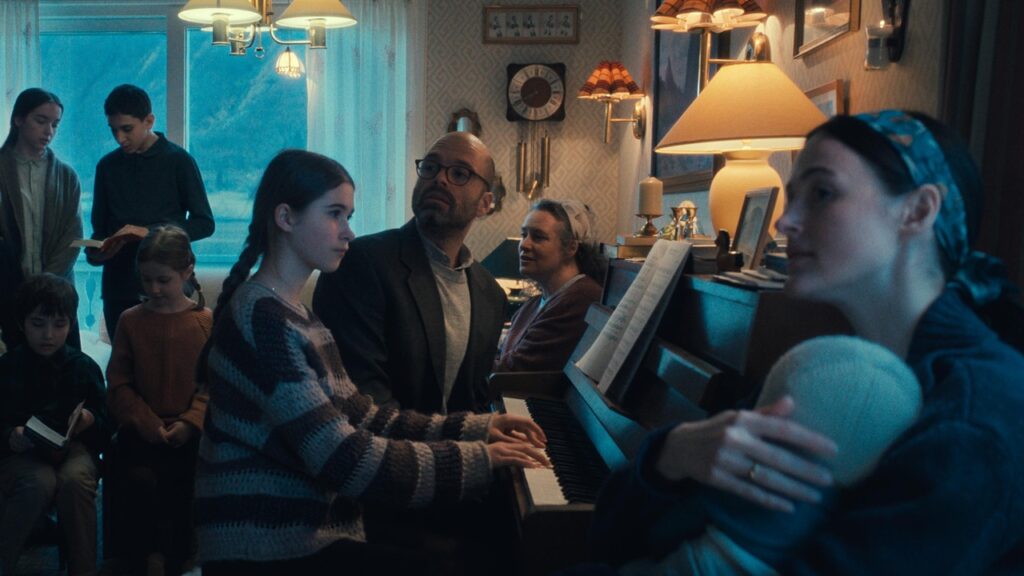
Lisbet and Romanian Mihai Gheorghiu (Sebastian Stan) have just moved back to the former character’s home country of Norway. This domain prides itself on progressive and inclusive politics. In contrast, the Gheorghiu’s and their five children, which include Elia (Vanessa Ceban) and Emmanuel (Jonathan Ciprian Breazu), are strictly religious. No phones or video games in the house. Always memorize your Bible verses. Never question your parents. When Elia and Emmanuel show up one day to school with bruises on their backs, their teachers grow concerned that this Christian upbringing also includes physical abuse.
Child protection services are called in and take the five kids away from their parents. Now two trials are underway to determine if Lisbet and Mihai are competent parents. The desperate Lisbet calls upon their neighbor Mia (Lisa Carlehed) to serve as their lawyer. Mihai, meanwhile, turns to his old Romanian pals to stir up public conservative sympathy for their case.
Fjord writer/director Cristian Mungiu’s filmmaking style emphasizes unflinching grimness. Such brutal aesthetics materialize silently. Mungiu’s films don’t use extremely externalized acting or abrasive music cues to signal something’s wrong or internal agony. Instead, quiet anguish radiates off the screen in images of a morally compromised father standing solemnly at his daughter’s graduation or a woman being trapped at a bustling dinner while her best friend undergoes a risky abortion. The silence consuming these characters is utterly haunting, not to mention captured through mesmerizingly realized unblinking camerawork.
That makes it frustrating how Fjord is a strangely talky Cristina Mungiu directorial effort. While his evocative sparseness and striking blocking persist, Mungiu’s screenwriting is oddly enamored with didactic verbiage. Characters are prone to delivering what sound like derivative talking points cribbed from message boards (“Can’t people have opinions anymore?”) rather than more imaginatively composed lines reflecting individual personalities. This problem culminates in Fjord’s third act featuring Mia’s courtroom defense boiling down to her turning to the camera and restating the entire movie’s thesis.
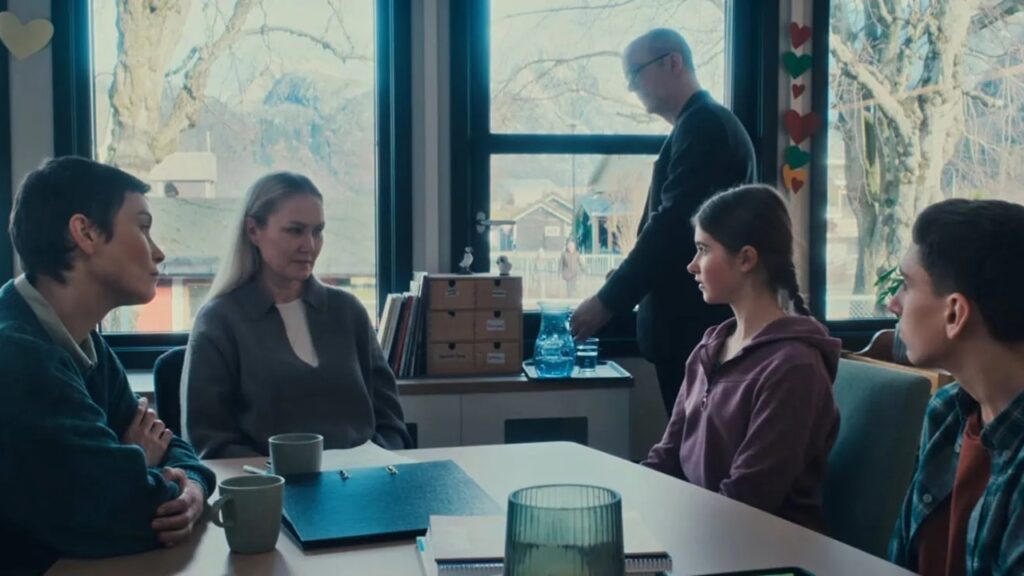
Cristian Mungiu’s filmmaking and atmospheric approaches work so well because they leave so much up to the viewer. His silent, haunted characters inspire viewers to both come up with their own interpretations of what’s happening and contemplate how those interpretations reflect our own biases. How much of our inner world do we project onto others? What does that say about our ability to comprehend entirely separate worldviews? Fjord often channels that aesthetic, sometimes quite effectively. However, it makes for an odd bedfellow with clumsier screenwriting choices.
Similarly frustrating narratively is Mungiu’s script hopping between various Gheorghiu family perspectives (as well as exploring Lisa’s domestic life). This stab at surface-level comprehensiveness leaves certain individual Fjord players (like Emmanuel) undercooked. The greatest result of this screenwriting tactic is sequences chronicling Elia and Emmanuel sneaking out to hang with their neighbor, Noora (Henrikke Lund-Olsen).
There’s a subtly bittersweet quality to their interactions since all three teens get along swimmingly. This trio finds more in common (while Noora starts nursing a crush on Elia) between themselves than differences. That’s a sharp contrast to the understated cultural tensions underlining every interaction between the adults in their lives. Hostility between people is learned, not ingrained into our DNA. These Fjord segments, tucked away from the larger plot, potently reflect that.
Similarly effective are the various ways complex power dynamics manifest throughout this plot. Sequences between Åke and Lisbet, for instance, see the former character often asking Lisbet to hasten his demise (like refusing to bring him food). Who’s in control in these situations? The bedridden man demanding a woman engage in assisted suicide? The woman who controls his diet and exposure to the outdoors? Another sequence depicts Noora attempting to “control” Elia and Emmanuel into coming onto her boat via threatening to cut her wrists. Almost immediately after Noora follows through on her threat, these siblings must take care of the woozy and wounded Noora.
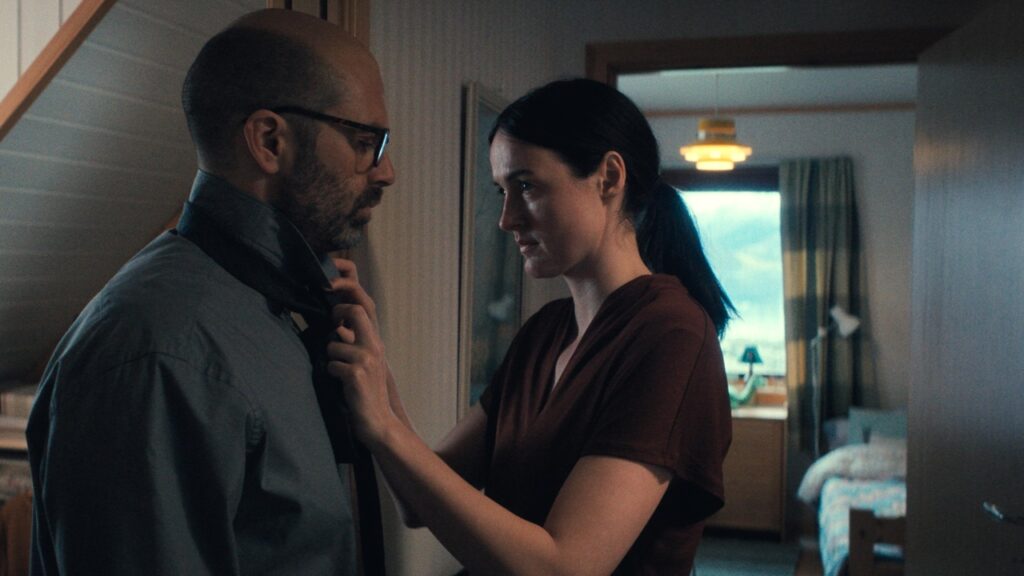
In the blink of an eye, the powerful becomes the vulnerable. Then again, Noora’s still got Elia and Emmanuel basking over her every need, so maybe her authoritative position festers. These multi-faceted approaches regarding who brandishes what power through Fjord persistently fascinate. This includes centering the story on the turmoil of hardcore Christians who instill prejudiced thoughts into their children.
Remember how HBO’s Watchmen’s first episode suggested that masked police officers brutalizing people behind closed doors still isn’t acceptable, even when it’s a Black woman cop beating up a racist citizen? A similar depiction of externally progressive yet invasive power structures informs Fjord’s morally intricate narrative. Yet the Gheorghiu parents aren’t depicted as woebegotten martyrs ripped from a God’s Not Dead installment. The intentionally clinical camerawork Mungiu and cinematographer Tudor Vladimir Panduru (the latter collaborating with Mungiu for the third time) deploy throughout Fjord frames the duo in visually ambiguous terms.
Is it creepy when Mihai lurks at the screen door to watch his daughter interact with Noora? Is their church service sweet communal bonding or creepy cult behavior? Eschewing maximalist visual cues (like heightened color grading) lets viewers conjure their own conclusions in a film about slippery power dynamics. Unfortunately, while these excellent visual impulses command viewers to draw their own conclusions, they often mingle with far less enigmatic dialogue. Fjord’s images rivet, while its conversations inspire disappointment.
Between that and Lisbet and Mihai just not being quite as compelling protagonists as past Mungiu leads, Fjord‘s unfortunately less than the sum of its parts. Fjord‘s unfortunately less than the sum of its parts. Luckily, this is still a new motion picture from the 4 Months, 3 Weeks and 2 Days filmmaker. That means artistry still abounds, especially in single-take shots rich in impressive blocking and spectaular performances. Even a weaker Cristian Mungiu movie inevitably has its striking elements.
Fjord is now playing in select theaters.