Read also:
How to Watch FX Live Without CableHow To Watch AMC Without CableHow to Watch ABC Without CableHow to Watch Paramount Network Without CableKiyoshi Kurosawa has been on a tear in recent years. Since 2020, he’s had eight projects. That includes two features and a short film in 2024 alone—Cloud, a thriller about an internet reseller; Serpent’s Path, a remake of his own 1998 revenge film about child killers; and Chime, a horror short intended only for theaters with no plans to ever bring it to streaming services. Bopping from genre to genre, Kurosawa doesn’t seem content to sit still. His latest, The Samurai and the Prisoner, takes him to new heights of narrative complexity and philosophical exploration.
The four-act film feels like a play combining the best of Shakespearean historical drama and Greek mythology. Our hero Lord Murashige Araki (Masahiro Motoki) returns again and again to his oracle as if plagued by his own set of labors. It’s 1578 and Nobunaga Oda (Bando Shingo), a powerful and violent lord, is on a campaign to bring the entire country under his control. Araki refuses to comply. He soon finds himself isolated in his castle, struggling to keep Oda at bay.
Meanwhile, a series of strange and mysterious crimes send his entire court into a tailspin. To keep his head and restore a semblance of order, he seeks desperate solutions. Repeatedly he turns to an enemy kept deep within his dungeon: Kanbei Kuroda (Masaki Suda), Oda’s brilliant strategist.
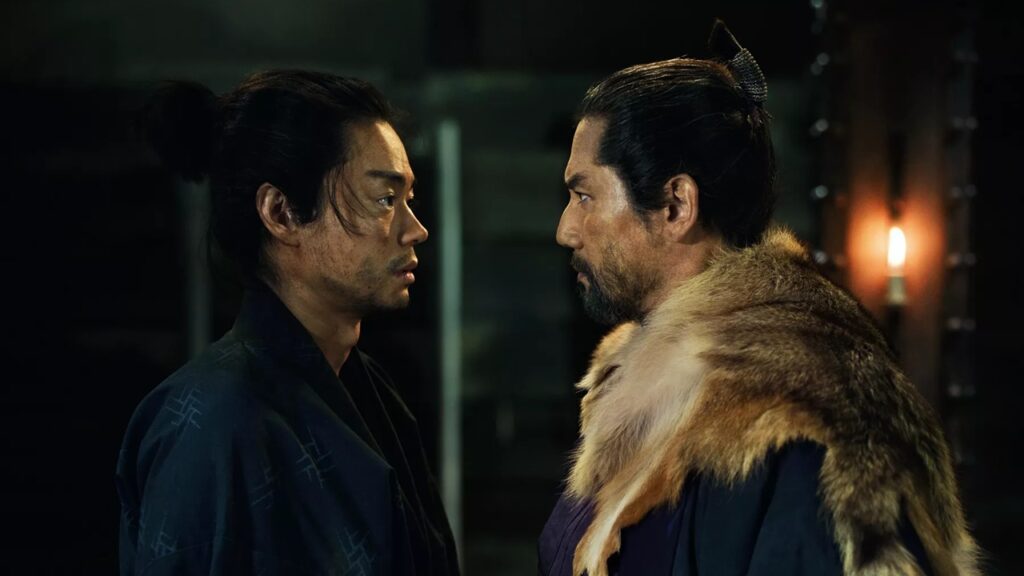
Each of the four chapters, one per season, presents its own mystery for Araki to solve. From invisible arrows to missing heads to acts of God, he tackles each one like a samurai Poirot. This simple and satisfying structure helps pull us through, even when the politics of the period start to feel a little overwhelming. That period of Japanese history is complex and Kurosawa’s dialogue doesn’t skimp on the details. By packaging the era in digestible mysteries, it effectively grounds audiences.
In a way, that sums up the genius of The Samurai and the Prisoner—it manages to be both complex and accessible at once. Because of course, like the Honobu Yonezawa novel it’s based on, the film’s not merely about solving the puzzles. It’s an exploration of faith and tradition and the ways both can be used to manipulate or destroy.
Grappling with these questions while trying to solve the various crimes and keep his people together makes Lord Araki a lonely figure. Kurosawa emphasizes Araki’s isolation with shots that highlight the tight quarters and small cast of characters. His world is shrinking so much that even the few glimpses we get of a battle or a village feel populated by the same dozen or so people. You get the sense the entire universe would fit in the bottom of a teacup. The tightness of it is what gives an air of unreality to what should be a very real world. These people did really exist, after all. Instead, Araki may as well be on a stage surrounded by cardboard sets and a tiny cast of players.
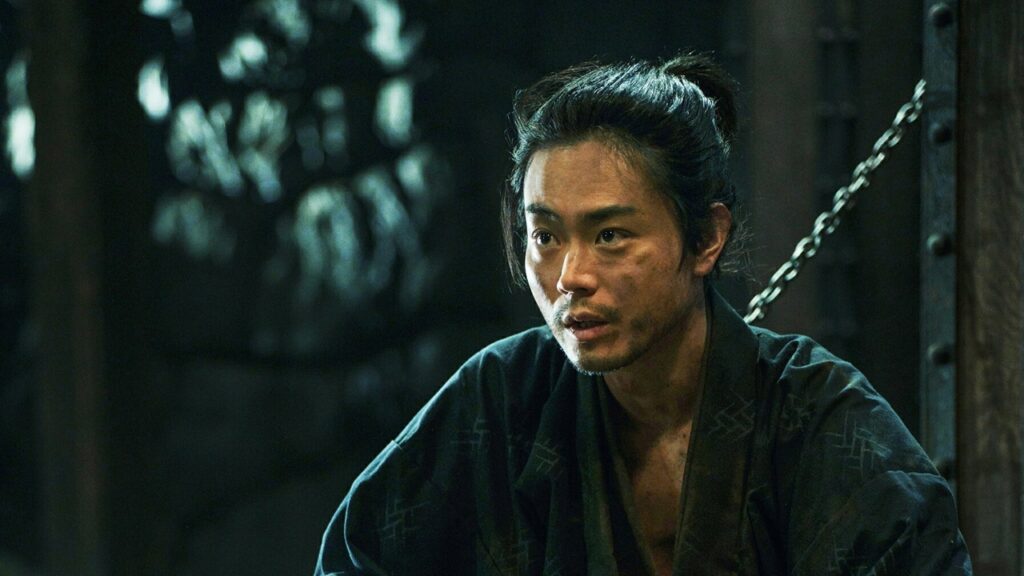
The dungeon, however, features shafts of light on an uneven dirt ground that’s eerily reminiscent of one of Stalker’s most famous scenes. Here, Kanbe serves as Araki’s own Stalker. He’s a guide to bring the lord through the depths of the hearts and minds of men with no guarantee that he’ll like what he finds on the other side. No matter how cryptic Kuroda’s responses to Araki’s dilemmas, he fast becomes one of the only people the samurai really trusts to answer him wisely and honestly.
As war and strange circumstances persist, Kurosawa uses the relationship between the two men to provide a throughline. The questions The Samurai and the Prisoner actually wants to posit are bigger than whodunnit and far more unwieldy. That the director explores them with a text this dense and yet so utterly watchable is something of a miracle.
The film proves Kurosawa has no interest in being boxed into any genre or setting. He’s out to make sense of the world and will use every tool at his disposal, from Macbeth to Russian philosophy. It’s the kind of film you can truly chew on in a media landscape of slim pickings.
The Samurai and the Prisoner investigates select theatres July 31.