Read also:
How to Watch FX Live Without CableHow To Watch AMC Without CableHow to Watch ABC Without CableHow to Watch Paramount Network Without CableIt’s 1932. Filmmaker Karl Freund strolls down a sidewalk, happening upon a movie theater playing his directorial debut, The Mummy. He stops a moment, tilts his gaze upward at the marquee, and cracks a soft smile. All that effort, come to fruition. Perhaps he walked away from the theater that day, believing that the bandage-wrapped character would fade, leaving little more than a memory. Instead, The Mummy persists in pop culture. Freund’s feature spawned multiple sequels. Hammer Films had several Mummy features in the 50s and 60s. Brendan Fraser and Tom Cruise anchored big-budget action-film adaptations of the property. And now? Lee Cronin, the Evil Dead Rise’s helmer, takes a crack at this property with Lee Cronin’s The Mummy. Freund created a pop culture entity as unkillable as the most resilient movie monster. Unfortunately, this latest interpretation is nowhere near the pinnacle of this bizarre horror property.
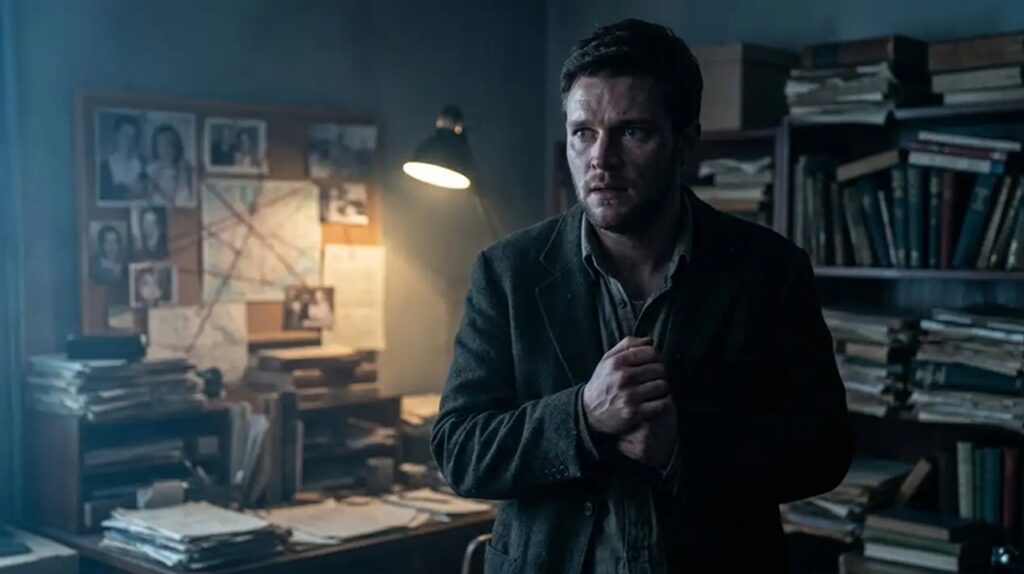
The film opens on a prologue depicting a family returning home to discover their pet bird dead. This lengthy segment gives way to a title card before introducing viewers to Lee Cronin’s The Mummy’s actual protagonists. The Cannons—newscaster Charlie (Jack Reynor), doctor Larissa (Laia Costa), and their two (soon to be three) kids—live in Cairo. Without warning, ten-year-old Katie disappears, victim of an apparent abduction. Cronin’s script then cuts to eight years later. That makes two preludes before reaching the actual plot. Taking so long to get going indicates larger problems with the feature.
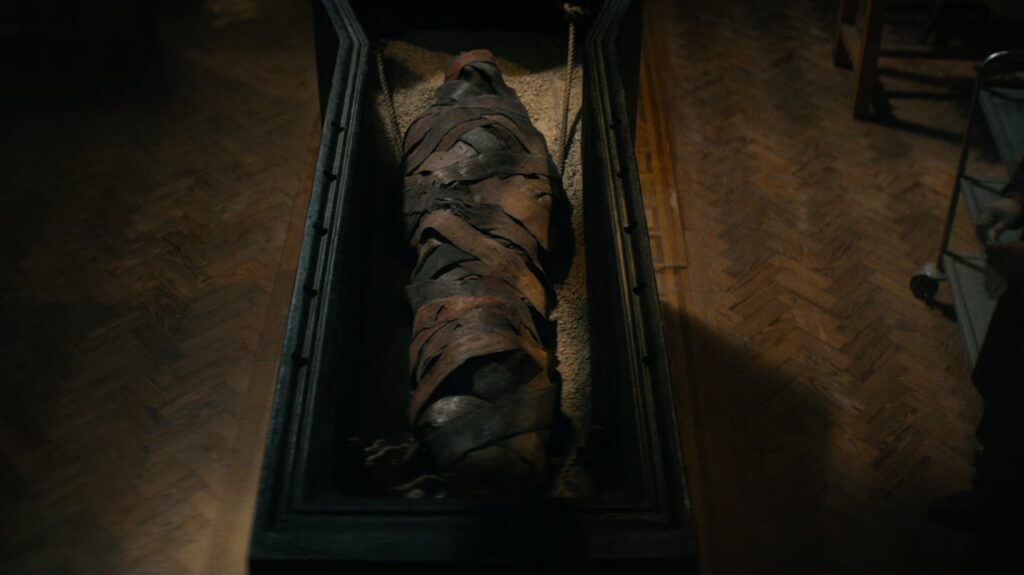
After all this time, the aftermath of a plane crash reveals Katie’s (now played by Natalie Grace) body in a tomb, wrapped in bandages. She’s almost like a…Mummy. The astonished Charlie and Larissa take her home to New Mexico. Meanwhile, Cairo detective Dalia Zaki (May Calamawy) searches for answers on who took Katie and how that led to her entombing.
Needless to say, the aforementioned prologue contains explicit answers to the “who” and “where” behind Katie’s disappearance, robbing the investigation of its tension. That the clue-hunting and interrogation sequences then play a major role in The Mummy is puzzling, to say the least. That it isn’t the movie’s primary goal, despite all the time given over to it, is only further confusing.
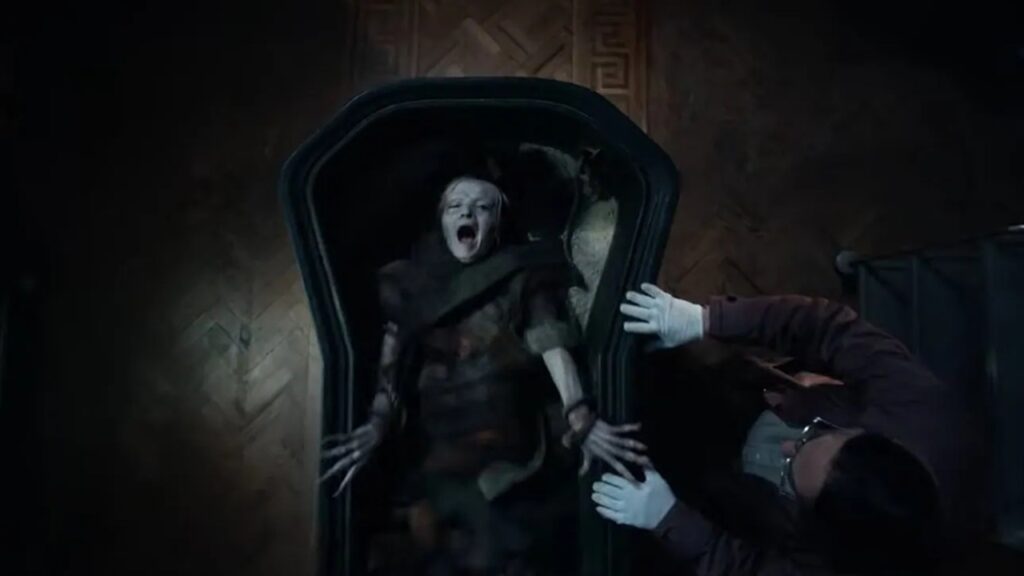
No, Lee Cronin’s The Mummy canopic-jarred heart lies elsewhere. Less of a horror movie than a gross-out dark comedy, it salivates at the thought of making audiences squeal. Conceptually, it channels early Peter Jackson/Sam Raimi works, with a not insignificant bit of that Terrifier aesthetic thrown in. Some of the gnarliest bits deliver the skin-crawling goods. For example, a toe-nail-clipping scene quickly escalates into something far more serious.
It’s also laudable that this aesthetic doesn’t directly echo past Mummy movies. This is certainly a project situated around Cronin’s interest rather than callbacks to Boris Karloff and Brendan Fraser. However, older gross-out titles like Meet the Feebles and Evil Dead 2 were wildly unpredictable. They went anywhere, killed anyone, and threw standard narrative impulses to the wind.
A few stomach-churning set pieces can’t catapult Lee Cronin’s The Mummy to its most depraved ambitions. The script’s too busy and explanation-driven for its own good. An excessively tidy ending especially betrays creative instincts pointing toward something more deranged.
It’s a shame Lee Cronin’s The Mummy’s narrative instincts are so humdrum, considering its laudably polished visuals. The makeup effects crew, for instance, delivered terrific work realizing Katie’s mummified form. Cronin and cinematographer Dave Garbett (reuniting from Evil Dead Rise) also provide handsome framing for all the supernatural carnage. With Rise initially intended for HBO Max, Cronin and Garbett clearly relish preparing a film unambiguously aimed at theatrical release.
The pair constantly keep the camera pulled back throughout the runtime to create striking images, like a distant fiery plane falling to the ground as a biker collects his breath in the foreground. There’s also specificity to early pieces of blocking nicely contrasting to later, more jaggedly arranged sequences depicting the Cannon family growing distant as Katie’s mayhem wears on them. Lee Cronin’s The Mummy happily eschews framing built for iPhone viewing, including in those split-diopter shots Cronin clearly adores.
However, most moviegoers coming here will only want scares, the more warped the better. On that front, this production has its creatively deranged moments. There’s certainly amusing entertainment in hearing a crowded theater react as vomit and corpses fill the screen. Alas, Cronin’s script too often recalls contemporary horror fare. Familiarity undercuts the transgressive urges.
Lengthy scenes of Charlie asking Professor Bixler (Mark Mitchsinon) about the inscriptions on Katie’s bandages, for instance, harken back to the Sinister Skype sequences in which Vincent D’Onofrio gives Ethan Hawke Bughuul mythology 101. Certain scares, such as an empty wheelchair slowly moving across a room as the music intensifies, could’ve hailed from a routine The Conjuring installment.
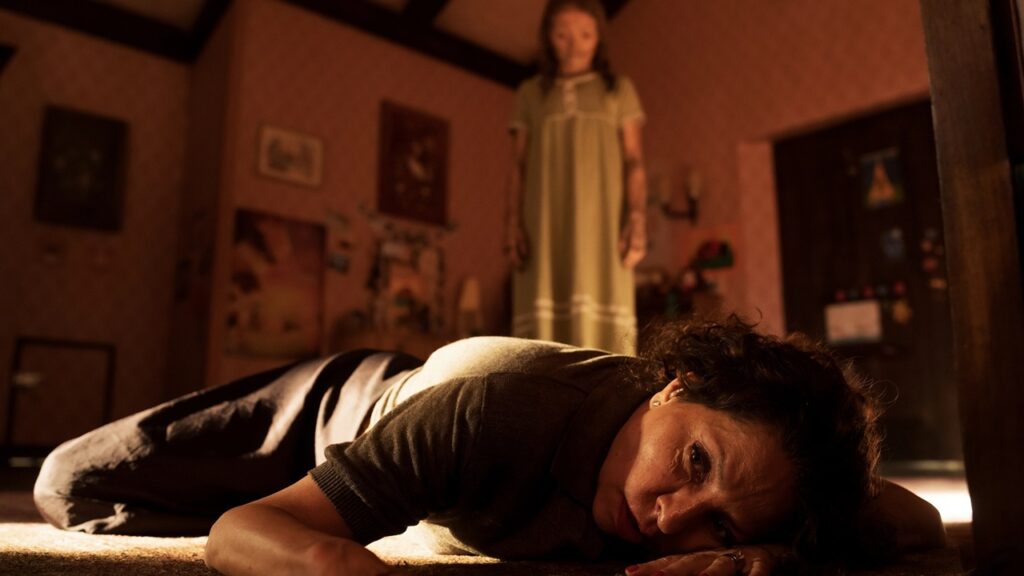
Most frustratingly, too much of the third act feels like reheated leftovers from Cronin’s own Evil Dead Rise. Repeatedly reusing the CG sandstorm visual from 2017’s The Mummy doesn’t help ward off the been-there-done-that aura. Even composer Stephen McKeon’s score deploys derivative instrumentation and melodies, rendering it interchangeable with any modern Insidious-inspired horror title.
Something like Multiple Maniacs doesn’t just shock viewers; it takes them for a ride, rejecting the expectations of standard American filmmaking. Lee Cronin’s The Mummy, meanwhile, is frustratingly familiar and lore-obsessed. Karl Freund’s vision of undead horror may still haunt the big screen 94 years later, but this incarnation needs more consistently unhinged jolts.
Lee Cronin’s The Mummy opens its sarcophagus into theatres everywhere on April 17.