Read also:
How to Watch FX Live Without CableHow To Watch AMC Without CableHow to Watch ABC Without CableHow to Watch Paramount Network Without CableIf you are younger, say under 30, you might know have a great idea who David E. Kelley is or was. But for Gen Xers and geriatric to mid-Millennials who grew up on network television, he looms large. His career these days is defined by near-prestige TV streaming projects like The Undoing, Nine Perfect Strangers, and Big Little Lies. Back in the 90s and naughty aughties, though, he was the weirdest showrunner to be successful, shepherding series like Picket Fences, Ally McBeal, and The Practice to, at least briefly, ratings triumphs. He was like a more humane and more disciplined (just barely, but still) Ryan Murphy. His adaptation of Rufi Thorpe’s novel Margo’s Got Money Troubles is perhaps the most old-school Kelley David E has been in some time, while still retaining the slickness of his prestige-adjacent era. It is, perhaps not coincidentally, his best work in years.
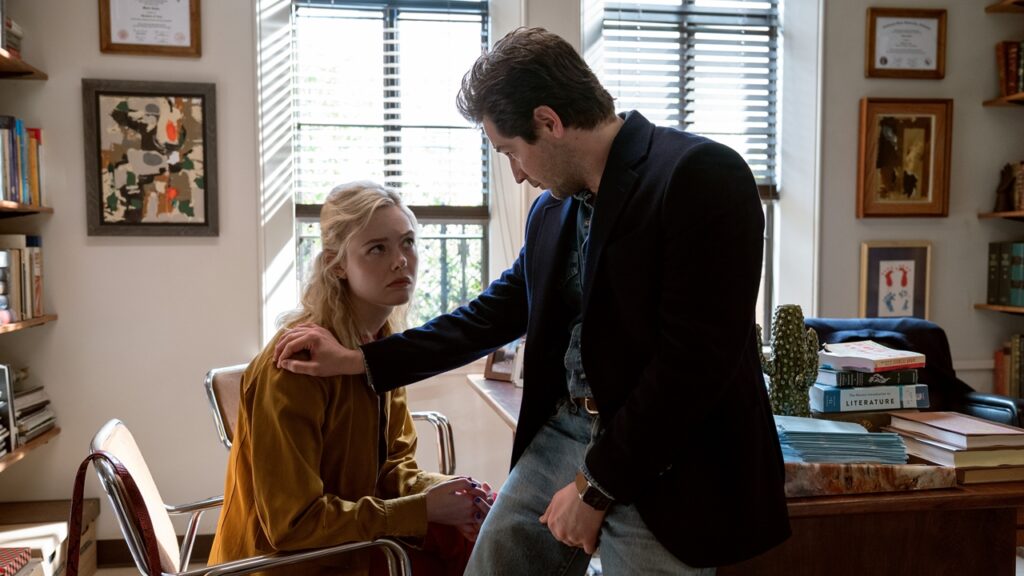
The story, fairly faithfully lifted from the source material, revolves around Margo Millet (Elle Fanning), a college student and aspiring writer. She has talent and drive. Unfortunately, she’s the sort of clever who can recognize a train rushing down the tracks towards her, but remains convinced she’s in no danger. The train, in this case, is her English Professor Mark Gable (Michael Angarano). He’s older, married, a dad, and, again, her professor. But that gives neither pause. Before long, they’re having the kind of noisy, unprotected sex bound to piss off your roommates and get someone pregnant. Predictably, when that happens, Professor Gable is quick to distance himself. When she decides to have and raise the child, he does everything but sprint from the scene.
As unpopular a choice as it is with him, it hardly thrills her mom, Shyanne (Michelle Pfeiffer). She’s a former Hooters waitress who, like Margo, fell for a married man. In her case, that man was Jinx (Nick Offerman), a WWE superstar who was often unavailable while Margo grew up, to put it charitably. Shyanne’s now poised to marry Kenny (Greg Kinnear), a frugal, almost unbelievably naïve youth pastor, and fears that her daughter having a child out of wedlock will upend that. But really, she doesn’t want to see her child travel the same rough road she had to.

Jinx, as a wrestler, hints at the show’s askew but empathetic tone, one that fits well with Kelley’s late 20th-century/early 21st-century heyday. Offerman depicts him as sad and struggling, but also a source of great support to his daughter. And she needs that kind of backup. Desperate to make ends meet, Margo develops an OnlyFans, starting with comparing pics of men’s penises to Pokémon before graduating to erotic cosplay with the help of her enthusiastic roommate, Susie (Thaddea Graham). Then the whole thing becomes a full-out art project, with Margo casting herself as a green-skinned, evidently sex-curious alien, The Hungry Ghost.
The show takes an amused but nonjudgmental stance towards all this. It doesn’t pretend others wouldn’t judge Margo for it, but while it falls short of endorsement, it clearly supports its protagonist’s unconventional path to financial solvency. It doesn’t shy away from nudity. Fanning is frequently naked, sometimes 100% herself, sometimes furnished with prosthetics for postpartum size increases and breastfeeding. However, Margo’s Got Money Trouble depicts nudity in not especially salacious ways. Even during explicitly sexual moments, the attitude is more carefree fun than lustful objectification.
This stance of curious acceptance permeates the show, granting unexpected grace to relapsed drug addicts, emotionally unavailable parents, and yes, even, in time, cowardly English professors. The only true villain turns out to be Gable’s mom, Elizabeth, played with obvious delight and high social status snobbery by Marcia Gay Harden.
Fanning is excellent in the lead, anchoring the show without succumbing to bland main-character syndrome. Her life is weird. One might find it difficult to see themselves following a similar path in their own lives. And yet, Fanning gives Margo enough humanity that the strangeness is easy to accept as honest. Anyone trying to make the best of a big mistake or wrestling with the tension between being financially comfortable and maintaining some semblance of self will find Margo understandable and, perhaps even relatable.

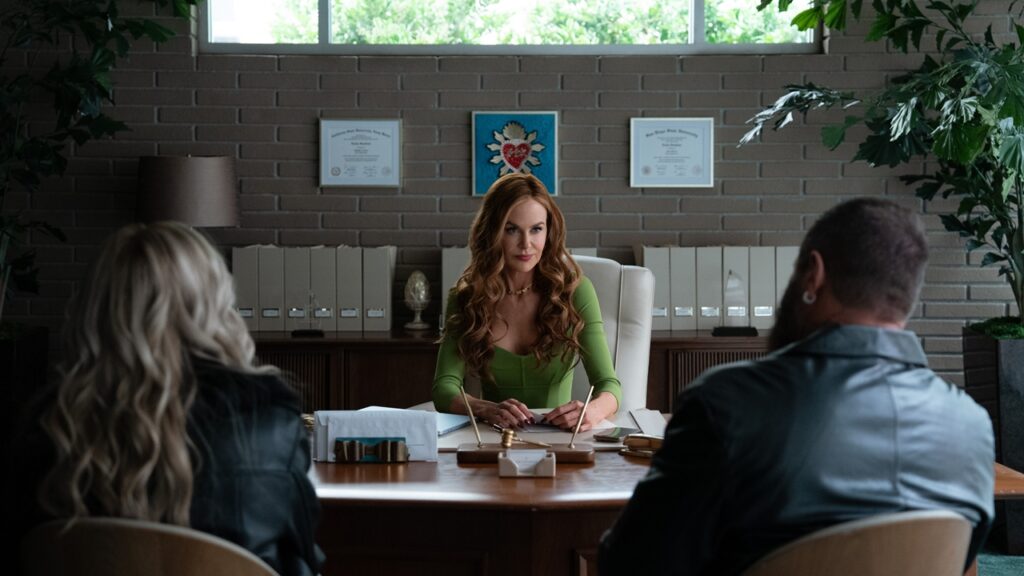
Pfeiffer is 2 for 2 this year in strong TV performances between this and The Madison. Kinnear finds nuance in Kenny, making him surprisingly empathetic at times without reducing him to a simpleton or a saint. Nicole Kidman, as a lawyer and former colleague of Jinx’s, finally has a TV role that feels worth her time after a series of small-screen haughty ice queen ciphers.
Everything gets increasingly messy until a finale that feels too easy. We want good things for the characters, so it is easy to let the show slide. Still, a court date settling everything is a misstep when it otherwise steps lively and stylishly through thorny matters. It’s a shame that the last choice it makes is so easy, if enjoyable. But if ever there’s a moment to give a little fairy tale, well, Margo’s Got Money Troubles earns it.
Margo’s Got Money Troubles wants you to subscribe for all her content starting April 15 on AppleTV.