Read also:
How to Watch FX Live Without CableHow To Watch AMC Without CableHow to Watch ABC Without CableHow to Watch Paramount Network Without CableOne of the hardest things about making movies about artists is convincingly capturing their work on screen. If you could paint an incredible work of art, chances are you’d do that, not create it for a prop in a film. Same with any of the other arts: film, dance, theatre, and so on. And it is even harder to go the other way and create or portray intentionally bad works of art. John Carney, the director and co-writer (with Peter McDonald) of the new film Power Ballad, has made a career out of besting this truism.
A big part of that is his chosen art form. Music tends to translate to film and television more readily than writing or painting do. It also helps that Carney isn’t interested in making his characters the best-of-a-generation types. He’s aiming for good, perhaps even great, but not genius. He knows most of the music we love and remember in our own lives comes from that zone. He’s evoking emotion, not seeking transcendence.

On to that story. Rick Power (Paul Rudd)—solid punning there, Carney—is a rock band frontman who was a rising star for a cup of coffee. On his biggest tour, though, he met Rachel (Marcella Plunkett) after a Dublin concert. He chose love over the possibility of rock godhood, never leaving the Emerald Isles. Now, when not adorably dad-frustrating to Rachel and their daughter Aja (Beth Fallon, on just the right sweet teen but still very much a teen frequency), he plays with his right-hand man, Sandy (co-writer McDonald, an absolute delight!), and the wedding band, Bride and Groove. Again, really pleasing wordplay.
At one especially nouveau-riche gig, the newlyweds convince the band to let their friend and former boy-grouper, Danny Wilson (Nick Jonas), join in. Rick, initially skeptical, comes away from the duet thinking Danny is the real deal. After the two spend the rest of the night drinking, smoking, and songwriting, the former rocker is even deeper in bro-hood with the questing for adult respectability star. That goes down the drain a few months later when a desperate Danny claims Rick’s song as his own, sparking a massive comeback.

The easy version of this story casts Rick as a wronged true artist and Danny as a selfish villain. Thankfully, Carney isn’t interested in easy. Power Ballad is interested in a thornier path. Rudd is charismatic as always, but smartly dulls his shine some here. That frees him up to be not quite as ageless—frequently looking like a chimera of the Train and Third Eye Blind frontmen—and increasingly self-centered and unpleasant. He highlights the thing we sometimes either forget or struggle to ignore. The righteously aggrieved can sometimes be pretty annoying despite being 100% in the right.
What I’m going to say about Jonas is going to sound harsh, but please stick with me. In his best film work (here, the Jumanji movies, even You’re Cordially Invited), there’s a certain emptiness behind the eyes. It isn’t soullessness or a lack of intelligence, though. In Jumanji, it is how he’s survived, locking away everything but a “hey, let’s have fun” attitude. Here, it suggests a different kind of survival mechanism. He’s a star who can feel himself setting and is forever packing on vague personal platitudes and “surprisingly nice guy” interactions to hold back the panic. When he can’t shove it down enough, as during a party confrontation with Rick, Jonas doesn’t explode so much as leak out of himself. It makes what could’ve been a moment of high drama or humor something more like devastating. And all the emptiness makes it possible.
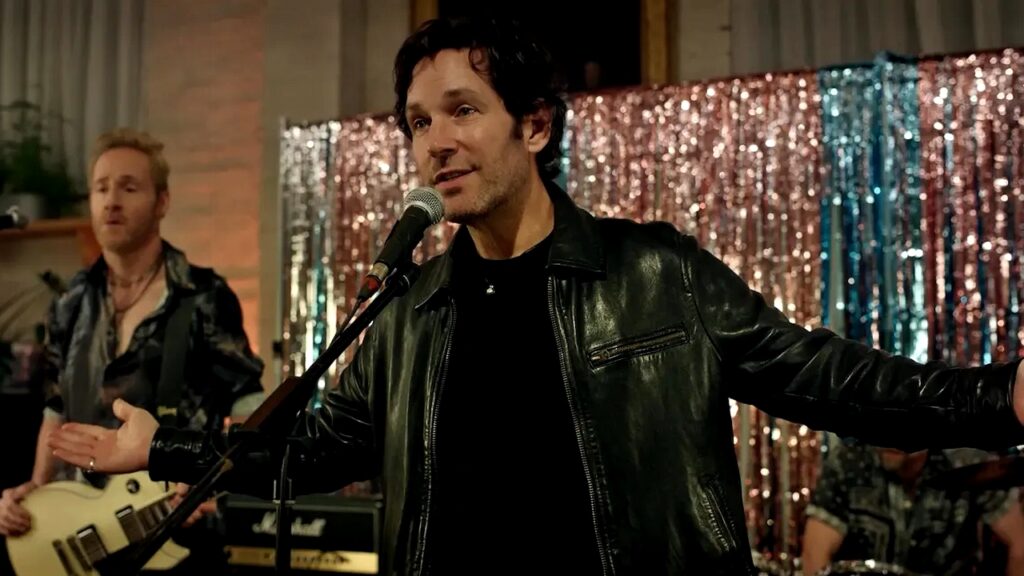
But, as we started with, the music is so important to make the story work. The song in dispute, “How to Write a Song Without You,” is exactly as faux deep as it needs to be. It won’t leave you with the impression that Rick is a secret Bob Dylan or even Paul Simon. But it has the shape of a song that you could hear a few years after its heyday and find yourself unexpectedly affected by. It is also flexible enough for Danny to repackage it as a convincing pop tune. In that form, it plays convincingly as a song that music publications might declare a “diamond in the rough”. However, it also still works as a joke. Not the song itself, but Danny’s conception of it, which includes him welding his current obsession with describing his situation as walking a tightrope to it.
Finding a song that is the right mix of good and nebulous allows the rest of the story to unfold naturally. As a result, Carney and McDonald have plenty of space to explore ideas like what it means to be successful, what the value of “credit” is, and how to live when the dreams you didn’t realize sometimes obscure the dreams you did. Like the song at its center, it is a light affair. But if you sit with it for a moment, it packs a surprisingly resounding emotional punch. It uses the good to touch genius. Quite the trick.
Power Ballad is strumming its song in theatres now.