Read also:
How to Watch FX Live Without CableHow To Watch AMC Without CableHow to Watch ABC Without CableHow to Watch Paramount Network Without CableTo adapt or not to adapt isn’t the question. Rather, it is why adapt Hamlet, one of Shakespeare’s most famous plays. With over 50 film adaptations since 1900, clarity of vision and purpose grows all the more essential with each subsequent interpretation. Director Aneil Karia certainly approaches the text with a strong vision. Whether his changes actually gel together, on the other hand, is a little more unclear.
I hesitate to describe the plot, as surely we’ve all absorbed it via cultural osmosis by now. Alas, poor reader, I can’t bring myself to risk alienating you. So, just in case you missed 11th-grade lit, here we go. After his father’s (Avijit Dutt) sudden death, Hamlet (Riz Ahmed) is shocked by his mother Gertrude (Sheeba Chaddha) immediately moving to marry his father’s brother, Claudius (Art Malik). Before he can even process the development, his father’s spirit appears. He tells Hamlet that Claudius murdered him, setting his son on a path for revenge.

Aneil Karia’s adaptation of Hamlet dances between faithful retelling and a true reimagining. He swaps Danish royalty for British-Indian real-estate moguls, but keeps Shakespeare’s original dialogue mostly intact. The names are the same, but some characters collapse into each other, most notably with the removal of Hamlet’s confidant, Horatio. Instead, Laertes (Joe Alwyn) pulls double duty, adding Horatio’s role as the Prince’s only real friend to the character.
The film also moves the drama to London. However, Karia’s framing, with highways, alleys, nameless clubs, and cookie-cutter mansions, presents a version of the city rarely seen on-screen. Light and color palettes draw the eye, alternating between glowing oranges and golds and stark, cold bluish-whites. It renders London almost unrecognizable as a result, at least to an outsider.
Where his direction really stands out is in his use of framing to capture the protagonist’s grief. In one scene, Hamlet leaves his father’s funeral party to slip away into the deceased’s old room. A wide shot of the sick room is haunting, with a small lamp casting shadows over the empty bed and abandoned medical equipment. Tentatively, Hamlet approaches, picking up a bit of blanket and bringing it to his nose, searching for the scent of his father. It’s a beautiful moment in which the sterility of the room makes Ahmed’s performance even more powerful.

In the famous “to be or not to be” speech, Ahmed delivers as he speeds recklessly down the highway, tempting fate as he contemplates suicide. It’s a bold choice that ramps up Hamlet’s own mental turmoil and shows Karia and screenwriter Michael Lesslie aren’t afraid to make interesting choices together.
That said, not all of those choices work half so well.
To keep the film well under the play’s four-hour runtime, most adaptations have to decide whether to keep its political angle. In Shakespeare’s text, fear of an invasion from Norway adds extra tension to Claudius’s machinations. Retaining it significantly expands the story into a meditation on how intimate dramas can affect the world at large. On the other hand, eliminating it allows an adaptation to focus more fully on Hamlet’s personal grief.
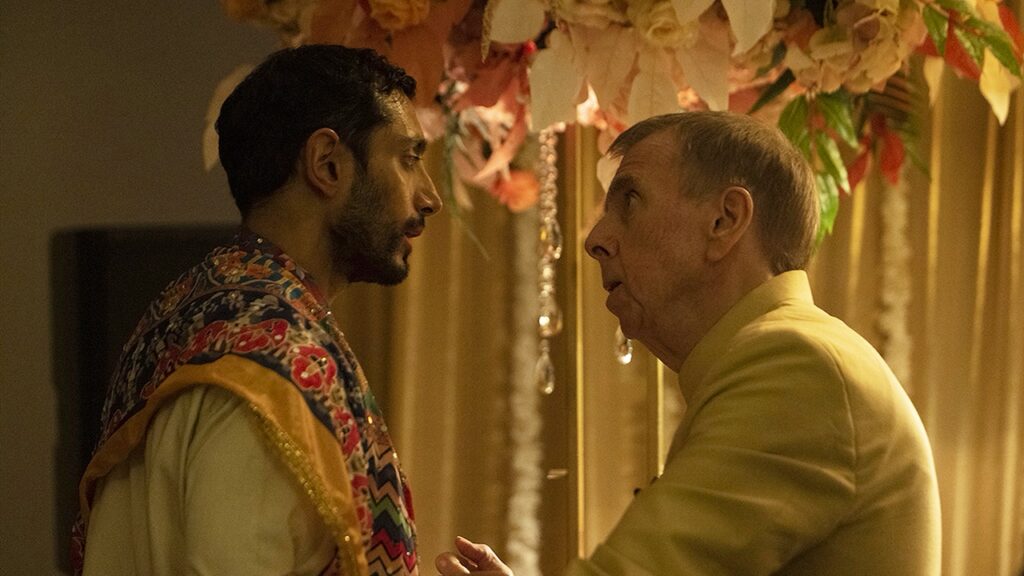
In this version, there’s a sort of half-explained antagonism with a tent city formed when land newly owned by Cladius seeks to evict the current inhabitants. If that sounds a little vague, that’s because the film itself barely understands how to get into it. The scenes we get suggest the film would be significantly better off if it forgot the subplot entirely. What could have been a bold and timely way to incorporate conversations about income disparity ends up feeling like a tacked-on afterthought.
Similarly, the script slightly expands Ophelia’s (Morfydd Clark) role by incorporating aspects of Horatio’s character. But to what end? It’s unclear what doing so adds. Expediency is simply not a good enough answer. Clark gives it her all in the role, but the character comes across as empty rather than tragic. It is hugely disappointing.
In these ways, Hamlet falters. Yet, it still does what a good adaptation should: highlight the work in a new way. That makes it worthwhile for fans of Riz Ahmed, the play itself, or those who’ve only seen Hamnet and really want to know what the heck that ending was all about.
Hamlet suffers the slings and arrows of outrageous fortune in American theatres on April 10.