Read also:
How to Watch FX Live Without CableHow To Watch AMC Without CableHow to Watch ABC Without CableHow to Watch Paramount Network Without Cable“What if Juliette Lewis switched bodies with a chair?” isn’t the kind of logline you hear every often. But in the universe of indie filmmaker Amanda Kramer, it fits like hand in glove. Starting her career as a playwright and director, Kramer’s work is deeply steeped in artifice and the strange social codes of gender and heteronormativity; 2018’s Ladyworld transplanted Lord of the Flies into the small social milieu of a group of teenage girls who must reform society in a basement post-earthquake, while 2022’s gender-bending Please Baby Please thrust a bohemian couple into a seedy work of kinky sex, queerness, and sublimated desire.
Her latest, By Design, which is finally in theaters after a premiere at last year’s Sundance, feels part and parcel with Kramer’s aesthetic concerns: Stylized, presentational, and deeply original. Befitting the logline, the film stars Juliette Lewis as Camille, a disaffected middle-aged woman who spends her days brunching with her two friends (played by Samantha Mathis and Robin Tunney, creating a troika of underappreciated ’90s leading ladies) and going window shopping. One day in a furniture showroom, she comes across a chair that stops her heart: She falls in love with it, and is crestfallen when she can’t buy it. Discovering the following day that another woman (Anita Torres) has purchased it, Camille makes a wish and, through the magic of Kramer’s surrealistic worlds, switches consciousnesses with the chair.
From there, the film follows two distinct tracks: As the inanimate chair, Camille finds herself falling in love with Olivier (Mamoudou Athie), the man Torres’ ex buys the chair for as a breakup gift. Dealing with his own heartbreak, he builds a curious connection to the chair that helps Camille feel needed. Meanwhile, as the soul of the chair inhabits Camille, she discovers that those around her vastly prefer her when she’s an inanimate object.
It’s this kind of playfulness that makes By Design, and by extension the rest of Kramer’s works, so curiously compelling. Deeply informed by the grab bag of aesthetic and cultural influences she draws on, ranging from the works of David Lynch to 1980s mall catalogs, the film feels free to wander in its own meditative, ruminative directions. Camille embarks on her own body-swap journey, but the film’s world yearns for connection, meaning, and love beyond the confines of the roles everyone expects them to play. (“What do the things we love give back to us?” one character asks.)
These questions and more inform our conversation with Kramer and co-star Tunney for The Spool, where we discuss Kramer’s overarching exploration of meaning, the theatricality of her work, and what it means for her to work with so many actresses who’ve endured the hamster wheel of Hollywood.
This interview has been edited for clarity and length.
I’m curious about the project’s genesis, because it feels like an extension of the kind of play with gender and performance, and of these presentational explorations of our relationship to our world. Whether it’s through people or ideas or objects. What did you specifically want to explore in By Design?
AMANDA KRAMER: It’s so hard to conceptualize a film that you want to be so intimate and your own. These things are sometimes meant for mass audiences, and you always wonder: Will I be able to connect with someone with my strange story and weirdo brain? I’m fortunate enough that there have been enough people that I’ve touched and connected with, which means that there are enough weirdo brains to keep me going for a while. But I’m exploring all of the strange feelings I have about myself, my body, other people’s bodies.
I see movies like The Substance, and I get what’s being said. I totally do. It’s just not something I relate to. But I want to talk about this thing they’re talking about too, in the way that I’m thinking about it. Which is not this adventure toward finding epic beauty and epic youth and what we’ll do to our bodies to get it, but more like, what if you can’t pinpoint the body or lifestyle that you want? What if you’re lonely because you see the omnivore’s dilemma of every lifestyle, every body, every choice. I mean, how many times have you seen a woman — she’s not stick thin, she’s not rich, but she’s got it, and you want it. Then the next day, you see someone, and they don’t look like anything that you would ever think you would want to look like. But God, their house. You’re always moving the bar as a human being. And Sam [Mathis] was saying it perfectly earlier: It’s capitalism, it’s all these other things. Your needs and your wants are not as straightforward as agelessness and endless beauty and no wrinkles. Your needs are really complicated, and the self you have is created. So you’re looking at your own chairs and furniture and thinking, “What does this say about me?” constantly.
That’s the beginning of how I start thinking about the idea, and where it goes from there is just the magic of writing.
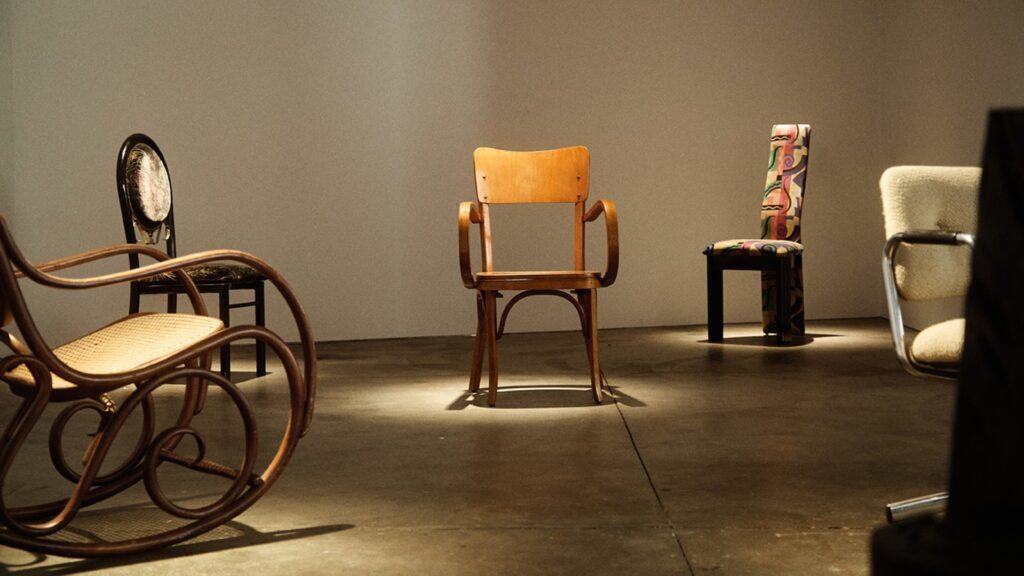
What do you think it is about the human condition that makes us stare at an object or piece of furniture and think, “I would love to be needed like this”?
AK: Well, Robin, you live with an interior designer. You take this one.
ROBIN TUNNEY: [Long pause] I think there’s something aspirational about how perfect and contained it is. I think we all feel like, “Am I in the right place? Am I doing the right thing?” With furniture, it’s beautiful, it’s contained, and it looks like it’s at peace.
A chair doesn’t have self-doubt.
ROBIN: No! I don’t know if it’s when your ego is formed that you start developing envy or looking at what you think is wrong with yourself. Because we’re not born like this or like that. My kids want the stuff at the grocery line endcap, but the idea of wanting somebody else’s hair or something like that is a developmental thing; how a thing of beauty is somehow going to translate to you. If somebody saw me sitting in that chair, they could think I was enough. I think that our culture, with Instagram and TikTok, there’s so much on there that you will never have, people renting private planes and renting a car, and wanting to say, “I own this to feel okay about myself.” It makes other people feel as if their lives aren’t big enough, as if they don’t have enough. That’s human nature, but social media has put it on steroids.
I think we’re all insecure, and it’s not a statement about the way a person looks or how their brain works. It’s the human condition.
Amanda, you touch on this in this film and in many of your others, and I think it’s reflected in the way your films draw on a mix of eras and aesthetics without ever feeling like a pastiche of any one specific era or aesthetic. In By Design, there’s a blend of 1980s mall catalogs and 1950s housewife anxiety, things like that. What’s your thought process when building these cohesive worlds out of such miscellany?
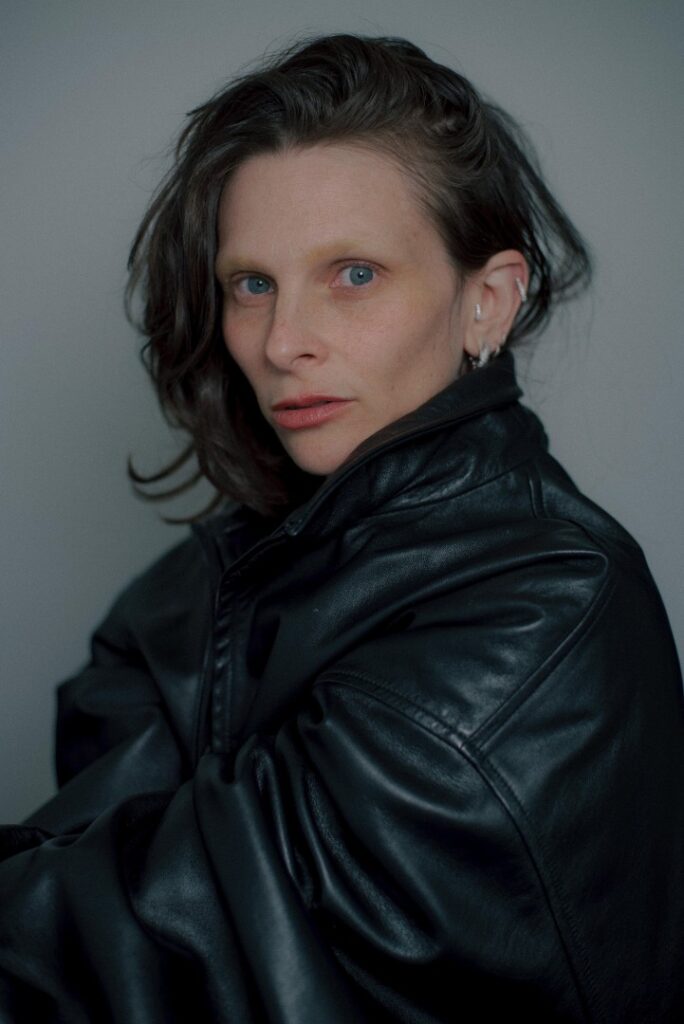
AK: I think in order to be a great artist, you can’t look to your own medium. I love films, I get so much inspiration from them. But there’s a limitation. We can’t just cannibalize films. We have to look at fine art, furniture, architecture, music. It’s the same with great actors; they can’t just look at a great Sandy Dennis performance and say, “I’ll do that.” It’s not useful to them. So I’m going all over the map. Let’s see photos of Thierry Mugler’s ’80s Paris apartment, which is exactly how I envisioned Camille’s apartment. American Gigolo, which I’ve seen 800,000 times. Joanna Hogg’s short film “Caprice,” which is, I think, one of her masterpieces. I’m watching The Red Shoes, I’m thinking about Swan Lake, you know? Just pinging the resources I have.
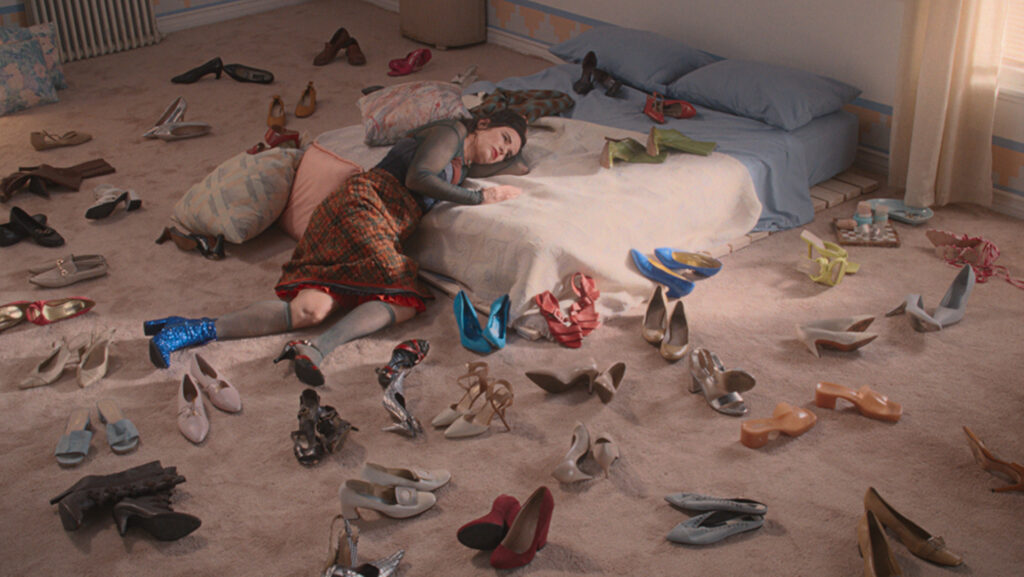
I’m also really obsessed with store windows. I think about store windows all the time. When I was a child, all I cared about was going by the store window. I wanted to see what was in Nordstrom, May Company, or Broadway, and the way they place the mannequins. I think about mannequins all the time. I think about actors as mannequins, but you know, only in pieces. [Laughs] I think about how my job is turning people into mannequins. When I was in theater, you look at everybody; you look at every inch of their body, their eyebrows, their feet, where they’re going. When you’re a filmmaker, and you have a lens, suddenly you can just film their shoes. You can just film their heads. You take people apart and you say something about that body part by showing it in such closeup.
RT: You can just film their lips!
AK: Or just film their ass, as many male directors have done before me.
Robin, how does that hit you as someone who has been directed by Amanda? What is she like as a director of actors, and how do you feel when you’re in a room with her?
RT: She’s just incredible. She has this wonderful, positive energy. If there’s any fear or stress, it’s deeply buried, and she’s got incredible masking mechanisms. You feel like you can’t do any wrong, and you feel very held. She surrounds herself with other artists who gently draw you into her world. I went to do my costume fittings with Sophie Hardiman and said, “This is what I’m wearing?!” There aren’t many descriptions of where the people are or what the sets will look like. So you’re immersed in this world, and you have to be open enough to let it envelop you and let go of any preconceived ideas you had about performance or cadence. You have to lose yourself in it, but she immediately makes you trust her.
It’s adrenalizing, because it’s not like anything I’ve done previously. So often as an actor, you fall back on your old protective mechanisms or tricks, and they’re not there, and you think, this is either going to be diabolical or great, or both. But you’re willing to take the leap and be a part of something that’s not familiar. As an actor, you observe people similarly to what Amanda said; I’ll be in a restaurant and see someone, and I’ll wonder what that person’s life is like, and what it feels like to be somebody else. This, though, is its own existence; it’s the Kramerverse.
I don’t know if there’s ever been an actor that didn’t trust [Amanda], because you have to commit.
Yeah, there’s a very specific performance style that happens in an Amanda Kramer picture, a tone and mood and fearlessness that comes from it. Andrea Riseborough in “Please Baby Please,” I still don’t know how she did half the stuff she did in that movie.
RT: How does she do anything? She’s incredible. She’s like a shape-shifting genius. She’s touched by greatness.
AK: Well, it’s crazy to be on set with her.
Going back to By Design, though, you’re on set with Juliette and Samantha and your fellow actors of a similar generation, all women who came up in the ’80s and ’90s and ’00s having similar experiences in Hollywood. And you’re teaming up for this story that’s somewhat about the anxieties of how women move through the world, especially as they get older, right down to Melanie Griffith playing the narrator. Amanda, how central was that thought process to the script and casting?
AK: The greatest part of my job is that I’m the department head of the actors. I would rather be with them than anyone else. I would rather be in their vulnerabilities with them and walk with them than go talk to my DP, who’s phenomenal and a good friend of mine. But the actors are what my film is. My film lives and dies on their breath and movement. So casting the movie is so important. As soon as I cast Juliette in the lead, I got the amazing opportunity to ask myself, “Who would be her best friends, and who can I populate her world with?”
The film is broken into two distinct parts: one half focuses on the lives of the two characters, and the other half has a slightly different feel and tone. The love affair between Juliette and Mamoudou does not have to be this one-to-one chemistry between actors. I could make amazing, wild decisions, because his job is to fall in love with a chair, and her job is essentially to be a chair. I was allowed to ask what I wanted and how I could have it.
Casting Juliette was somewhat an easy choice, but then getting to cast her friends was…. I don’t know if everyone knows this — they should — but in the age range of 40 to 55 are some of the greatest working actors ever of all time in any decade. They are some of the most soulful, funny, bizarre, and unique performers, and they should be cast all the time in far more complex, interesting, evocative, and provocative roles. I was so lucky I got to choose Robin and Samantha; it felt weirdly like my destiny. There’s only one movie that gets made, and it’s the one that gets made. So when you’re given lists of people, and you have to sit and fantasize about so-and-so and whether they’d do that… none of those things came to be. What came to be was the perfect thing.
RT: When I started auditioning for movies, I wanted to be Samantha Mathis and Juliette Lewis. They were the ultimate. You would read something, and it would say they want a Juliette Lewis or Samantha Mathis type, and I always thought they were both incredibly talented. I had this experience with Juliette that’s so weird; I’ve never told her this. But we were auditioning for a movie together, and it wasn’t good, and the lead actor we were both in the final round to read with was an hour and a half late. I think I walked up to her and said, “You deserve better than this. I don’t, but you should get up and leave. If they want to offer it to you, they should offer it, but you are better than this.” I think she is a national treasure; she’s worked with all the greatest directors; she can do anything. I think they should give somebody a blank check if she decides to be in their film. She’s so remarkable and so sensitive and a real artist, everything you want an actor to be.
All three of us had been around each other throughout our careers, and the idea that we got to act together, especially at a point in our lives where we get to learn from each other, was great. The contest is over, you don’t feel competitive, you feel nothing but great admiration that the three of us are still doing this. It’s a miracle, because this business kills people or it humuliates you to the point where you quit, or you’re so disillusioned that you don’t love what you do anymore. Somehow, the three of us still love it, and do things for artistic reasons. You go and do a movie like this because of the way it’s going to make you feel while you’re doing it. You’re not doing it for the money, you’re not doing it for more fame. Just the experience and getting to be a part of a filmmaker’s vision. This younger generation of female filmmakers are like “What’s next?” We’ve seen the regurgitated bullshit. And to be a part of something incredibly unique and support somebody’s vision is so exciting. It’s an honor.
With that in mind, what was it actually like to act alongside them, and the crucial question: What is the acting challenge inherent in acting opposite a chair?
RT: I didn’t think about [the latter] much, actually; I just remember emailing Amanda and asking, “Why don’t I just buy her the chair? I feel like I would buy her the chair!”
But it was interesting; we shot the last scene first [where Camille comes back to her body], and Juliette was like, “I don’t know how I’m going to do this.” Amanda’s background is as a playwright, so she doesn’t write much direction about what the characters will physically do or how they will react, as many screenwriters do. So you get this blank canvas. And when Juliette fell to the ground, both Samantha and I went to get her and were deeply concerned for her. As awful and self-centered as [Samantha and I] are to her at the beginning of the film, in the end, when the chips are down, we were there for her. That informed the rest of the performance, because you can’t play somebody who’s just a vapid monster. You have to find the humanity in them. That scene really informed who the women were and gave you permission to dig into her and be unkind and callous. Because you know who the character is at the base of it.
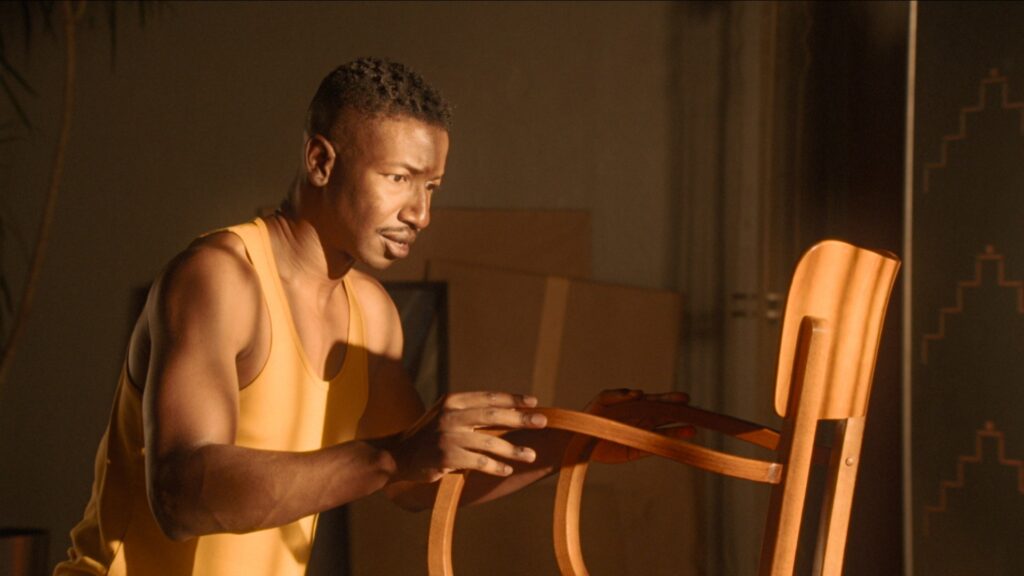
Amanda, we’ve talked about the innate humanity of these movies and how you love to explore people’s impulses and anxieties, especially women’s. But By Design and Please Baby Please also take time to explore the messy performance of gender on all sides; take Harry Melling’s character in Please, or Olivier in By Design, who are men desperate for meaning alongside their female counterparts. What was it like looking at these concerns and yearnings from that other end of the gender spectrum?
AK: I’m going to say the controversial bit: I’m a proud feminist. I believe you cannot be a feminist in art unless you love men. You have to think about their lives. You have to think about what makes them the thing that might scare you. You have to care so you can make better men. Once you become a mother and give birth to a man, you don’t look at him as a baby and think, “Oh, you might rape someone someday.” Your sensation is, I hope, to let him be raised in a world where he wants to love women. It all comes from a headspace of celebrating the complexity of men, opening doors to other aspects of their personality, and seeing where we can go.
In Please Baby Please, that’s not a film about a man who realizes he’s gay. This is a film about a man who has no fucking clue what’s going on inside of him, and he’s just asking questions of himself, which, let’s be honest, I don’t think very many men get the opportunity to ask questions of themselves and their souls.
For By Design, Mamoudou is so elegant and graceful as a performer, and he’s so strong; he’s got an amazing voice, and he brings all those things to any character. There’s a masculinity in him that is inherent, but his sensitivity and vulnerability are apparent when you know him as a man. I’m lucky to call him my friend. When I wrote that part and was hoping to cast him, all I really wanted to do was see if I could get at a man who sees something inside of a woman that nobody else sees. It’s a stupid cliche, beauty is in the eye of the beholder. But can you get something so connective and romantic from a wooden chair? Lucky for me, he was able to give me that performance, and I’m allowed to write a man who asks questions, doesn’t know everything, and stumbles.
RT: He’s also objectified [the same as Camille], which I feel like we rarely get to see that side of men in movies.
Finally, Amanda, why “Someone to Watch Over Me” as a song to bookend the film?
AK: I was looking for romance, pure sentimentality. I love Gershwin for that kind of purity of emotion — uncomplicated and sincere. The line “Where is the shepherd for this lost lamb?” makes me cry.
By Design is currently playing in select theaters, courtesy of Music Box Films.