Read also:
How to Watch FX Live Without CableHow To Watch AMC Without CableHow to Watch ABC Without CableHow to Watch Paramount Network Without CableIn his 2025 book One Day, Everyone Will Always Have Been Against This, author Omar El Akkad references a 2016 Roy Scranton essay. In it, El Akkad writes that the veteran “[confronts] the reality that so much of the American self-image demands a narrative in which his country plays the role of the rebel…when at the same time every shred of contemporary evidence around him leads to the conclusion that…this country is clearly the empire.”
That quote kept racing through my mind while watching Edgar Wright’s The Running Man. Here is a film that is very much critical of America. It showcases a country that celebrates corporate- and state-committed bloodshed, while keeping healthcare for the proletariat ever elusive. There’s tangible rage against the machine.
However, that anger’s poster child is Glen Powell, A.K.A. Storm Chaser Mr. Beast from Twisters. The Running Man wants a revolution, but turns to Corporate America’s new favorite cis-het white leading man. What a strange proposition in the here and now, considering, as Robert Daniels so astutely put it, “the White Savior [is] this year’s cinematic punchline.”
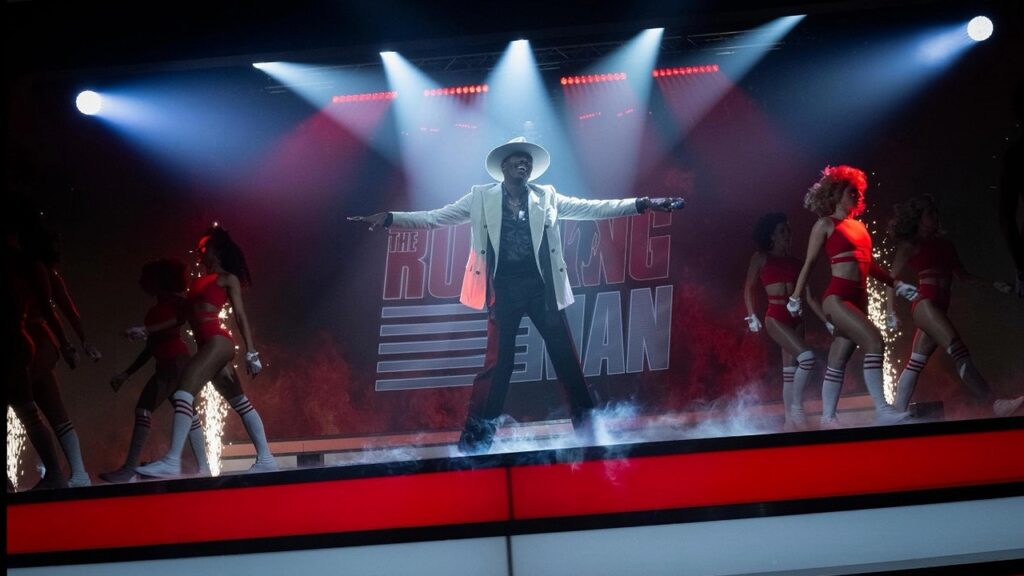
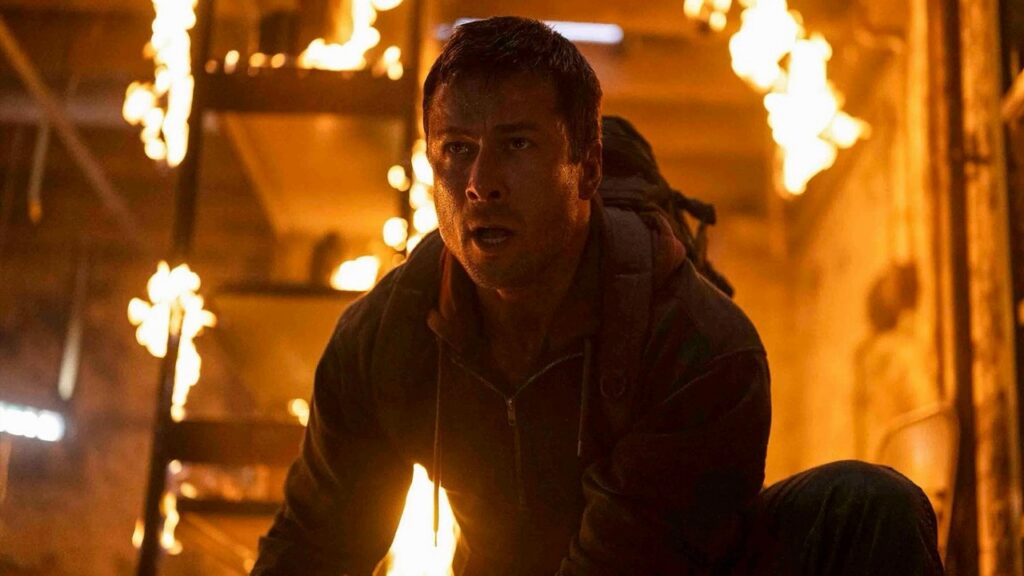
In this latest film adaptation of Stephen King’s 1982 novel The Running Man (following the 1987 Arnold Schwarzenegger incarnation), Powell plays Ben Richards in a dystopian America where class divides have left the rich richer than ever. The poor, Richards among them, have few options to make it from one day to the next. He and his wife, Sheila (Jayme Lawson), are scrambling for medicine for their sick daughter.
In a last-ditch effort to secure some cash, Richards auditions for one of the many dehumanizing yet profitable game shows filling up the airwaves. His rage-induced tendencies and assuredness convince producer Dan Killian (Josh Brolin) that our protagonist should be the face of The Running Man. In the show, contestants attempt to endure 30 days of relentless hunting for a potential $1 billion reward. Despite early resistance, soon Richards scurries across various desolated American tableaus, steadily building a following among viewers. His resilience and willingness to stand up to the big shots could make him…a hero?

Writer/director Edgar Wright (who penned this update with Michael Bacall) happily doesn’t skimp on the specific, detailed rage at modern America. Advertisements demonizing the poor and glorifying slaughter litter the landscape. Figures like host “Bobby T” (Colman Domingo) present Richards as a “Commie union” supporting “evildoer”. Elsewhere, there are hints of the weaponization of Christian theology to justify unspeakable human rights violations that even conversion camp horror movie They/Them was too timid to raise.
These qualities lend much-needed specificity to The Running Man’s dystopian universe. Richards’ growing anger over corporate pollution and influence isn’t just relevant social commentary; it provides clear narrative stakes. Bringing this saga closer to tangible reality than other 2025 blockbusters is welcome.
It helps that Wright and cinematographer Chung-hoon Chung deliver several zippy action sequences. They channel the energetic visuals one expects from the Cornetto Trilogy helmer. One highlight is a naked Richards dangling from a hotel roof, if only for a terrifically silly gag involving a perilously loose gigantic letter. Also, oodles of fun is the extended mayhem of leftist Elton Parrakis (Michael Cera) finally getting revenge on some police officers via a tricked-out house full of grisly and enjoyably silly traps.
Despite this and Wright’s reputation for visually driven features, The Running Man often succumbs to excessive expository dialogue. Too many scenes, especially the airborne finale, feature characters standing around explaining their lore or sneaky plans. This writing problem hits a drastic low when Richards berates unwilling wealthy accomplice Amelia Williams (Emilia Jones) for her economic status. Huzzah for telling the bourgeoisie to suck it. However, the ham-fisted writing renders this diatribe the classism equivalent of Sam Wilson’s “do better” speech from The Falcon & The Winter Soldier. It’s surface-level social commentary told with tin-eared verbiage.
Instead of feeling like a bullet, the film is rife with multiple stops/starts. This problem lies partly in how Wright and Bacall keep introducing new, fun companions for Richards, only to ditch them after one scene. It derails a sense of progression while injecting a frustratingly episodic ambiance.
Then there’s Powell’s lead performance. Outracing bullets or drone cameras, Powell exudes physical deftness without sacrificing the ramshackle everyman energy his role requires. However, he lacks Richards’ intended signature emotion: anger. While one woman claims, “You’re the angriest person to ever try out for one of our shows,” the actor doesn’t sell it. He’s just got too much of a puppy-dog face and an “aw shucks” demeanor. The script demands Adam Sandler in Punch-Drunk Love or Glenn Howerton in It’s Always Sunny in Philadelphia-style hostility. That is at odds with Powell’s star persona, a separation the feature can never reconcile.
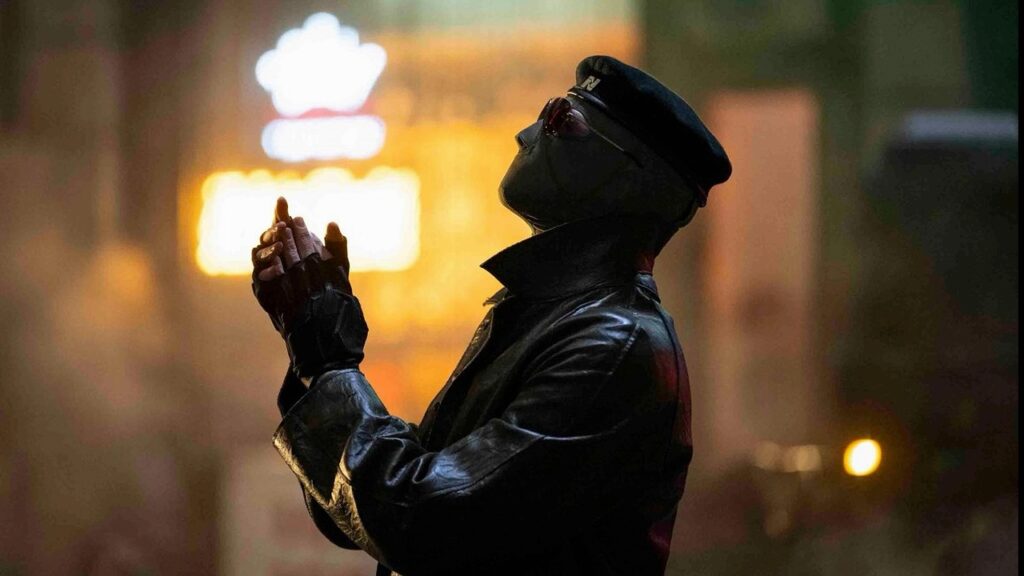
It’s the supporting actors who really shine. Domingo is having the time of his life chewing scenery. Lee Pace’s towering stature is perfect for a head-to-toe concealed bloodthirsty adversary. Katy O’Brian, always welcome, is especially delightful, if frustratingly fleeting.
There’s some truly fun entertainment in the best The Running Man sequences and performances. However, there’s too much dead air between those high points, giving the mind time to ponder its sociopolitical shortcomings. Is the answer to America’s classism problem really Comcast and Disney’s favorite leading man? Can this country’s mainstream cinema only suggest rebellion against oppressors if the fighters look like Powell? American forces killed Che Guevara, yet decades later, The Running Man uses his face to accentuate a supporting character’s revolutionary bona fidas.
Granted, this is a popcorn-muncher movie designed to let people ogle Powell’s naked body and cheer at bad guys going boom. Wright’s assured hand with car chases, visual gags, and actors ensures it’s got its fair share of crowd-pleaser material. Still, it isn’t enough to ignore the larger deficiencies. The revolution may start with The Running Man, but it is a stumbling beginning.
The Running Man sprints into theaters everywhere on November 14.