Read also:
How to Watch FX Live Without CableHow To Watch AMC Without CableHow to Watch ABC Without CableHow to Watch Paramount Network Without CableLike 1935’s Bride of Frankenstein, writer/director Maggie Gyllenhaal’s The Bride! begins with Mary Shelley (Jessie Buckley). Here, though, she’s trapped in a monochromatic afterlife void, her head full of chaotic thoughts she can’t quell. Soon, her mindset collides with a lady known only as The Bride (also Buckley), whose existence among the living comes to an end after gangsters toss her down some stairs. To paraphrase the Poochinski teaser, “but that’s not the end of her story, no no.”
Rather than getting reincarnated into a bulldog, The Bride’s unearthed by Frank A.K.A. Frankenstein’s monster (Christian Bale) and Dr. Cornelia Euphronious (Annette Bening) to bring back to life as a wife for the lonely, lovesick Frank. Once she’s “aliiiiiive”, The Bride is a kooky creation spewing up black goo, switching between personalities (Shelley is also in her head), and smashing fragile plates. It isn’t long before the undead couple ventures into Chicago for a night on the town. Thanks to some violent mishaps, it isn’t long before they’re declared fugitives.
Once The Bride’s in newspapers across the country, Gyllenhaal briefly shows that she’s inspiring women across the country to put pantyhose over their heads, dye their tongues and lips black, and yell in the street. The Bride! fails to get into the nitty-gritty of what exactly they’re rebelling against. Conceptually, these ladies and the film’s titular character are rebelling against societal norms and rigid expectations. On-screen, though, Gyllenhaal tiptoes around the specifics. We see the protest chants, but not their inspiration. Fret not, right-wing viewers and media pundits. There’s no exploration of classism, racism, homophobia, or even the systemic roots of misogyny here. You should stay blissfully unperturbed.
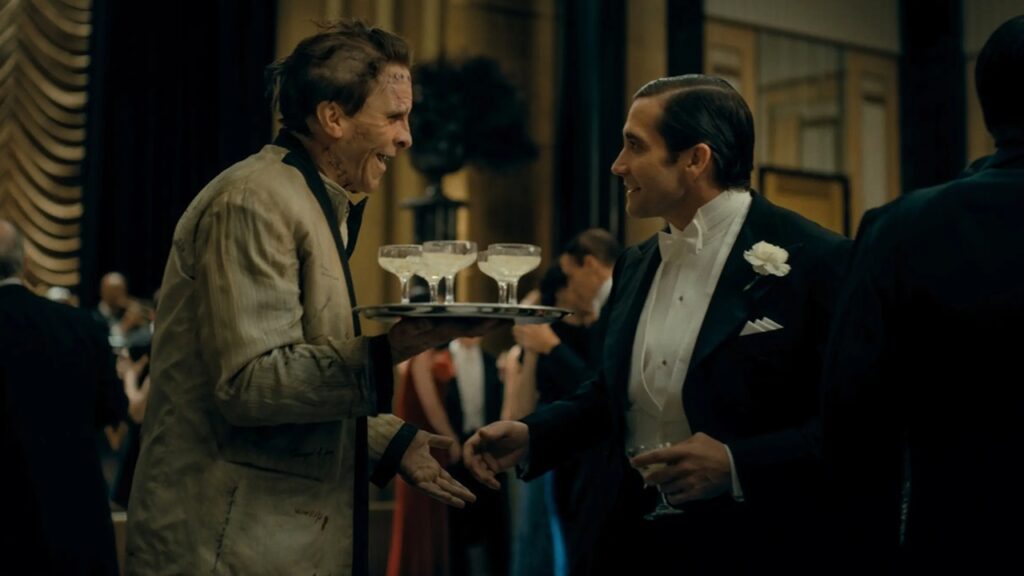
Instead, everything remains very vague. Even supposedly adversarial characters like movie star Ronnie Reed (Jake Gyllenhaal) don’t exhibit any especially repulsive qualities. There’s a narrative urge to rebel, but without mention of controversial topics that could alienate viewers. Maggie Gyllenhaal clearly wants to make The Bride! a Lizzie Borden/Vera Drew/Boots Riley-slice of anarchic cinema. However, its unwillingness to either rage against the machine or go consistently unhinged undercuts that ambition. You can’t echo The Doom Generation and try wringing “girlboss” moments out of a heroic white cop. Thus, the rebelliousness of The Bride and her devotees is shrug-inducing.
There are brief flickers of The Bride! letting its freak flag fly. For instance, The Bride and Frank crash a wealthy soiree. In no time, they turn it into an old-school musical number, complete with extensive tap-dancing. The whole thing is a hoot. At other times, creative visual motifs, like the undead lovers bleeding onto nearby movie theater screens, enhance the narrative. The cuts between the film’s titular lead and Mary Shelley are enjoyably loopy. Still, Gyllenhaal’s writing too often centers dry, straightforward expository dialogue and equally uninspired backdrops.
Take Detectives Jake Wiles (Peter Sarsgaard) and Myrna Malloy (Penélope Cruz), for example. The “subversive” gender dynamics of their rapport—Malloy’s the actual detective, Wiles distracts the guys—is clear because the former character flatly says it. Worse is the precious screentime devoted to a storyline that you can find in nearly any mob movie in the third act.
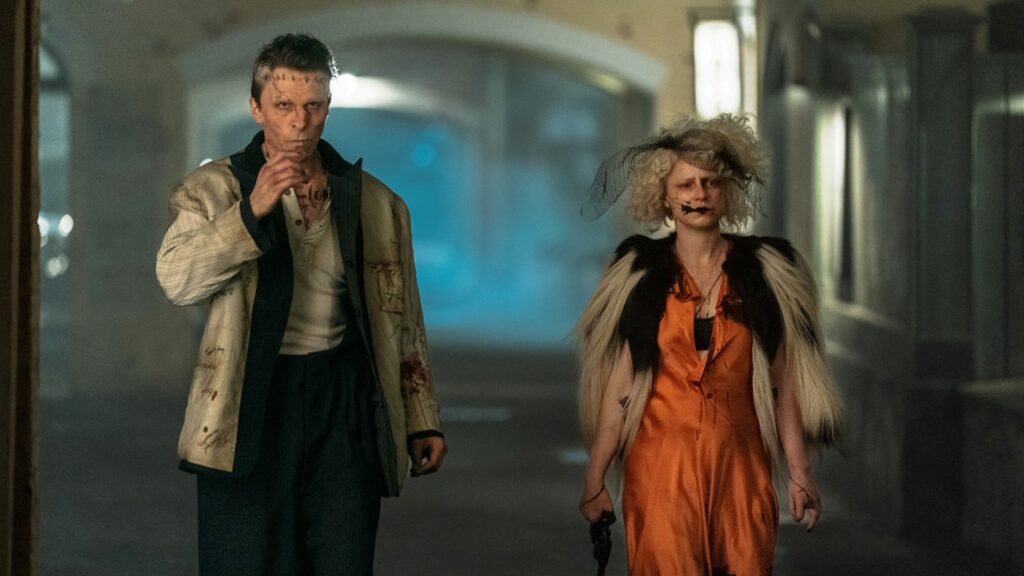
Gyllenhaal’s excessively cluttered script overcomplicates what should be easily digestible lovers-on-the-run cinema. The screenplay’s narrative priorities reinforce the status quo rather than subvert it. “Nice” white cops and a reluctant mobster are de facto protagonists in American cinema. Compare this effort to the likes of Borden’s Working Girls, Donna Deitch’s Desert Hearts, or Cheryl Dunye’s The Watermelon Woman. They boast a deluge of complex, messy, and fascinating working-class—and often queer—women. Marginalized or outright erased in typical motion pictures and capitalist society, they become movie stars anchoring features rich with depth, unorthodox imagery, and uniquely specific storylines. It’s subversive artistry all the way down.
The Bride! doesn’t exhibit such creative chutzpah. Instead, it deploys the same “police detectives investigating horror movie material” archetypes that people were already making fun of when Hellraiser: Judgement hit shelves.
Visually, the production isn’t much better at upending conventions. Dimly lit New York hotspots and an abandoned pool house are among the tableaus, rather than more surrealistic or distinctive backgrounds. Heaven forbid any bright colors or grandiose sets materialize.
Also visually frustrating is the cramped framing. I kept yearning for the camera to pull back and show a larger world dwarfing Frank and The Bride. Instead, editor Dylan Tichenor constantly cuts across claustrophobic imagery perfect for iPhone viewing.
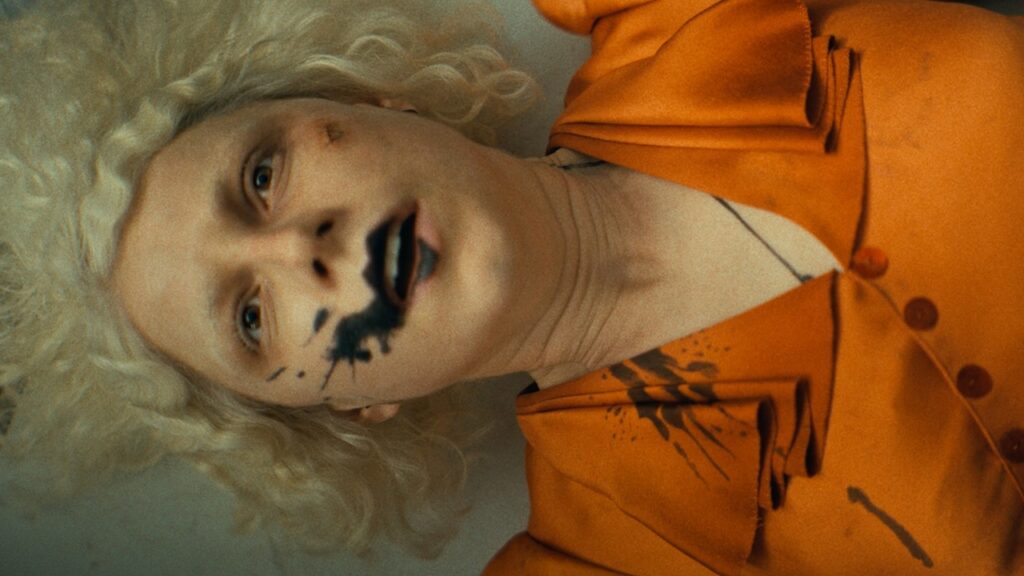
Even the use of violence here is frustratingly safe. The only people The Bride and Frank kill are either overt creeps or didactically emphasized acts of “self-defense”. Once more, timidity capsizes The Bride!’s unhinged cinema ambitions. Let these two be bloodthirsty and weird monsters!
If there’s one area of the feature that works like a charm, though, it’s Buckley. Since her star-making turn in Wild Rose, Buckley’s bravura acting tendencies have been laudable. That makes her perfect for The Bride!’s gonzo lead. Her approach to The Bride echoes a 2000s Johnny Depp performance, but not annoying. Zigging and zagging between the voices in her head and exhibiting chaotic physicality, Buckley’s absorbing every time she’s on-screen. I could’ve watched her frolicking for coins in a fountain or smashing fancy breakfast dinnerware for hours on end. While not necessarily chaotic, Bale’s committed work as a lovesick vision of Frankenstein’s monster is also commendably realized.
Despite Buckley and Bale arriving ready for madness, The Bride! only fleetingly rises to their level. The dissonance between this feature’s anarchic creative ambitions and its boilerplate execution has me once again reaching for a Poochinski quote. “This is ridiculous.”
The Bride! is alive in theatres everywhere now.