Read also:
How to Watch FX Live Without CableHow To Watch AMC Without CableHow to Watch ABC Without CableHow to Watch Paramount Network Without CableDerek Cianfrance’s directorial career has centered on the grimmest personal stories imaginable. From Blue Valentine to The Place Beyond the Pines to his HBO miniseries I Know This Much Is True, Cianfrance weaves sagas of trauma and pain. Often in his pictures, these psychological scars touch and wound multiple generations. Once lovely relationships eventually curdle into bitter fights. Revenge consumes a young man’s soul from the moment of his birth. Seemingly noble gestures, such as saving a lost child, have gruesome ripple effects. He doesn’t make pick-me-up movies, in short.
Looking at Roofman, one thinks that maybe the relentless grimness of the 2020s finally got to Cianfrance. In the middle of a decade marked by COVID-19, genocide, and global authoritarianism, the Blue Valentine auteur has delivered this frequently wacky comedy. Although not bereft of serious digressions, this is largely a vehicle for Channing Tatum’s crime caper silliness.

Cianfrance and Kirt Gunn’s script is based on the true saga of Jeffrey Manchester (Tatum), a U.S. Army veteran struggling to carve out a good life for his kid. Desperate to make money, he robs 45 local McDonald’s locations, entering through the roof. Hence the feature’s title. Throughout the crimes, he keeps a chipper and thoughtful attitude towards any employee he encounters. Two years into the low-key, unhurried spree, Manchester’s caught and sentenced to over four decades in prison.
Thus begins a series of unbelievable events, all possible through Manchester’s keen observational skills. He eventually gets out of prison and secretly hides out inside a Toys “R” Us. After a few months, he begins sneaking out under a new alias. He then sparks up a relationship with a Toys employee, Leigh Wainscott (Kirsten Dunst). The “roofman” is cunning, no question there. But how long can he keep up all this duplicity?
I spent countless hours as a kid obsessed with the Chicken Run movie and its PlayStation One adaptation. From Ginger’s antics was born a lifelong fixation on stories where people duck behind walls or narrowly avoid guards while making a break for freedom. Certain Roofman sections certainly scratch that specific itch in the lizard part of my brain.
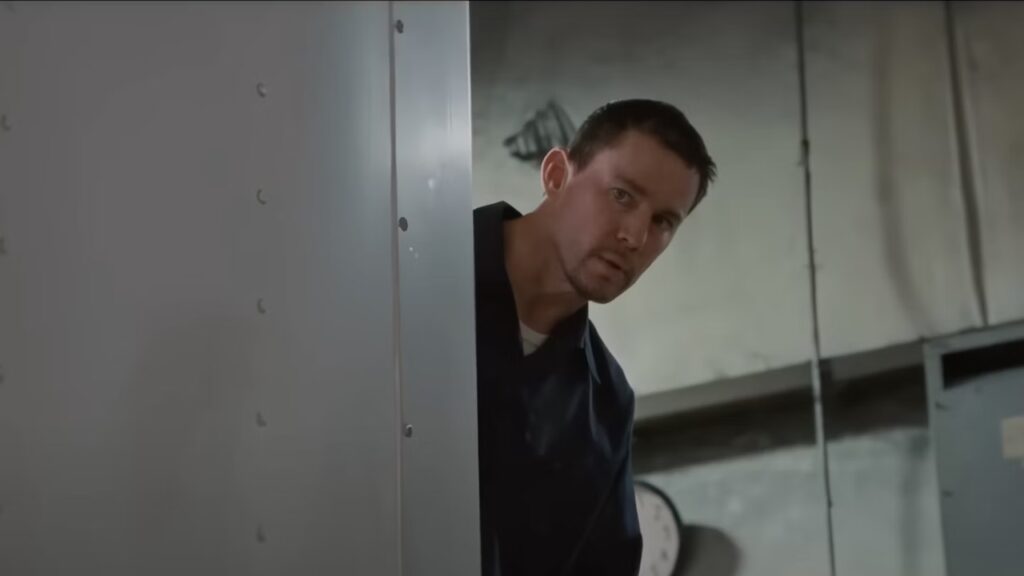
Particularly satisfying is an early scene of Manchester crawling out from under the truck he’s used to secure freedom from prison. As he walks around the vehicle (largely framed in one unbroken wide shot), he narrowly keeps out of the driver’s line of sight. It’s a great dialogue-free set piece, thrilling in its simple pleasures, especially Tatum’s superb physical acting. A later, increasingly haywire robbery is another standout. It’s a terrific bit defined by chaotic uncertainty.
Cianfrance shows a welcome streamlined sensibility in these sequences. Some even could’ve worked as silent film shorts in their reliance on physicality and elegantly simple moral dynamics. Innately, you just root for the underdog to outmaneuver the authority figure.
Tatum’s enduring movie star charm certainly helps. As Logan Lucky showed eight years ago, this beefy sex icon has a remarkable talent for functioning as a convincing fly-over-state everyman. That comes in handy here. In Tatum’s hands, Machester’s believable as a guy you’d see at a local church’s singles night at Red Lobster.
When there’s more dialogue and drama on-screen, Cianfrance seems a bit lost as a screenwriter. He often draws from very broad and familiar creative wells to compensate for his lack of mainstream cinema experience. He trades Pines’ grim dialogue or Valentine’s naturalistic verbiage for characters explicitly stating the film’s thesis. For instance, Wainscott scolds Manchester, “You don’t need to buy us gifts to get us to like you!”
Further heavy-handed dialogue leaves nothing to the imagination throughout Manchester’s character arc. Pronounced familiar gags like a montage of silly wigs to wear while on the lam lack much identity. The worst of these derivative jokes is a weirdly recurring bit where Wainscott initially believes Manchester is gay. After This is the End and Bullet Train, —to name only two of several—“Tatum=gay?!? Can you imagine??” as a go-to Hollywood punchline is no longer novel, if it ever was.
These outsized impulses and routine comedy beats reflect Cianfrance’s insecurities and Roofman’s creative nadirs. It’s frustrating that he and Gunn keep the proceedings very straightforward despite 128 minutes at their back. It seems that Cianfrance, unfortunately, mistakes “boilerplate” for “mainstream entertainment”.

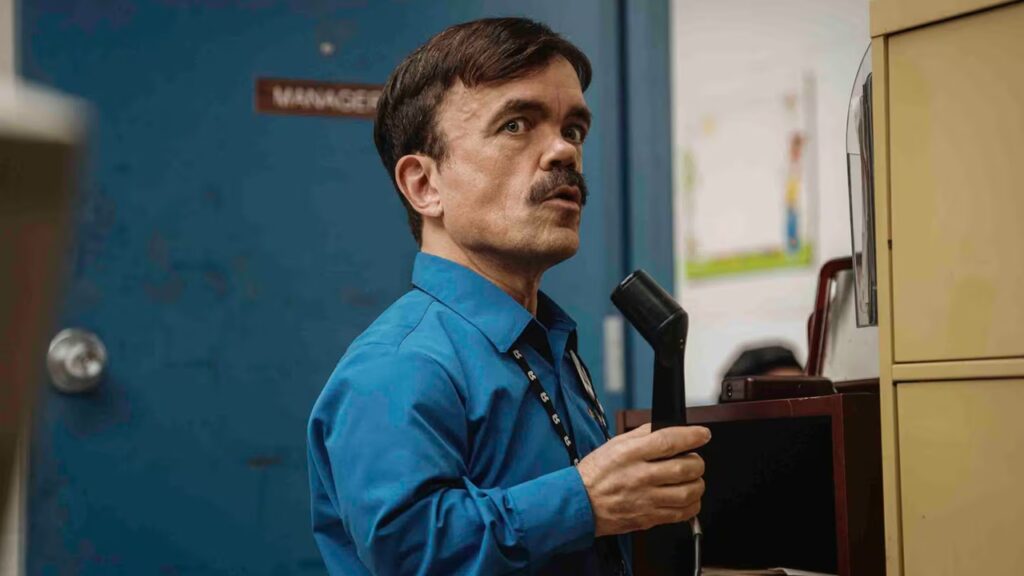
Luckily, this filmmaker’s talents for working with actors remain as strong as ever. Tatum is a compelling hoot, while Dunst lends so much more depth to Wainscott than what’s on the page. She’s so effortlessly mesmerizing. Though their respective characters don’t have much to do, it’s always welcome to see Ben Mendelsohn and LaKeith Stanfield on the big screen. Ditto Lili Collias as Lindsay, Wainscott’s older daughter. Collias was excellent in last year’s Good Ones, so it is a delight to see her showing up in mainstream cinema.
Roofman’s better qualities really carry the day. The entertaining sequences of Manchester evading detection, the commendable performances, and the 35mm photography keep the proceedings consistently engaging. The affable atmosphere is similarly welcome.
Still, this is one of those films that’s less than the sum of its parts. Manchester kept pulling off the impossible in his robberies and escapes. Yet Cianfrance can’t quite nail his own feat of transitioning from Blue Valentine bleakness to crowd-pleaser cinema. His talents aren’t quite enough to carry Roofman to its fullest potential.
Roofman breaks into theaters everywhere on October 10.