Read also:
How to Watch FX Live Without CableHow To Watch AMC Without CableHow to Watch ABC Without CableHow to Watch Paramount Network Without CableIs it possible to largely agree with a film’s message, enjoy its look, and still come away feeling underwhelmed and preached to? Good Luck, Have Fun, Don’t Die, Gore Verbinski’s return to feature film directing, is a test of that possibility.
Written by Matthew Robinson (who will always be the co-host of Get Up On This to me, but also wrote Monster Trucks), the film opens wonderfully. Looking like he rolled out of the trash behind a defunct Radio Shack, The Man from the Future (Sam Rockwell) walks into a diner and demands everyone’s attention. The script and the camera, under the guidance of cinematographer James Whitaker, wisely give Rockwell space to move.
He unspools (hey, like this site!) a tale as old as time. He’s from a horrible future where everyone’s addicted to technology or targeted by a wholly independent AI. This one night is humanity’s last opportunity to avoid that terrible fate. He’s tried before. 117 times, in fact. All prior efforts have failed, with several of the diner patrons winding up dead. But he can’t stop now. Humanity depends on it. It’s a great hook, and Rockwell’s spitfire sarcastic patter is the perfect way to deliver it.
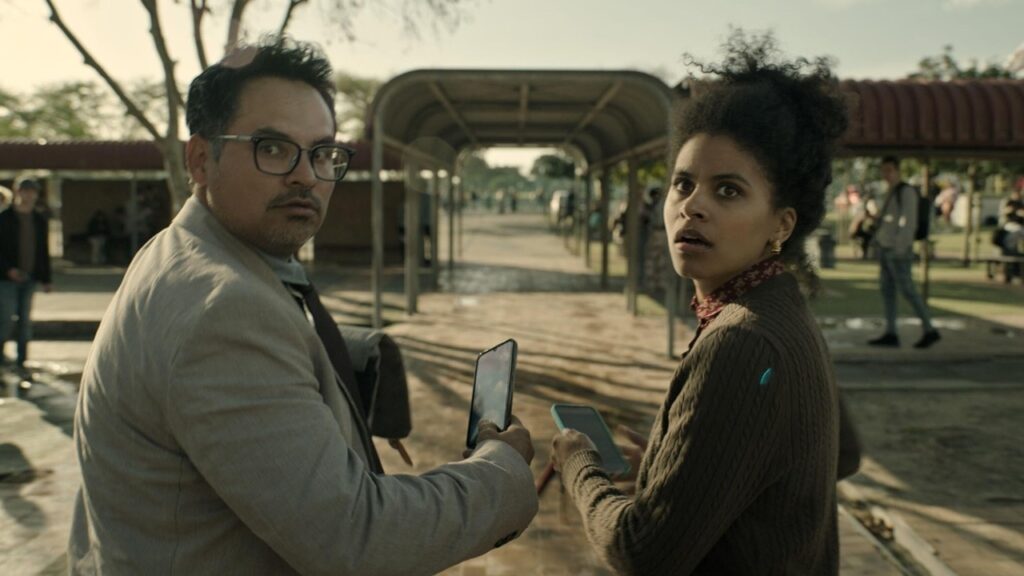
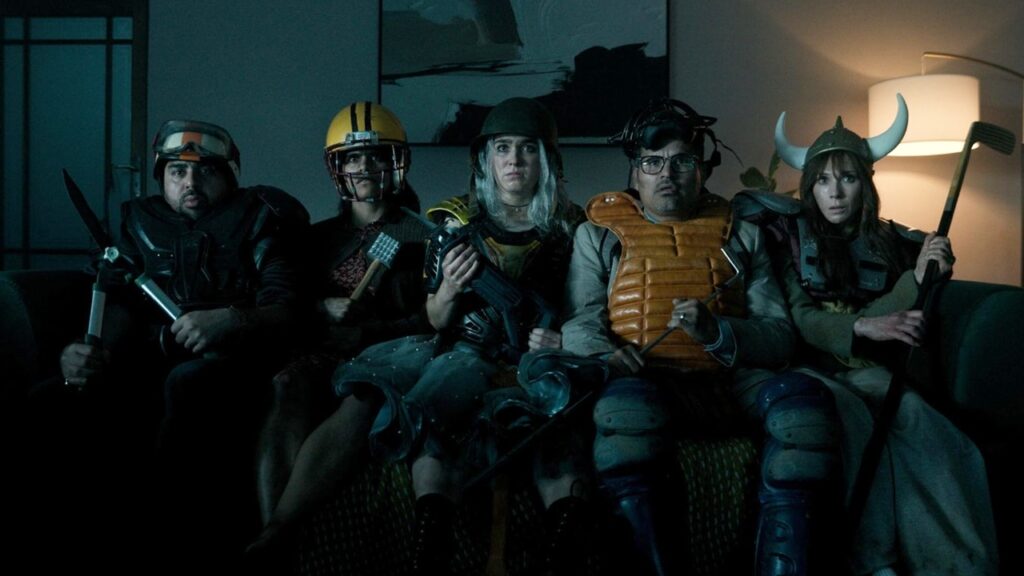
Prominent among the patrons are a couple on the rocks, Mark (Michael Peña) and Janet (Zazie Beetz); a highly skeptical Uber driver, Scott (Asim Chaudhry); Ingrid (Haley Lu Richardson), a woman in a princess costume that has seen better days; and oddly knowledgeable single mom Susan (Juno Temple). Together, they escape the diner, which is no guarantee, according to the Man. They then battle their way across town to reach the birthplace of the humanity-ending AI.
Interspersed among their adventures are three flashbacks, each highlighting a dangerous encounter with tech run amok. Mark and Janet barely escaped the school where they were teaching. Why? Because Mark somehow sent off a hive mind of students by daring to touch one of their phones. Susan lost her son in a school shooting, only to discover a secret government cloning program that “gives” grieving parents back a version of their child. Often, those kids go on to get killed in another mass shooting. Finally, Ingrid has a lifelong allergy to tech, WiFi in particular, but had managed to carve out a life for herself as a birthday princess performer and a tech-skeptical boyfriend, Tim (Tom Taylor/finally representation!). That unravels when the young kids become increasingly device hooked, and Tim gets addicted to VR goggles.
Unfortunately, the deeper we get into the tale, the more the film seems to lose control of the proverbial stick. Verbinski and company can’t keep enough plates spinning quickly to stop the audience from asking questions like “If the AI doesn’t yet exist, who hired those two assassins?” “What was turning those kids into phone zombies?” “What about those two bodyguards, who hired them?” And so on. Susan’s vignette is by far the darkest and most interesting. The chipper Genius Bar vibes of the cloning company, the fellow parents who have cloned their children so many times they seem wholly divorced from feeling, and the ad spouting replacement kids are darkly funny and deeply unnerving. Temple, largely lost in the rest of the film, is stellar in this section as the one sane person in an insane world.
The other two vignettes feel like jokes you’ve never heard before, but immediately know the punchlines. Like The Beauty last month, Good Luck, Have Fun, Don’t Die struggles with what to really worry about. Putting “kids use their phones too much” as a tech sin equivalent to “we clone children rather than consider gun control” is, well, a choice certainly. One feels like grandpa shaking his fist, as he plays Worldle, while the other is a harrowing satire of what we are willing to accept to avoid change.

The idea of a lone creator making AI in his basement also seems oddly out of step with our times. We have multiple companies trying to sell people on their LLMs as AI being not just the future of tech but an inevitability. They’re gulping down water and devouring capital at a devastating rate while so many ignore their shortcomings. Corporate AI is a juicy target. It is banging on our doors, wanting to write our emails and convince our depressed teens that ending their lives is better than reaching out for help. And the script centers on some basement kid instead? Talk about missing the easy and rewarding target.
These logical gaps and missed opportunities slam into an ending that seeks to prolong the tale rather than close the loop. That’s fine as these things go, but it doesn’t get there in a convincing manner. It seems reverse-engineered from an ambiguous ending, even after the script built largely successfully into something more definitive. It brings a film that starts with promise and energy to burn closed on a fizzle. If only Good Luck, Have Fun, Don’t Die could’ve held tighter to the second clause in its title.
Good Luck, Have Fun, Don’t Die drafts multiplexes into a fight for the future starting February 13.