Read also:
How to Watch FX Live Without CableHow To Watch AMC Without CableHow to Watch ABC Without CableHow to Watch Paramount Network Without Cable“Bless your heart.”
Fellow lifelong Texas residents undoubtedly have heard that phrase countless times. It’s a trio of words epitomizing the bizarre paradoxes of Texan culture. Externally kind but intrinsically condescending. Contradictions like that exist throughout the Lone Star State. A suburban domicile like Allen, Texas once lived by the slogan “keeping it country.” Now it houses a sprawling mall and HEB supermarket. Dallas denizens will wear spurs and cowboy hats while waltzing around a ritzy Neiman-Marcus. Texas politicians will stress the importance of “small government” while intruding on marginalized people’s lives. Even the physical land, housing so many varied geographies (from concrete-heavy cities to deeply rural domains), speaks to how it is, as a wise Patrick Star once declared, “an enigma”.
Dallas, Texas-originating writer/director Meredith Alloway uses this state’s incongruous nature to inform the aesthetic of her movie Forbidden Fruits. Here are a bunch of characters who aren’t just paradoxical. They’re also constantly sharing pop culture-laden Gen Z barbs equivalent to “bless your heart.”
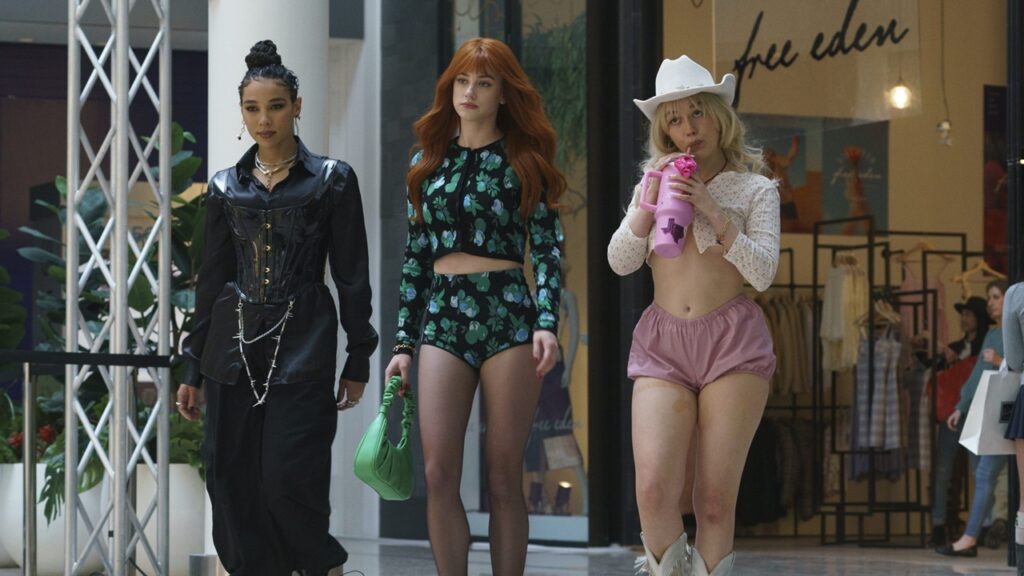
At the Highland Place Mall, Free Eden employees Apple (Lili Reinhart), Fig (Alexandra Shipp), and Cherry (Victoria Pedretti) are royalty. Everyone stares at the trio in awe, basking in their confidence, beauty, and prowess. Apple is the group’s strict leader, enforcing minimum contact with other mall workers, particularly boys. Nonetheless, when former pretzel seller Pumpkin (Lola Tung) applies for a Free Eden job, these three gals take the newcomer under their wing. Specifically, they invite Pumpkin to join their coven.
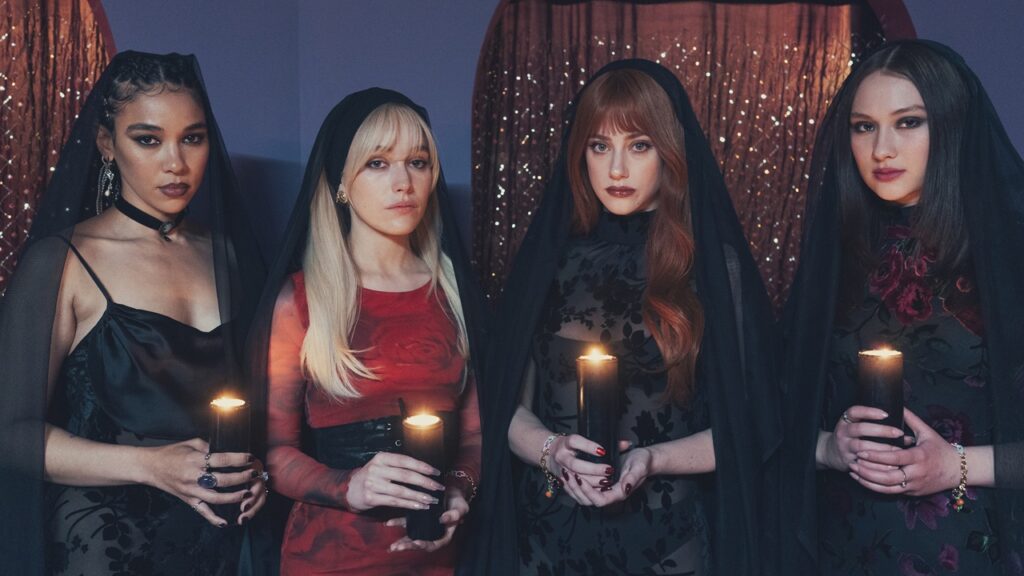
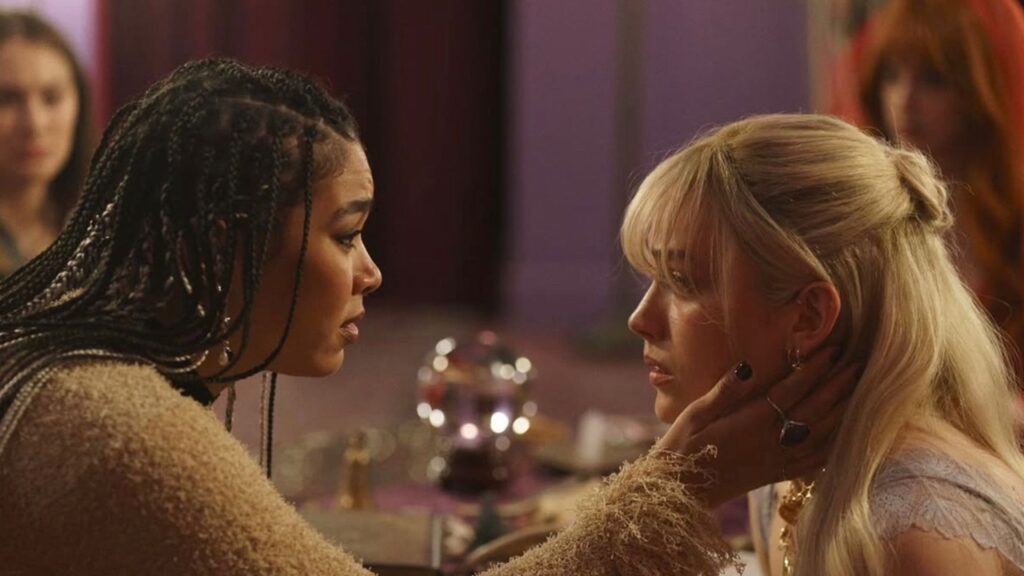
Expanding this trio to a quartet initially seems like a dream come true. Apple especially takes a shine to their newest recruit. However, the frayed edges of the friend group quickly become apparent. Sure, they’re always talking about “women supporting women”. However, Highland Place Mall’s elite employees harbor a great deal of narrowly suppressed hostility towards one another.
Alloway and fellow screenwriter Lily Houghton (the latter adapting her play) execute this premise with heavy doses of dark humor and blunt verbiage. The script and the primary actors are terrific at making Apple, Fig, Cherry, and Pumpkin distinctly different and riveting creations. Their tremendous chemistry is a joy. This ensures intimate sequences like an early incantation ritual or the quartet dancing after hours to a cover of Bryan Adams’ “Heaven” excel.
While overlaps exist in verbiage and pop culture references, Reinhart, Pedretti, Shipp, and Tung bring specificities that give life to their characters. For instance, Apple is always cutting down Cherry with barbs like, “You always have to make yourself the main character, that’s another one of your unattractive qualities”. She also treats everyone besides her three confidantes with enough above-it-all self-satisfaction to make Kuzco blush. It’s all incredibly fun and humorous. Messy and unhinged women are just irresistibly entertaining, especially when written and performed this well.
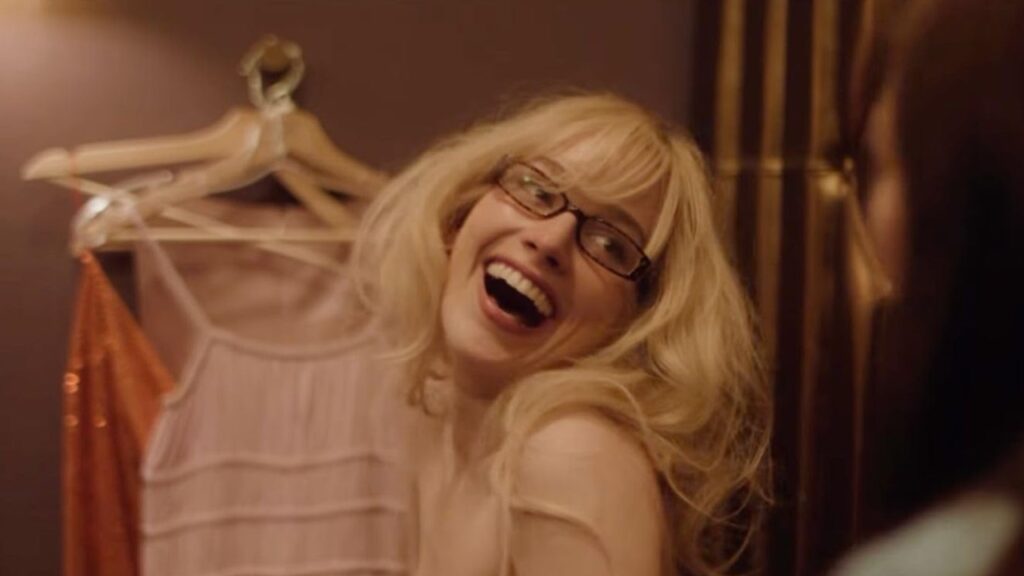
As an uncultured swine who hasn’t seen either The Haunting of Hill House or The Haunting of Bly Manor, Pedretti is my biggest discovery here. For the film’s first half, she delivers terrifically amusing work. She lives up to the legacy of Amanda Seyfried in Mean Girls or Tara Reid in Josie and the Pussycats as the absent-minded blonde girlie in a friend group. Still, her masterful delivery of lines like “we were supposed to go on a whimsical walk after work!” or squealing the word “therapy” as she bounces out of Free Eden ensures her performance is no hollow pastiche of those earlier turns.
However, in the film’s second half, things begin spiraling out of control for the quartet. Chaos and lies start bubbling to the surface unavoidably. Pedretti transfixes as she depicts Cherry’s haunted and pained side. There’s a sequence that focuses on her speaking to a mirror, relaying the daily horrors she endures. It’s a mesmerizingly raw turn that Pedretti handles with such finesse. It’s especially impressive how this scene evokes her earlier performance while uncovering a largely concealed corner of her.
The film itself, which, like Texas, contains multitudes, mirrors her performance. Of course a movie featuring Apple “complimenting” a potential customer by saying “Is there sand in your ass crack? Because you’re giving beach” would have more unhinged tricks up its sleeve. In addition to both sides being wickedly entertaining, the hysterical dark comedy makes Forbidden Fruits’ tonal shift go down smoothly.
But it isn’t just the nuanced tone or constant serving of memorably ribald dialogue that deserves major kudos. Costume design Sarah Millman absolutely ate—and left nary a crumb afterward—with the film’s outfits. In the very first scene, Apple, Cherry, and Fig strut over to the food court for lunch, decked out in incredibly distinctive, fun looks. They foreshadow the barrage of iconic attire to come. Cherry especially gets incredible garb, like a black dress with heart-shaped holes over her navel and chest and a lavish strawberry-covered dress for a fitting room sexual rendezvous. It’s only fitting that these upscale clothing store employees would wear such gloriously creative outfits.
Alloway’s filmmaking demonstrates dedicated assuredness and unabashed showmanship. Nonchalant weirdness, such as Fig, Cherry, and Apple taking off their panties while explaining an important witch ritual, materializes with confident aplomb. Vibrant colors and richly detailed performances abound, all rooted in maximalist femme aesthetics punctuated with dark undercurrents.
Of course, not everything in Forbidden Fruits is as ripe as the costumes, punchlines, or lead performances. The film’s creative reach sometimes distractingly exceeds its budgetary grasp. Most notably, an exterior shot of Fig waving goodbye to a just-off-screen ambulance in the third act too closely evokes Joe Lo Truglio’s reaction to an unseen riverside rescue in Wet Hot American Summer. The act also struggles to move the characters into place. Cherry, especially, seems to pop in and out whenever the plot dictates.
After most of the film thriving on witchy melodrama and ribald barbs, the finale sometimes feels too mechanical in its narrative impulses. Even here, intimate camerawork allows Reinhart to really shine in Apple’s most emotionally raw sequence. Plus, those great darkly comic lines keep coming.
Texas culture is so fascinating—despite the state’s lame-brained politicians—because of its contradictions. Dallas locales like the Texas Theatre and The Wild Detectives keep one foot firmly in the honky-tonk past while clearly embracing the present. Well-worn restaurant staples deliver incredibly cutting-edge cuisine. Forbidden Fruits riotously embodies that legacy. It’s a fitting achievement for a movie about a “girl power” friend group that’s rife with social toxicity. Alloway’s feature-length directorial debut impressively nestles so much humanity into characters who could’ve been forgettable caricatures. Forbidden Fruits slays, packing as much fun and quotable lines into its runtime as a Texan’s delivery of “bless your heart” is stuffed with judgment.
Forbidden Fruits is now playing in theaters everywhere.