Read also:
How to Watch FX Live Without CableHow To Watch AMC Without CableHow to Watch ABC Without CableHow to Watch Paramount Network Without CableAfter helming a pair of quiet indies (Columbus and After Yang) focused on meditative conversations and complicated connections between people, director Kogonada leaps into the major studio cinema game. The springboard is A Big Bold Beautiful Journey, a romantic drama channeling big Eternal Sunshine of the Spotless Mind/Defending Your Life energy. Kogonada’s latest saga begins with a disheveled David (After Yang leading man Colin Farrell) leaving for a wedding. On the phone with his parents, he reassures them he’s fine being alone. To that, his father reminds his son of the importance of “being open” to life’s possibilities.
David only reaches the wedding after procuring an automobile from two peculiar car rental personnel (Phoebe Waller-Bridge and Kevin Kline). After the vows, the quiet romantic David encounters Sarah (Margot Robbie), a woman who refuses to connect with people. They chat, joke about how silly it’d be if they danced together, and then part ways. That should be the end of the story…except the GPS in David’s care implores him to go “on a big beautiful journey” with Sarah. This involves the pair traveling to various disembodied doors providing entryways to key moments from their past. Mayhaps these visits to yesteryear can heal some wounds in the present.
Most admirable in screenwriter Seth Reiss and Kogonada’s creative vision for Beautiful Journey (beyond providing an R-rated romantic drama for theaters in 2025) is its old-school and colorful visual sensibilities. Key crew members like cinematographer Benjamin Loeb, production designer Katie Byrin, and art director Mary Florence Brown (among others) work overtime, imbuing vibrant colors into even the story’s dingiest corners. A seedy alleyway can still house a bright green sign. All umbrellas appear adorned in vivid hues. Even cafés housing gut-wrenching break-ups aren’t devoid of more cheerful tinges.
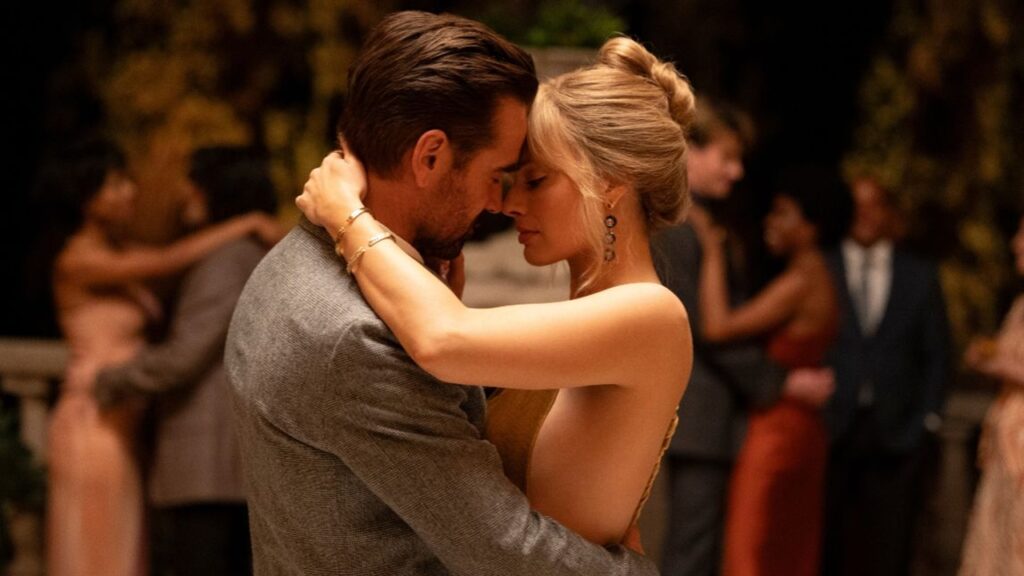
At times, Kogonada and Loeb primarily channel Jacques Demy and Powell & Pressburger in Beautiful Journey’s color palette. One specific shot of Sarah and David putting away their umbrellas outside a Burger King as the rain dissipates features lighting and orange-tinted colors, especially evoking a memorable Matter of Life and Death scene. Unfortunately, this new feature from the Columbus auteur is nowhere near as good as a Powell & Pressburger or Demy joint. That primarily comes down to Reiss, whose writing too often radiates self-consciousness. Romantic dramas, like musicals, simply can’t survive snarkiness.
Throughout A Big Bold Beautiful Journey, there’s often too much exposition or self-referential “isn’t this weird?” quips. This undercuts attempts at a more melancholy atmosphere. Poor Margot Robbie suffers most of all. She’s handed truly atrocious “he’s right behind me, isn’t he?”-style dialogue punctuating “weird” Beautiful Journey events. These memorable lines include “Okay, what kind of a break is this?” and “Did that just happen?”. Hiring a performer of Robbie’s caliber to deliver dialogue seemingly tailor-made for Ryan Reynolds is a travesty on par with hiring Tony Leung to recite The Big Bang Theory “punchlines”.
Beyond wasting talent, this writing leitmotif forces distance between audiences and the film’s world. The snarky asides and hastily ADR’d expository lines in wide shots are hand-crafted to charm cynical viewers rather than lend insight into characters. Visuals and physical performances can’t speak for themselves. The CinemaSins crowd must be appeased. With these recurring pokes into moviegoers’ rib cages, full immersion into Journey’s story proves tricky. This saga needs the energy of teenage David and a willingness to “wear [its] heart on [its] sleeve.” Instead, it eschews the confidence of Powell & Pressburger for sarcastic retorts.
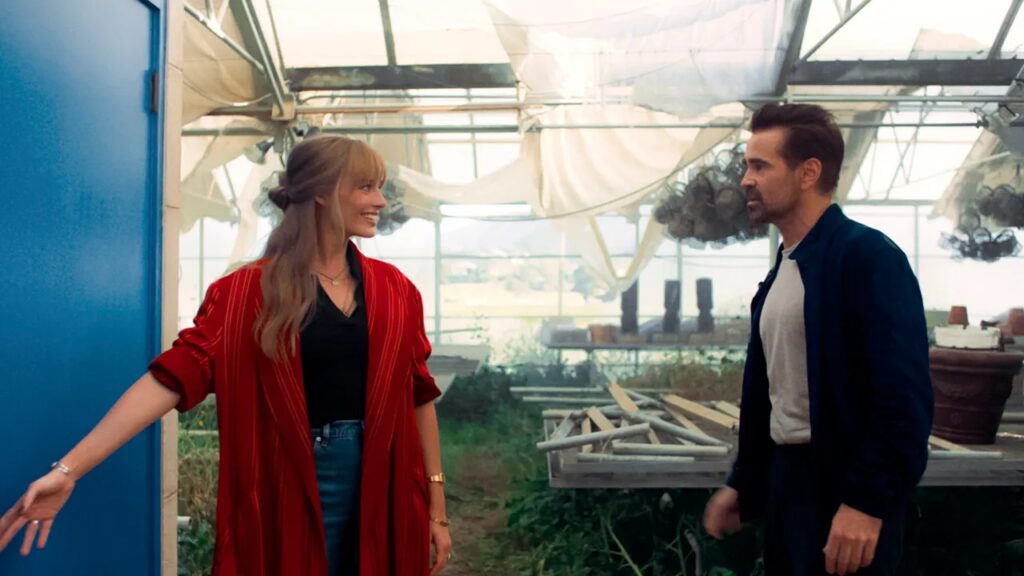
Odd visual details (like a tight close-up ruined over it by blatant green screen) and Sarah’s more generically defined world also keep the project from reaching its full potential. The latter problem is especially irksome. Audiences learn that this woman loves going to the museum for nostalgic purposes, misses her deceased mom, and is “bad with men.”
But who are her friends? What were her career goals? Where are her dream vacation spots? Even her passion for musical theater only exists because it intersects with David’s teenage life. A romantic drama two-hander fizzles when half the duo isn’t fully defined. That and the general lack of memorable side characters ensure there’s a ceiling for Journey’s emotional prowess. This deficiency in detailed humanity means everything on-screen can only be so affecting.
Despite those glaring shortcomings, A Big Bold Beautiful Journey still rustles up certain tearjerker charms. When the dialogue takes the backseat, Kogonada more freely channels his Columbus and After Yang strengths. Now the focus is on quiet depictions of people’s interior worlds rather than self-referential quips. A silent moment of David racing his fingers across a toy car on his childhood bedstand, for instance, is deeply moving.
Without a single word or music cue, Farrell and the intimate camerawork vividly communicate David realizing how much he missed a texture he hadn’t thought about in years. Also affecting is a similar image of Sarah tracing her finger around a missing figure’s space on her family’s house number. Kogonada skillfully handles these quiet depictions of the past and present colliding. An outstanding single scene showcase for Hamish Linklater, meanwhile, similarly thrives on sparseness. The raw vulnerability in his performance is a welcome reprieve from Big Bold Beautiful Journey’s heavy emphasis on self-awareness.
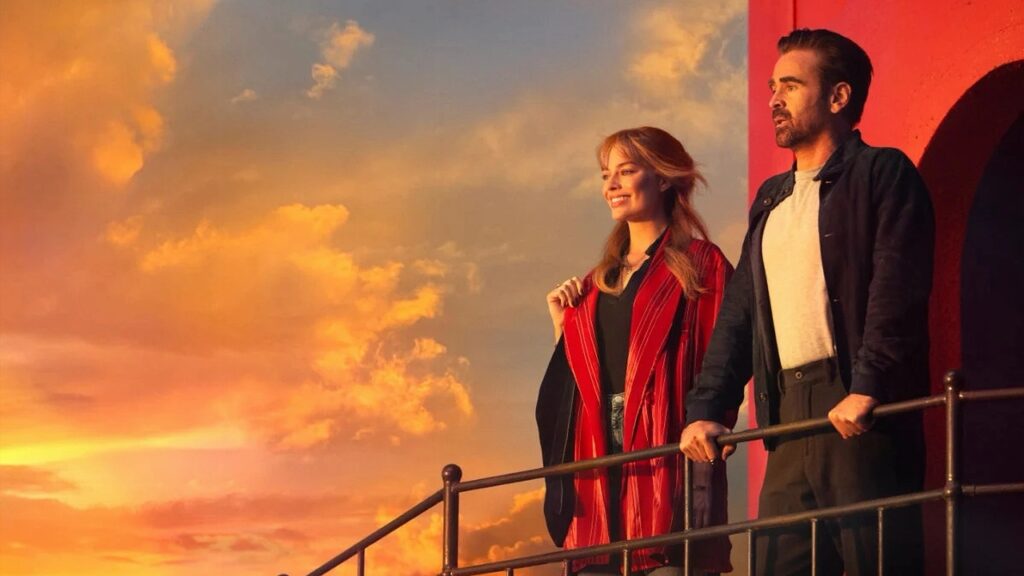
Sporadic bolder visual impulses also impress, like a recurring “home base” for Sarah and David resembling a black box theatre in purgatory. Loeb’s blocking, meanwhile, is always remarkable, especially in the first act when he’s juggling lots of wedding crowds. Plus, A Big, Bold, Beautiful Journey still has Farrell and Robbie. These two talented individuals can shine even in flawed confines.
Farrell operating in handsome DILF romantic mode isn’t as fun as his unhinged Killing of a Sacred Deer/The Banshees of Inisherin/The Batman exploits, granted. However, he’s still got the effortless conviction to make David’s romantic outbursts believable. Robbie, when not saddled with Journey’s worst dialogue, remains as magnetic as ever. A mid-movie scene where she stares straight into the camera and recounts a childhood story involving mashed potatoes and Big especially epitomizes how compelling she is. Even devoid of props, a detailed backdrop, or other actors to bounce off of, Robbie delivers.
Unfortunately, she and Farrell are headlining a movie with an intriguingly unorthodox central conceit and a deeply conventional execution. Titles like Eternal Sunshine of the Spotless Mind and The Life of Chuck leaned on the inexplicable to echo existence’s unpredictability. A Big Bold Beautiful Journey, meanwhile, excessively holds the audience’s hand and delivers generically defined characters. Thus, this voyage across time’s full potential remains untapped. “Be open” isn’t bad advice. However, moviegoers who aren’t die-hard romantic cinema fans should apply it to “being open” to Kogonada’s first two superior movies.
A Big Bold Beautiful Journey makes a play for your heart only in theaters starting September 19.