Read also:
How to Watch FX Live Without CableHow To Watch AMC Without CableHow to Watch ABC Without CableHow to Watch Paramount Network Without CableNote: this film was watched as part of the 32nd annual Austin Film Festival
It takes a freak to properly skewer freaky societal norms. Who better for such a job than exceedingly unorthodox filmmaker Park Chan-wook? Like fellow sicko auteurs Paul Verhoeven and Boots Riley, Chan-wook’s unhinged works comment on the depraved world lurking outside movie theaters. In adapting the 1997 Donald Westlake book The Ax, Chan-wook’s No Other Choice zeroes in on the modern job landscape. It’s a bloodbath out there trying to secure stable income and employment. The genius behind Oldboy and The Handmaiden just literalizes those grisly realities here.
Yoo Man-soo (Lee Byung-hun) needs money. His comfortable life with his wife, Lee Mi-ri (Son Ye-jin), and two kids has come crumbling down after getting laid off from his paper factory job. Things get so rough that plans begin to form for the family to move away from their current home (which is also Man-soo’s childhood domicile) and give away their two canines.
All these new part time gigs aren’t cutting it. Yoo Man-soo needs more stable income. Trouble is, there’s few fresh jobs around for folks in the paper industry. Desperate times call for desperate measures. Soon, Man-soo is formulating a plan to make sure he’s the only viable candidate around for any high-paying jobs at the Paper Moon company. Said scheme involves murdering the other applicants. Class solidarity has gone out the window for this man. Instead, visions of bloodshed and a replenished bank account dominate his mind.

Revisiting Oldboy on the big screen two years ago, I was struck by the effective physical comedy nestled into a police station-set opening sequence. Park Chan-wook’s works are often harrowing, but they can also house memorably rib-tickling moments. Much like Jar-Jar Binks in the Star Wars, No Other Choice is a “funnier [film] than we’ve had before” in the man’s filmography. Comedic flourishes of other films become more prominent in highlighting modern capitalism’s innate absurdity. You have to laugh otherwise you’d cry over this status quo.
The script’s (credited to Chan-wook, Don McKellar, Lee Kyoung-mi, and Lee Ja-hye) tension and comedy come from the same place. Yoo Man-soo’s really not being good at this whole “killing” thing. He’s a deeply flawed, quietly deranged human being whose plans crumble thanks to unexpectedly loud music or impromptu snake bites. No Other Choice’s ingenious thrills often emanate from how his clumsiness and inexperience create unexpected new narrative detours. It’s enthralling watching all the chaos build upon itself.
This element reflects the pervasive sense of vulnerable humanity coursing through all of No Other Choice’s characters. Gu Bummo (Lee Sung-min), a target of Man-soo, and his wife Lee A-ra (Yeom Hye-ran), for instance, have a very messy, jagged dynamic. Not even the prospect of a Bummo securing a new job saves their romance. After all, this guy’s merely gone from lounging around the house to always checking his phone for employment application updates. Insecurity and longing for stability permeates all of these souls yet they’re all stuck in their own bubbles. This reality informs sublime dark comedy in No Other Choice, but also a potent tragic core. A capitalism-informed hierarchy transforms potential allies into adversaries.
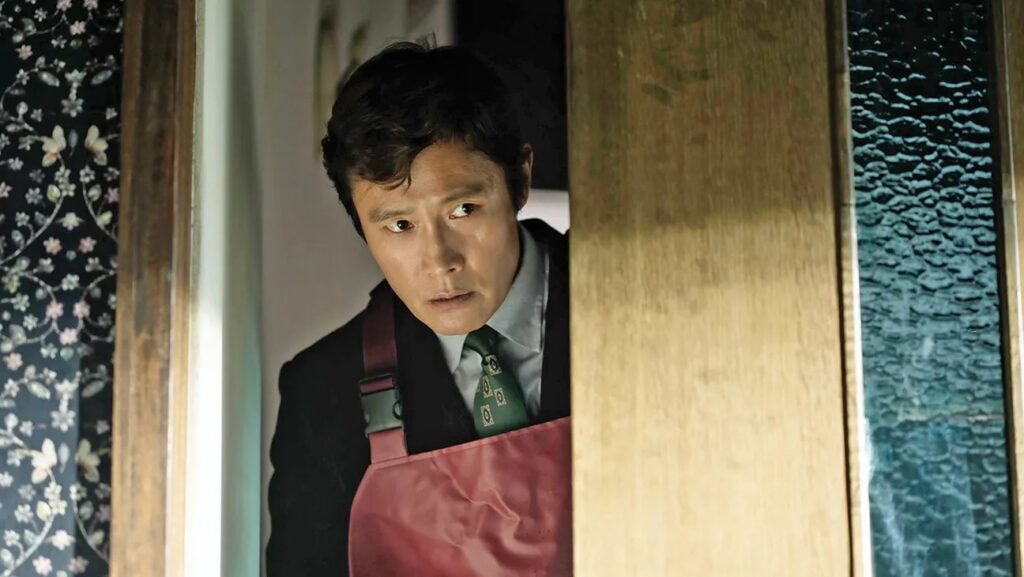
The film’s primary autumn setting accentuates those bittersweet impulses. Orange and brown leaves descend around Yoo Man-soo and other characters grappling with change and their smallness in the world. It’s a visual detail working wonders for No Other Choice’s tone and lends a pleasing color palette to the proceedings. A wide shot of Man-soo frantically running away from a violent adversary especially benefits from this background element. The contrast between the tranquil, subtly mournful backdrops and this man sweatily zipping away like Dr. Zoidberg is highly amusing.
That set piece encapsulates how No Other Choice is a fantastic showcase for Lee Byung-hun’s acting chops. Like so many handsome leading men, it turns out Byung-hun’s adept playing messy and chaotic. His extensive experience as a dramatist means he plays Man-soo navigating domestic strife (particularly with his character’s wife) with appropriate heft. However, he’s also a riot depicting this man at his most disheveled or with punctured confidence. Whether tasked with inhabiting a buffoon, a chilling killer, or an everyman, Lee Byung-hun soars.
He and the rest of the No Other Choice cast and crew members are excitingly on Park Chan-wook’s very specific, intense wavelength. This allows creative precision and audacity to permeate every corner of the movie, including the sound design. Mixers, editors, and supervisors in this department, like Eunjung Kim and Kim Suk-won, conjure up a bevy of memorable toe-curling noises. Gardening-fixated Man-soo’s unsettling clatter especially bring out the best in these artists. Crackling of plants getting chopped or clanking of tools convey this world’s intensity even before guns are fired or bodies get buried.
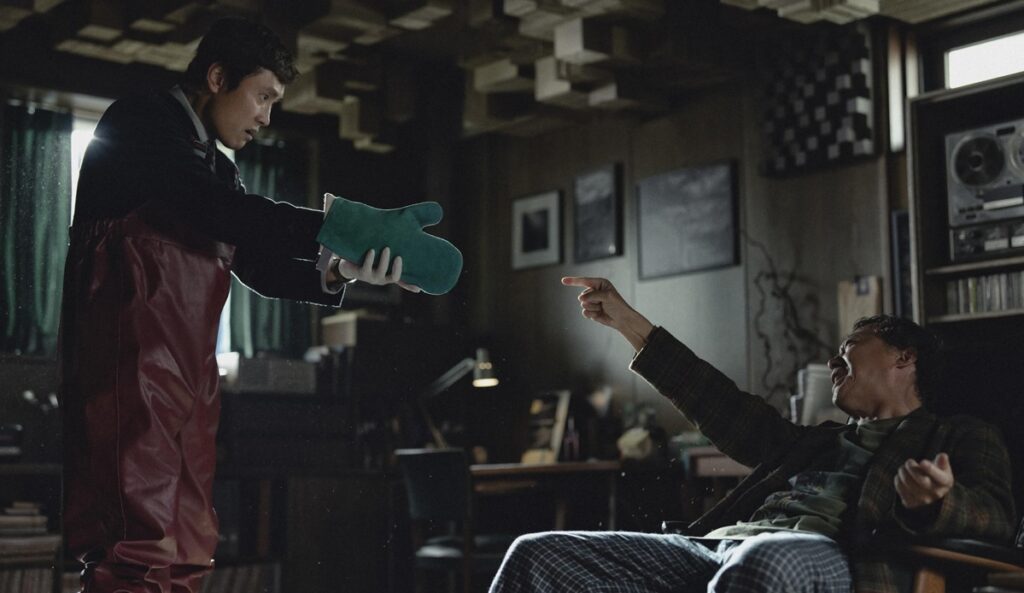
All these elements coalesce into an exquisite dark comedy concoction wielding a fire in its belly. Though No Other Choice hails from a late 90s novel (the film itself transpires in 2025), you can feel frustrations against modern-day employment woes informing every corner of this tapestry. Just look at an early, unblinking wide shot of Man-soo unwillingly taking off his work clothes when he loses a department store gig. Even from a distance, his anguish is palpable. However, everyone around him is just going about their business. The sight of a distressed man, overwhelmed by financial anxiety, reduced to his undergarments isn’t even worth glancing at. It’s that commonplace in the global capitalist status quo.
No Other Choice’s bleak yuks (like Man-soo attempting a dramatic monologue before he kills a target only for loud music to derail him) are already hysterical in surface-level terms. These gags and Man-soo’s descent into cruelty against others (including his wife) in his economic class, though, flourish given the tangible rage against modern reality. As Maggie Simpson once said, “this is indeed a disturbing universe.” With No Other Choice, Park Chan-wook proves again he’s perfectly equipped to captivatingly confront existence’s freakiest corners.
No Other Choice begins its limited North American theatrical run on December 25, 2025 and expands into theaters everywhere in January 2026.