Read also:
How to Watch FX Live Without CableHow To Watch AMC Without CableHow to Watch ABC Without CableHow to Watch Paramount Network Without CableI don’t say this sort of thing often. In fact, this might be the first time I’ve ever said anything like this. But, here we go. The Madison would be better off if it had nothing to do with New York City. I know, I know, I’m as stunned as you. But for the sake of the show, steering clear of the Greatest City on Earth would’ve improved things for everyone.
Ok, out of context, that probably doesn’t make much sense. Give me a second to fill in some blanks here.
Preston Clyburn (Kurt Russell) lives a double life of sorts. Most of the year, he’s a high-finance guy, a real master-of-the-universe type with the bank accounts to match. However, out in Montana, there’s another Preston. He has a cabin with limited plumbing. He spends his days fishing with his totally disinterested-in-the-rat-race brother, Paul (Matthew Fox). Given he’s a real man ™, he loves Montana and resents his mostly New York life. He does acknowledge his money helps him go to beautiful places only old retired suckers can otherwise afford, but that is the closest to a compliment he has for his most-of-the-year residence.
 Paramount+) Michelle Pfeiffer Kurt Russell" class="wp-image-56560"/>
(Sidenote: the scene where Russell discusses watching retirees on vacation is made accidentally hilarious by his own age. Clearly, viewers are supposed to round his age down. Nonetheless, a 75-year-old talking trash about the nerve of people his own age having fun is an odd note.)
His wife, Stacy (Michelle Pfeiffer), on the other hand, has refused to go to Montana. But don’t worry, she hates the City, too. When she comments to a friend that all their circle does is talk about getting out of the Big Apple, it doesn’t exactly sound like a recrimination. She’s not saying, “God, we whine a lot for being successful, wealthy, and having everything we could possibly ask for, don’t we?”. Instead, it is more of a “isn’t it about time we do something about it? Get the hell out of Dodge and only stop to kick the dust of this cursed realm off our boots.”
To be fair to her, The Madison does start with her daughter Paige (Elle Chapman) encountering violence. The youngest Cyburn gets punched in the head and her bags stolen in broad daylight. Partially based on a weird string of random run-by punchings back in 2024—there was another random one just last month as well—Sheridan and co. present it less as an odd bit of urban phenomenon and more as a fact of life in the Big City. To make the incident all the uglier—and less reflective of reality—Paige refuses to tell officers the race of her attacker. The Madison nudges the audience in the ribs to make sure viewers get it. She knows it. She just won’t say it. Presumably because political correctness. You know how those rich assault victims do wring their hands about the racial implications of reporting their attacker.
 Paramount+) Patrick J Adams Elle Chapman" class="wp-image-56561"/>
But don’t conclude that the creative team means to imply that urban softness is an affliction of women alone. No, the series makes sure to introduce us to Russell (Patrick J. Adams), Paige’s husband. When his wife isn’t scolding him for feeling unnerved about her attack—it’s not like it happened to him—she’s dismissing him from moments of family togetherness to fetch pizza or ice cream. His emotions and willingness to run these errands suggest he is a city boy and thus, fundamentally, not the kind of real man Paul represents and Preston mostly embodies.
So what’s the conflict? Sounds like the whole thing sucks, right? Therein lies the trick of The Madison. Because while it is a delivery system for some of the most boring and reductive stereotypes of urban centers and their denizens, it is also a shockingly insightful portrait of a family in grief.
 Paramount+) Ben Schnetzer" class="wp-image-56558"/>
When events force everyone to move out to the Montana property to gather, process (though they’d NEVER use that word), and reset, The Madison becomes something else entirely. Fronted by a magnetic and often surprisingly intense performance by Pfeiffer, this might be the most insightful work about people Sheridan has created. As everyone struggles with the wait of an unexpected tragedy, the show is arresting. The ugly laziness of its urban contempt disappears as the audience witnesses the utter shattering impact of grief.
Tragedy haunts much of Sheridan’s work. As his “universe” has expanded, that sometimes becomes easy to forget. When a person is generating the GDP of a small country with the number of shows he’s overseeing at once, that ubiquity tends to become the focus. However, his best works—most of which, admittedly, first appeared on the big screen—are animated by violence, tragedy, regret, and grief. For all his dismissiveness of squishiness, Sheridan—and his collaborators—seems to recognize mourning as a “worthy” state of emotion. Russell might be ridiculous for fretting about his wife’s mugging. When the cards are really down, though, emotional pain is noble and righteous.
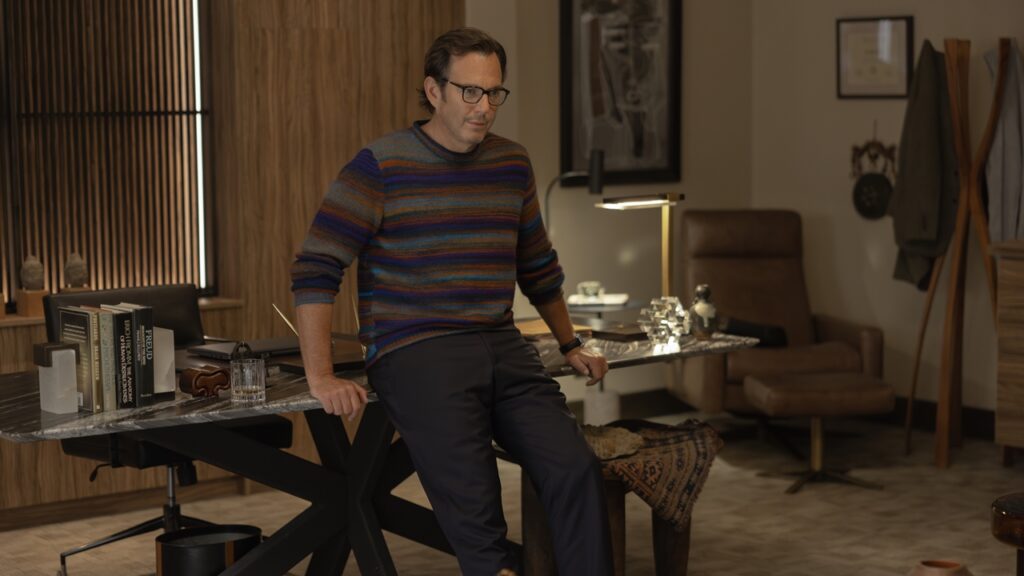 Paramount+) Will Arnett" class="wp-image-56562"/>
Christina Alexandra Voros, pulling double duty as series director and cinematographer, also comes to life when the show focuses on tragedy and its aftermath. Her work in NYC isn’t without style, to be clear. How she films Paige’s assault is especially interesting. However, photographing pain—and the scenery of Montana—seems to give her a bigger charge. There is a beauty in these sections, even if you’re a city boy who remains largely unimpressed with the scenery of very large and sparsely populated American spaces.
So how do you review a thing that excels so much at one aspect while coughing up the ball so hard in another? For this critic, it can only be partial credit. In many ways, the excellence of the grief-fueled portions of the series only further illustrates how bad the city parts are. If you are capable of this kind of insight and this level of empathy, it becomes a choice not to apply it to all your characters and locations. And that’s an ugly choice to make.
The Madison makes home, home, home on the range of Paramount+ starting March 14.