Read also:
How to Watch FX Live Without CableHow To Watch AMC Without CableHow to Watch ABC Without CableHow to Watch Paramount Network Without CableTake this by way of a public service announcement. There are moments in DTF St. Louis’s first episode that are utterly suffocating. The opener is frequently so quiet, soft, and still. Viewers can feel the walls closing in on them as much as, if not more than, the characters. It is as though series creator and director Steven Conrad guides the audience into a nonspecific middle-class, middle-aged inertia. Then, he strands them. While the three subsequent episodes better define the challenges faced by weatherman Clark (Jason Bateman), his new friend ASL interpreter Floyd (David Harbour), and their families before Floyd’s mysterious death, at first, there is just the feeling. Over and apart from Floyd’s fate, one can’t shake the feeling that nothing is irrevocably broken. And yet, everything is well and truly fucked.
Told non-linearly, we quickly learn the players. Clark and Floyd met during one of those awful “it’s a dangerous storm, so I am standing in it!” broadcasts. Clark was the reporter. Floyd, his interpreter. Both at points in their marriage where passions have cooled. Clark wakes up every morning at 4 am. That means he’s in bed and asleep long before his kids and wife (Wynn Everett). Not great for spousal intimacy. Floyd has gained weight and sometimes cries while reading Batman comics. Compounding things, Carol (Linda Cardellini), Floyd’s wife, has taken to wearing baseball umpire gear—her side hustle—frequently. It is a look that kills her hubby’s sex drive in its tracks.
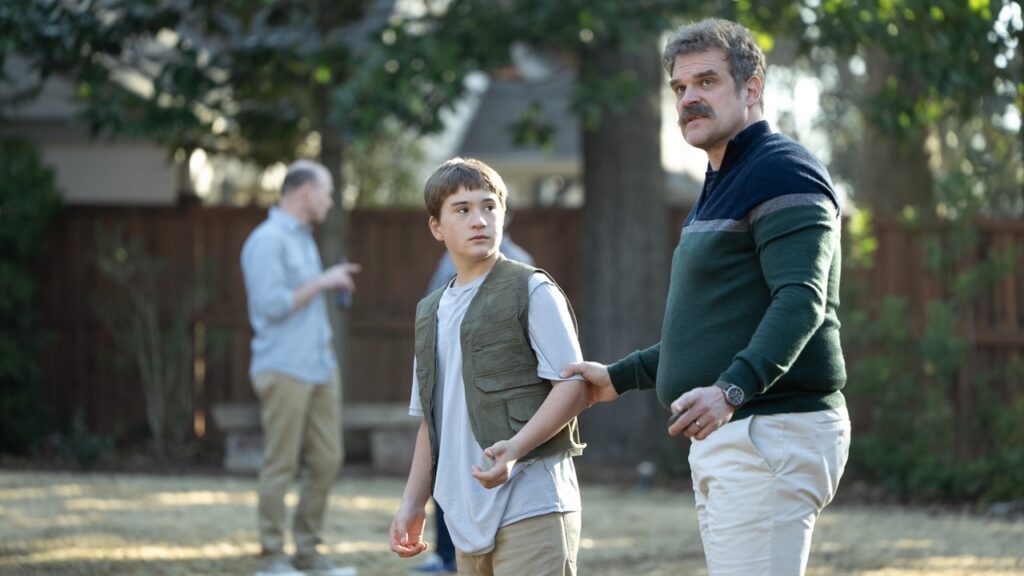
Clark, while waiting to go on camera, overhears a fluff piece on the titular app, DTF. Before long, he’s pitching it to Floyd as a solution to their problems, an adventure they can embark on together. However, things quickly go awry. It isn’t long before someone discovers Floyd’s dead body in the bathroom of a closed-for-the-season town pool.
As the season progresses, it becomes increasingly clear that Conrad has created a suburban noir, unfolding in slow motion. The “for marrieds looking for spice” app is set dressing, a red herring. DTF St. Louis is not especially concerned with those down to fuck, the mainstreaming of new sexual norms like polyamory, or the return of swinging to public consciousness. That’s just the setup for a tale as old as time: lust, betrayal, and regret.
Despite that and the PSA that kicked off this review, DTF St. Louis is not a nonstop bleak look into stagnation and heartbreak. Richard Jenkins as Detective Homer wrings every drop of humor out of simple turns of phrase. For example, his insistence on using “frenched” as a verb. And yet, there’s a strange undercurrent of legitimate empathy to him. When it appears one character is living a double life, Jenkins’ sad declaration that a person should be able to be who they are wherever they are carries true emotional heft. His counterpart on the investigation, Jodie Plumb (Joy Sunday, proving a strong scene partner), makes him look foolish at every turn. And yet, Homer never collapses into cartoonishness.
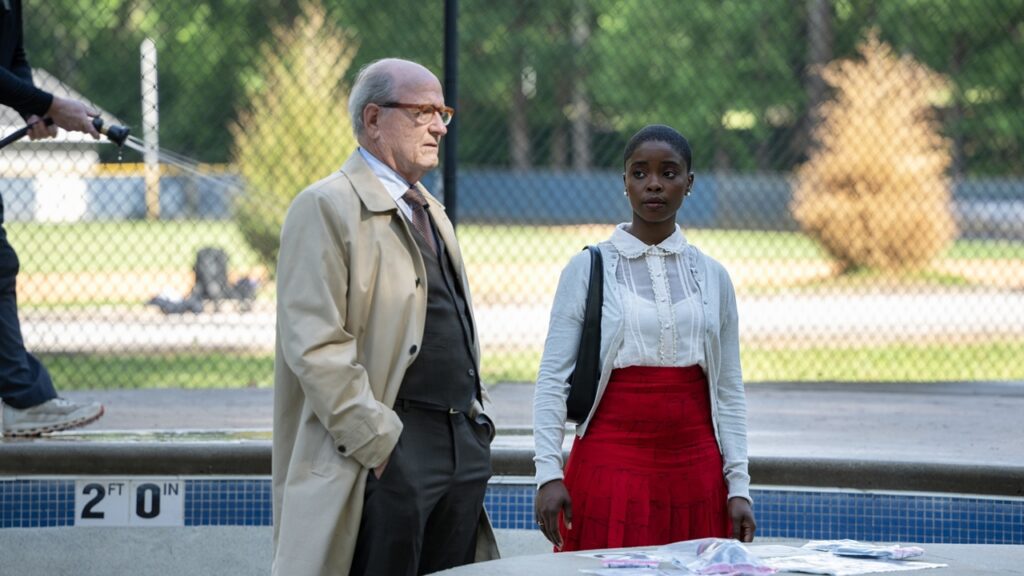
In general, the show makes great hay of the repetition of certain business or product names, much like Homer’s dedication to “frenching.” It rarely scores a laugh, mostly just chuckles and smirks, but that also seems to be the series’ goal. Much like the show itself is quiet and constricted, it never pushes for its humor to scream to the surface. It’s just a constant undercurrent of the ludicrousness of life in the middle—middle class, middle-aged, middle of the country in a mid-sized town.
In the same way that Detective Homer is a figure of folly that never collapses into silliness, Harbour gives Floyd remarkable dimensionality. Initially seeming like a sad sack who’s entirely too quick to share news of a certain genital defect he suffers from, Floyd proves resistant to that flat characterization. As the story reveals complications to him—most wonderfully through his relationship to his stepson Richard (Arlan Ruf)—Floyd becomes a genuinely decent man. He’s arguably too kind and soft-hearted for the world he inhabited. Harbour brings all this to life despite playing Floyd at basically the same level throughout. By having the confidence to not reach for big moments but instead trust the plot sequence, it makes the audience as cynical as everyone else who discounts Floyd. We come to realize we, too, were too quick to dismiss him.
Bateman’s role is a bit trickier, but he similarly rises to the occasion. It would’ve been easy for Bateman to fall back on some of the charismatic jerk tricks he’s honed since his comeback. Instead, he uses them only briefly here and always with a kind of half-hearted embarrassment underscoring them. If Floyd is a decent guy made to feel like a loser, Clark is a surface success who knows he’s a loser. Harbour and Bateman’s self-esteem issues make Cardellini’s unapologetic and social dominance-obsessed Carol such an interesting foil. Often a wonderfully warm presence on camera, she has no problem turning hard and brittle while still hinting at some (perhaps false) complexities.
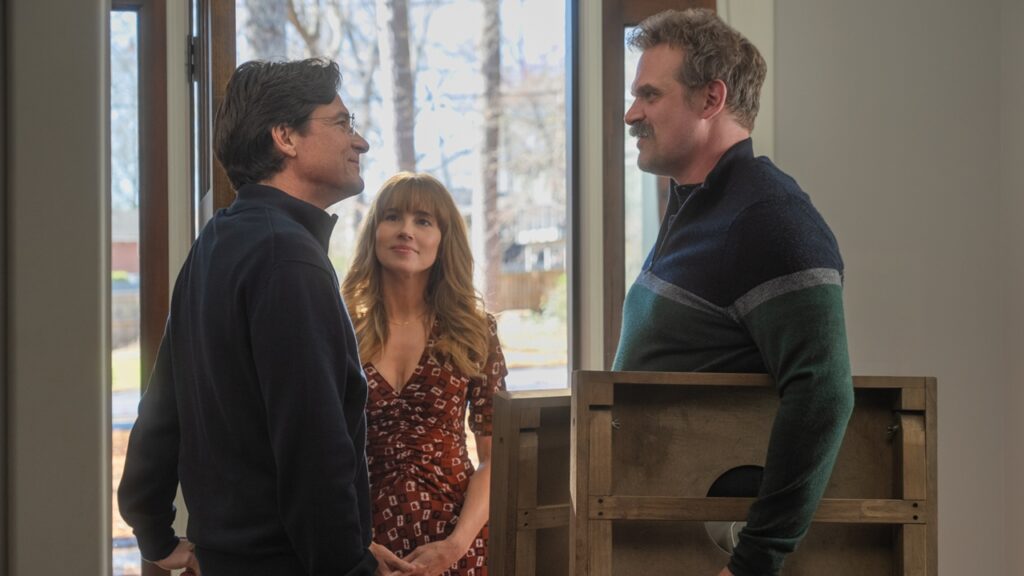
Visually, DTF St. Louis is appropriately desaturated. The “St. Louis area” of the series feels locked in early winter. Deeper colors only arrive periodically, usually attached to almost impossibly sweet memories. Cinematographer James Whitaker repeatedly frames things in layers, with action in the foreground being peered in on by figures in the background, often partially concealed. It serves as confirmation of the character’s inner lives, the fact that they are frequently unable to fulfill Detective Homer’s belief that a person should be who they are, no matter where they find themselves. The slow pacing is mirrored in how long scenes linger on-screen. It heightens the show’s tension and its undeniably melancholy tone.
DTF St. Louis is no comfort watch, frequently reaching for discomfort and depression as its emotional motifs. It’s an addictive watch in spite of, or perhaps because of, its own stifling atmosphere. With three episodes left unscreened, there’s no guarantee Conrad and the creative team won’t lose control of this tightly wound project. At this point, though, the show is equal parts unnerving and powerfully compelling, a feel-bad watch I don’t want to miss.
DTF St. Louis joins the apps starting on March 1 on HBO.