Read also:
How to Watch FX Live Without CableHow To Watch AMC Without CableHow to Watch ABC Without CableHow to Watch Paramount Network Without CableLike so many massive conspiracies, the one at the heart of Down Cemetery Road unravels for the smallest of reasons. A museum conservationist, Sarah Trafford (Ruth Wilson), wants to bring a girl a “Get Well Soon” card in the hospital. Hospital administrators turn her away. However, they don’t just tell her something boilerplate like “She can’t see anyone right now”. This raises Sarah’s (and the audience’s) suspicions. Eight episodes and so much senseless violence follow. It is enough to make one reflect on the utility of just acting like a human once in a while.
But I’m getting ahead of the show a bit.
After what appears to be a tragic accident in her neighborhood, Sarah has the aforementioned bizarre interaction at the hospital. Noticing someone has edited the child, Dinah (Ivy Quoi), out of photos at the scene, Sarah can’t shrug off the strangeness. So she hires Private Investigator Adam Godley (Joe Silvermann) to shake the tree. When something far darker and scarier shakes loose, Adam’s wife and partner Zoë Boehm (Emma Thompson) has no choice but to make the case her own. Before long, she and Sarah are on the run from government bureaucrat Hamza (Adeel Akhtar as another in power, hopelessly corrupted type) and relentless assassin Amps Crane (Fehinti Balogun).
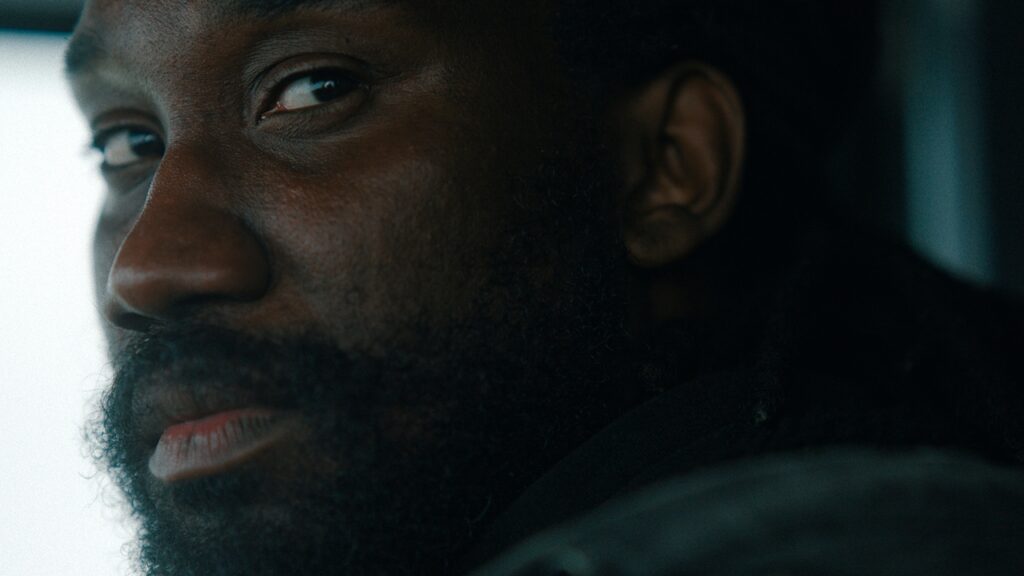
To paraphrase the meme, yes, this Morwenna Banks-created adaptation of a Mick Herron novel escalated quickly.
The early episodes of the eight-installment series are thick with mystery and escalating paranoia and tension. Somewhere around episode three, however, Down Cemetery Road abandons the small-scale entirely. In its place, it embraces massive government conspiracies, embedded clandestine agents, secret weapons trials, and several civilian deaths. And that can be a bit of a problem at times.
What keeps the proceedings on the rails, for the most part, are Wilson and Thompson. The latter, gruff and cynical to the point of misanthropy, feels nicely out of step with much of Thompson’s work. It mixes her gift for barbed humor with an aging action persona she hasn’t much touched on until now. Picture the kind of grit her character shows near the end of Dead of Winter as Zoë’s closest predecessor. Thompson does an excellent job of softening Zoë as the story progresses. She reveals she shares the kind of dogged do-gooder spirit she attributed only to her husband. However, she does so without fundamentally changing the way the character moves through the world. She reveals her layers without losing the thread.
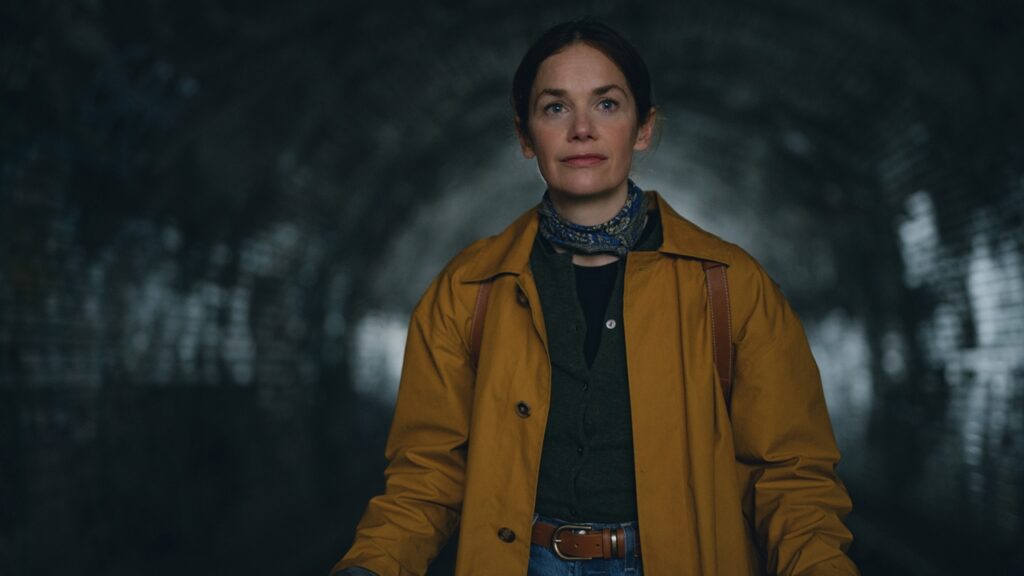
Wilson pulls a similar trick with Sarah, who starts with plenty of desire to help and little working knowledge of how to do so. By the story’s end, she gets tougher without casting off her gentleness and commitment to doing right. It’s an impressive trick on both actors’ part, to guide their characters through big changes while authoring a sort of core essence for each.
Another aspect of Down Cemetery Road that doesn’t suffer as the series grows beyond its breaches is the visual. Whether it is using the tight spaces of a train to build tension or the nearly empty expanses of a UK island to create a sense of inevitability, series director Natalie Bailey and her team of cinematographers deliver. They ensure it doesn’t have the typical flattened streaming “the least we can get away” look. Instead, it is dynamic and engaging, creating a concrete space for the show’s outlandish twists to play in.
Something that doesn’t survive as the conspiracy grows is the show’s early interest in English class and racial politics. The series begins with a bomb detonating in a part of the city populated by artists and other communal living types. Just before that happens, Sarah and her husband are entertaining two couples. One is from their own neighborhood, artsy types who seem eccentric but sweet. The other couple is richer, with a gun-loving (far rarer in the UK than the US) husband, Gerard (Tom Goodman-Hill), who drips with dismissiveness for Sarah and her friends. It is no wonder Sarah’s initial suspicions about Dinah’s disappearance include Gerard and his wife as co-conspirators. However, the class tensions rapidly dissipate even as Gerard continues to pop up like a bad penny.

Similarly, the series is aware that its four men of color are being either forced into violence or utterly ignored by high-ranking white people. However, beyond simply being aware of it, Down Cemetery Road makes little effort to say much about it. It feels much more interested in the gun and knife play than exploring the racial dynamics of who’s asked to make war and how.
This leaves the show as an attractive but shallow piece of work featuring excellent performances by Wilson and Thompson. There are worse ways to wile away your time, for sure. But after such a promising launch, it is disappointing to see the series largely conduct itself as just another based on a novel thriller.
Give Down Cemetery Road your arm, old toad, and see it now on AppleTV.