Read also:
How to Watch FX Live Without CableHow To Watch AMC Without CableHow to Watch ABC Without CableHow to Watch Paramount Network Without CableThere is a certain temptation to compare Project Hail Mary to 2015’s The Martian. Both are, after all, Drew Goddard-penned adaptations of Andy Weir books that feature lone human beings unexpectedly forced to problem-solve on their own after their missions go awry. And the two share DNA to be sure, namely a mixing of hard science, sincerity, and warm humor. Still, there are two separate projects. The books do not exist in some shared universe, nor do the films. Yet, they do share one more very important commonality. Both prove quite entertaining works of science fiction filmmaking.
In the near future, our Sun and many other stars are facing extinction at the hands of a newly discovered microorganism christened “Astrophage”. To prevent Earth’s death from rapidly dropping temperatures, Eva Stratt (Sandra Hüller) leads a massive multinational task force to address the problem. Unexpectedly, they tap middle school teacher Ryland Grace (Ryan Gosling) to help figure out what makes Astrophage tick. A microbiologist in a previous career, he saw himself drummed out of the field for his insistence that water was not necessary for all life. While resistant to Stratt’s invitation, the lure of science and possibly proving himself right all along proves enough to drag Grace into the project.
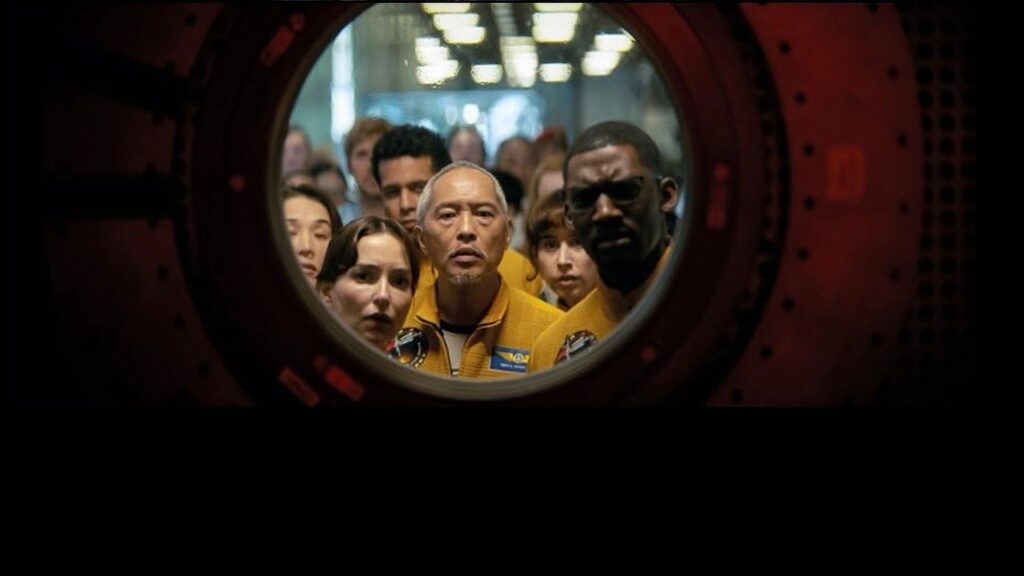
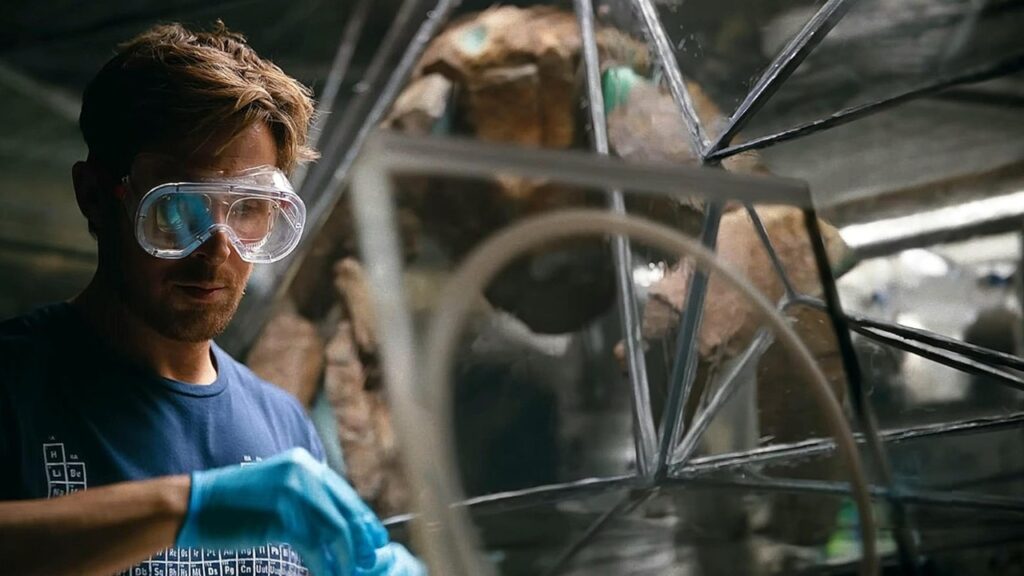
Eventually, despite his protests, he becomes the only living human on a spacecraft bound for Tau Ceti, the one star that seems unaffected by Astrophage. Once there, he finds proof of intelligent life elsewhere in the galaxy in the form of an Eridian also visiting Tau Ceti with the same goal. Grace quickly names Rocky as the alien looks like a collection of rocks roughly in the shape of a spider. He, too, is the only surviving member of his mission, after the rest fell to radiation poisoning due to shortcomings in their own scientific knowledge. Bypassing the usual attempts to dominate through violence or manipulation that frequently mark first-contact stories, the two quickly begin collaborating. Before long, Grace has built a translation machine for their communication, and Rocky has moved in.
Weir’s works, in addition to mixing hard science into easy-to-digest compelling prose, are frequently marked by a generous sense of humanity. In Project Hail Mary, he broadens that to reach into the stars and whole other classes of beings. While math is the universal language, the book and film suggest that empathy, love, and collaboration may be as well. Goddard does well translating these ideas in his script, giving them a zip without diminishing the quiet power they carry.
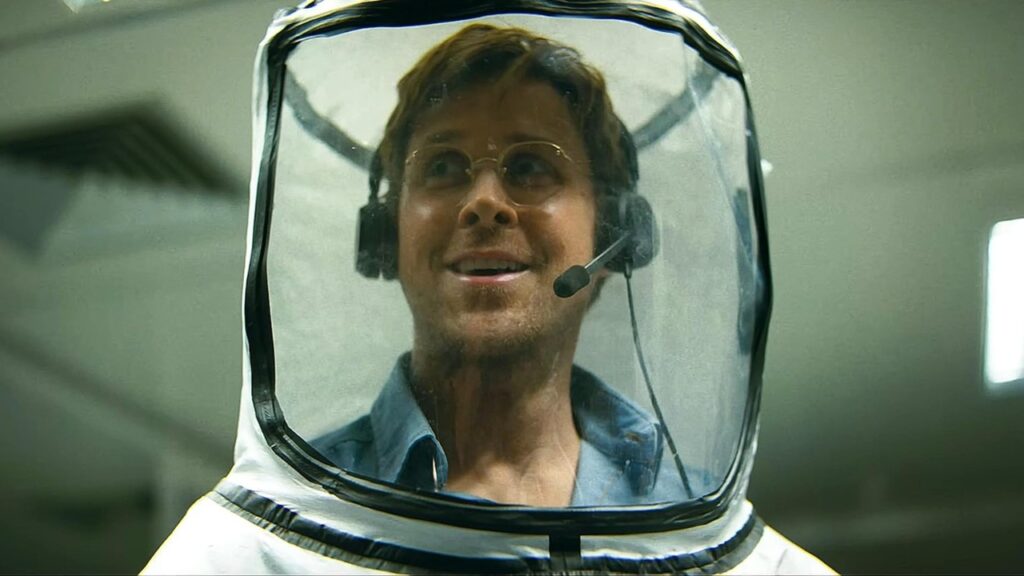
Gosling, similarly, impressively makes Grace a hero who often finds himself compelled to do what’s right despite his inclinations. His tête-à-têtes with Rocky could easily tip over into overly cutesy or annoying. However, the actor and James Ortiz—the voice and lead puppeteer of Rocky—never overplay that hand. The rough edges aren’t especially rough. The growing pains, perhaps, are too easily overcome. Yet, they’re present enough to give the relationship a reasonable sense of friction without demanding conflict. Even if sometimes they do boil down to Rocky dismissing whole aspects of Grace’s interstellar existence as “boring”. There’s an honesty and sweetness to Grace and Rocky’s bond that wouldn’t work without the right script and the right actors.
Directors Phil Lord and Christopher Miller have gained more fame as producers and idea men than for their work behind the lens. Nevertheless, a dozen years after their last completed directing work—2014’s 22 Jump Street—the two demonstrate they still have plenty of skill for the work. Working with cinematographer Greig Fraser, they give the film a subtle sense of scope and beauty. When they go bigger, the moments pay off, such as a massive explosion on Earth that the audience sees before hearing and before the characters feel the impact, or an infrared look at a massive colony of Astrophage pouring into an alien world.

Similarly, when they shrink the scope of their visuals or favor a more impressionistic style, it lands. A scene in the film’s second half, where the team mixes a strobe effect with long periods of black, disorienting close-ups, a sense of motion, and deep black smoke to convey a critical situation, provides the best example of this. By literally and figuratively reducing the range of images available to the audience, the filmmakers nail those viewers in that ship, in that moment, alongside Grace and Rocky. It isn’t especially groundbreaking work; it is just smart, emotionally satisfying, well-executed filmmaking.
Beyond Rocky and Grace, characterization sometimes falls flat. Grace seems to be holding both the realities of the world and his co-workers at arm’s length. That leaves the audience on the proverbial other side of the table as well. While this does well capturing Grace’s own experience working with the international group, it prevents others from showing depth. So as much fun as it is to see Ken Leung or Milana Vayntrub show up, don’t expect them to do much more than that.
Project Hail Mary also often struggles to generate tension. Because of its intermittent flashback structure, we already know how past events resolve themselves. Those in the present fare a touch better. Nonetheless, save for the strobe scene mentioned above, most moments of danger resolve too quickly to register as stressful.
Ultimately, though, that doesn’t feel like where the film’s heart lies. Instead, it’s focused on telling a story of collaboration, friendship, and discovering one’s place in the cosmos. And by that measure, even Rocky must agree that nothing is boring about Project Hail Mary.
Project Hail Mary hits theatres at lightspeed starting March 20.