Read also:
How to Watch FX Live Without CableHow To Watch AMC Without CableHow to Watch ABC Without CableHow to Watch Paramount Network Without CableFor most of his career, Denzel Washington has been an actor of tremendous intensity and control. Lately, he’s been a bit looser. Take, for instance, his turn earlier this year as Macrinus in Gladiator 2. Easily the most interesting person on screen, Washington gave the Roman schemer an oversized louche charisma. Macrinus moves like liquid, feeling every space and moving with easy yet undeniable force. From the outside, it looked like the most fun Washington has had in years.
His take on David King, the record-producing giant of Highest 2 Lowest, isn’t as giggly a turn, but shares a similar sort of wheeling, dealing, won’t stop moving style on Washington’s part. In the final analysis, the character doesn’t coalesce into a logical whole. Still, much like director Spike Lee gave the actor the room to do his thing, audiences will likely be happy to watch one of the greatest actors of the modern era, if not all time, throw punches into the air, engage in miming a murder-suicide in his office, and make two photos of himself engage in conversation.

Whether Highest 2 Lowest took its lead from the actor or Washington took his lead from the film is unclear. Nonetheless, the star and the work are absolutely on the same wavelength. The result is a frequently compelling effort that never clearly says anything beyond, “Enjoy this ride.”
Lee has not had the best of luck with remakes over the course of his career. His take on Oldboy hewed close to the 2003 original while failing to capture the dread or shock. Da Sweet Blood of Jesus, a remake of Ganja & Hess, was more interesting for how Lee raised the money to make it—through Kickstarter—and how he adapted to a relatively small budget. Taking on High and Low, consistently cited as one of Akira Kurosawa’s masterpieces, is a wild swing given that history. In the end, however, it proves Lee’s most successful remake. That’s likely due to him treating the original more like an inspiration than a blueprint. While the two still share much in common, Lee goes further in reinterpreting the material than his two previous remakes. The result is a film with a more personal stamp.
King ruled the charts as a producer and founder of Stackin’ Hits Records for twenty years. Unfortunately, recent music history has been less kind to David King. Now, years after selling his majority share, a rival label is circling, planning to buy the rest of Hits. Their interest shows King he isn’t ready for the lie-down yet. So he builds a plan to buy back his majority share in the company and block the deal. Then, somehow, he’ll make the business about the music again. Despite the Hail Mary of it all, he seems about ready to pull it off after getting his wife, Pam (Ilfenesh Hadera), reluctantly on board. A phone call from a kidnapper claiming to have grabbed the couple’s son, Trey (Aubrey Joseph), demanding 17.5 million to return the King heir alive and well throws a spanner in the works.
When it turns out the kidnapper actually abducted Kyle (Elijah Wright), the son of David’s right-hand man/chauffeur/friend Paul Christopher (Jeffrey Wright, Elijah’s real-life father), the situation changes. David was ready to give up on buying back into Stackin’ Hits for his own son, but is shakier on that idea when it comes to Paul’s child. Making the choice doesn’t make things clearer as the City elevates him as a hero, but the investors pledged to aid him in buying back Hits abandon him and label him a fraud.

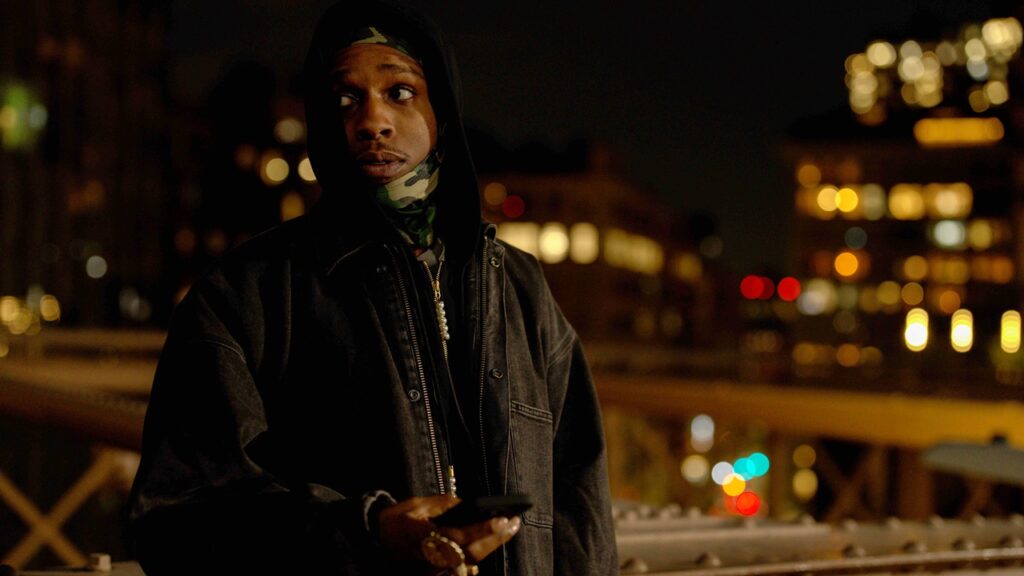
For so much of this film, Lee is in the pocket. The signature “action” sequence spends a significant amount of time on the subway, waiting for things to happen. And yet, it thoroughly jangles the nerves throughout. The way Lee, in collaboration with cinematographer Matthew Libatique and editors Allyson C. Johnson and Barry Alexander Brown, establishes the scene’s rhythm is impressive. Layering those visuals in with the soundtrack—including Howard Drossin’s score, a live version of Eddie Palmieri & The Salsa Orchestra’s “Puerto Rico,” and Nicholas Turturro leading a packed subway car in anti-Red Sox—gives the sequence an unshakeable thrum of tension. When a chase involving cars and multiple mopeds finally ensues, it comes in like a sigh of relief. Other standout scenes include two confrontations between King and a hungry-for-attention rapper, Yung Felon (A$AP Rocky a.k.a. Rakim Mayers), both times with the two separated by thick panes of glass.
Washington’s performance is complemented by another near-perfect turn by Wright. As much fun as it is to watch Washington here—and it is plenty of fun—Wright pulls the stronger turn. He’s quieter and smaller, certainly, but deeper and more human as well. After those two, a range of good, small performances including Mayer, and John Douglas Thompson, LaChanze, and Dean Winters as a trio of NYPD detectives, round out the film.

The film’s shortcomings are present in what it all ultimately means. No movie owes you a neatly spelled out moral—and most should avoid them—but some clarity on what points Lee is trying to make would be appreciated. Glancing musings on AI versus real art don’t shy away from being declarative. Yet, the ambiguity regarding how bad the antagonists are or how virtuous the protagonist is feels less by design and more like not fully considered. I was still more than happy to take the ride, but unlike Lee’s more essential works, Highest 2 Lowest grows thinner with a closer look.
Finally, there is the matter of the film’s 5ish-minute postscript. Essentially a music video, it finds Aiyana-Lee Anderson belting out a piano ballad while David occasionally throws in a few vague but encouraging words. In a film that is a well-earned victory lap for star and director, it feels like a few more strides around the track than necessary. The conclusion isn’t offensive. Anderson has a strong voice. Nevertheless, the scene adds nothing to the story or our understanding of the characters. Placed somewhere earlier, it would feel inessential but not worth much thought. As Highest 2 Lowest’s final word, though, one cannot help but bump on how underwhelming it plays.
After a limited theatrical run, Highest 2 Lowest starts jamming on the ones on AppleTV+ September 5.