Read also:
How to Watch FX Live Without CableHow To Watch AMC Without CableHow to Watch ABC Without CableHow to Watch Paramount Network Without CableI can’t be rational about 1996’s Happy Gilmore. As a teen, its quick-to-anger titular protagonist (Adam Sandler) and the odd world he occupied immediately appealed to me. I had seen better comedies before and better comedies since. Nonetheless, rare was the movie that made me laugh as hard and as often. Rarer is the feature that continued to do so upon several revisits. I am, therefore, the prime audience for Happy Gilmore 2.
However, to paraphrase the cliché, you can’t eagle the same par five twice. I’ve changed, the world has changed, Sandler has changed. So what chance does a sequel nearly 30 years later stand? It turns out, a so-so one.
To get this out of the way right off the bat, Happy Gilmore 2 is not quick-moving, unpredictable, or, indeed, as funny as its predecessor. Like most of us not born Thomas Cruise Mapother IV, 29 years take their toll. Gilmore, the character and the franchise, has lost a step. The movie is too long, too sluggish, and too reliant on cameos to give it juice. It also has a more complex performance by its lead character, a more cohesive tone, and enough gas left in the tank to please fans.
Life after the first film was, indeed, the sort of fairy tale the ending seemingly promised Happy. He keeps winning tournaments and earns the respect of his fellow golfers. Thanks to that, he kisses goodbye to financial worries and marries Virginia (Julie Bowen). Together, they built a life and family. When a freak accident on a course takes Virginia’s life, however, things go wrong in a hurry. Happy can no longer play the sport that filled his bank account and gave his life structure. While never the most emotionally healthy, he finds grief far harder to manage than even his legendary temper. Rather than try, he climbs into a bottle. Soon, he’s lost everything save for the love of his kids and the support of his boarder (Jon Daly).
In this early section, Sandler shows legitimate chops. He balances absurdity—everything he owns is a flask in disguise—with legitimate emotional distress and love for his family. It is the kind of performance I don’t think Sandler could’ve managed while shooting the original in his late 20s. So while his concern about his grandmother (Frances Bay) didn’t feel false back in ’96, there is a depth here that that movie never managed. Reminders throughout the film of those lost, both fictionally (Bowen’s Victoria) and in reality (Carl Weathers, Joe Flaherty, Richard Kiel, Bay), further inform this sense of melancholy.
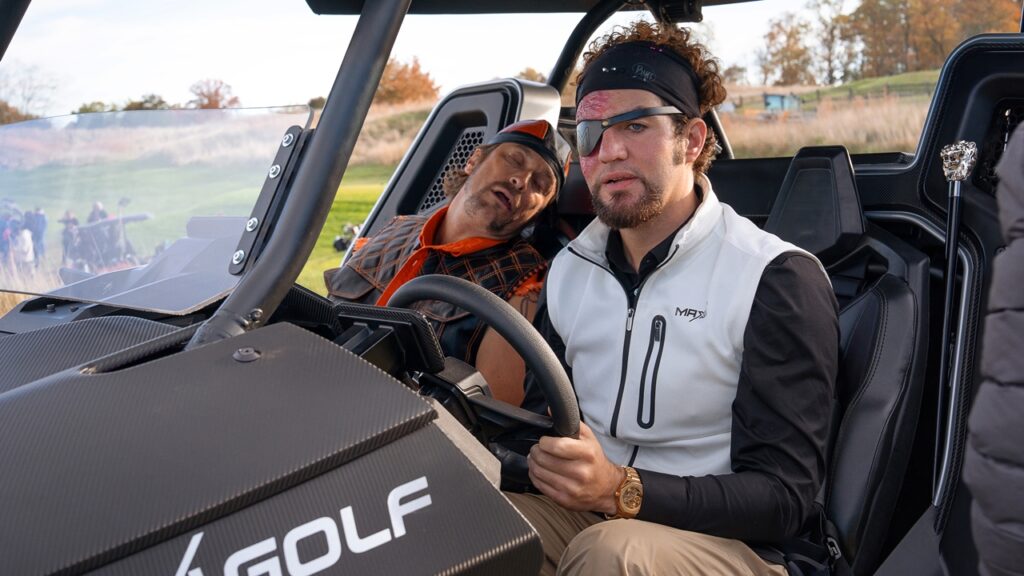
Still, most, if not all, viewers are going into Happy Gilmore 2 for laughs, not an honest look at the emotional perils of middle age. Sandler, perhaps sensing that he’s not as combustible a comedic performer as he once was, stacks the cast with enough actors and familiar faces to keep the energy up. Some work—or rather don’t—about as well as you’d anticipate (most of the golfer cameos).
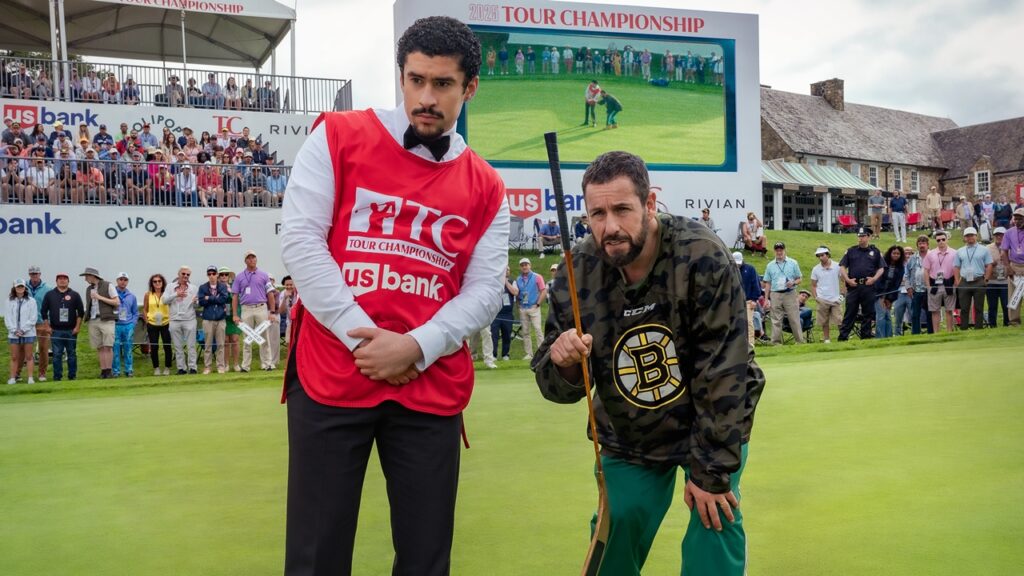
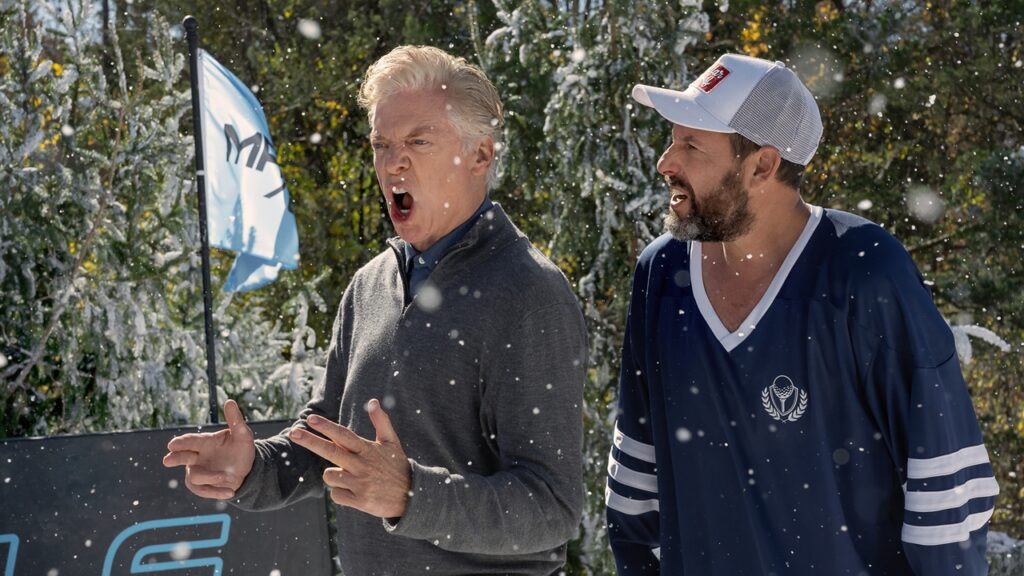
Others prove surprisingly good fits for the film (Scottie Scheffler as himself, Benny Safdie as Frank Manatee, an Energy Drink mogul trying to start a rival golf league). Benito Antonio Martínez Ocasio, aka Bad Bunny, as Happy’s new caddy, Oscar, and Marcello Hernandez as Oscar’s up for anything with the pain tolerance to match cousin, come out looking like MVPs. The best of the returning actors is far and away Christopher McDonald as Happy’s broken rival, Shooter McGavin. Not only is McDonald as funny as ever, the film successfully moves from cartoon to real person in a surprisingly deft way.
Once the plot, which sees Happy trying to claw his way back into competitive golf to send his daughter Vienna (Sunny Sandler) to a Paris dance school and then fighting for traditional golf’s very survival, kicks in, it tends to underline some of the movie’s shortcomings. Having Happy become golf’s last best hope of maintaining the status quo in the face of Manatee’s EXXXXTREME take on the sport, unfortunately, reminds viewers how much blander Sandler’s comedies became. Big Daddy, the first “softer, gentler Sandler” movie in the actor’s oeuvre, feels downright anarchic against the likes of Pixels. Thankfully, the Sandler of the past seven years is far more interesting, but the accidental bit of metatextuality is difficult to ignore. Viewers looking for the wild man of golf may well be put off by this, dare we say, corporate sellout.
That is, perhaps, a bit too much to hang around the neck of a film that does ultimately come down to a golf tournament with more pyrotechnics than Summer Slam hosted by Guy Fieri. It is still, ultimately, a very silly exercise in nostalgia. Still, for a movie that’s so nostalgic for its predecessor, it almost becomes a clip show at times, it also reveals the shortcomings of looking back. By all means, enjoy the fun and appreciate the performer Sandler has become. There’s plenty of opportunity for both. But fans of the original may find it as impossible as I did to ignore a tiny voice. The tiny voice that whispers it was better when it was fresh and new.
Happy Gilmore 2 putts for birdie on Netflix starting July 25.