Read also:
How to Watch FX Live Without CableHow To Watch AMC Without CableHow to Watch ABC Without CableHow to Watch Paramount Network Without CableIn the spirit of the band chronicled by director Amy Scott’s new documentary Counting Crows: Have You Seen Me Lately? here’s a bit of naked vulnerability. I’m a massive Crows fan. Their first album, August and Everything After, was one of the first CDs in my personal collection. I’ve seen them in concert multiple times. I even interviewed Adam Duritz backstage during college. My college era, not his, to be clear. So, in many ways, I’m THE audience for this documentary. On the other hand, nearly everything “revealed” in this doc I already knew.
That’s the paradox of this effort. Those most likely to check it out will find little new here. And those who’d learn the most are least likely to watch. Finding a sweet spot where diehards, the vaguely familiar, and newcomers can all get something is often a challenge for music docs. Scott found it with Melissa Etheridge: I’m Not Broken by drilling into the inspiration for a recent song. By centralizing Etheridge’s relationship to a small group of incarcerated women in the Topeka Correctional Facility, the director found a way to examine the singer without treading overly familiar ground. Sadly, a similar angle eludes Scott here.
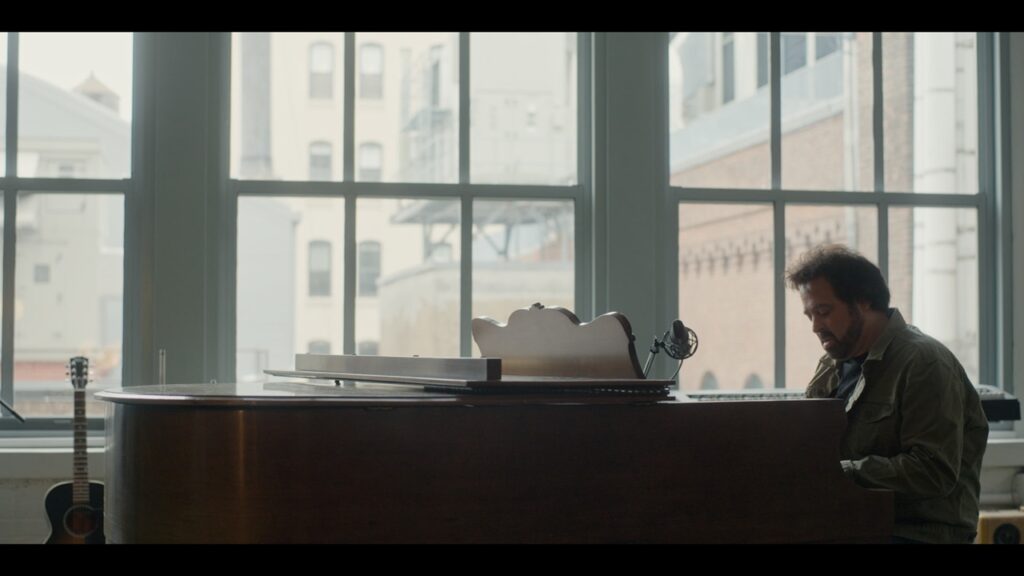
As Counting Crows: Have You Seen Me Lately? itself admits, this film covers the peak of the band’s fame. Writers spilled gallons of ink over August and the three years that followed. That gives Scott plenty of source material but also ensures that few stones of that time remain unturned. It means when something rarely mentioned gets the spotlight —frontman Durtiz’s brief period of self-harm, for instance—it is bracing. However, the familiar stories dominate the narrative.
Some, like the singer’s romances with two different Friends stars, are well-trod, but the film adds interesting context. In that case, former Rolling Stone writer David Wild points to how those relationships coincided with the mid-’90s explosion of celeb journalism in which even magazines with Stone’s pedigree felt forced to chase Us Weekly-like stories. As a result, Duritz—and the Crows by extension—got hit with overexposure from both sides, personal and professional. More often, though, the doc just states (and frequently restates) well-known facts with little further analysis.

The film follows the lead singer’s lead in not spending much time celebrating the band’s successes. Even moments of triumph mostly serve to underline the negatives of the time. For example, it frames the band’s breakthrough SNL performances as a moment where Duritz’s artistic integrity got him labeled an asshole. Similarly, discussion of the Crows’ Rolling Stone cover story results almost entirely in modern-day Duritz critiquing his past self’s mopey-ness for ruining the photo shoot.
That isn’t to say the movie is devoid of light moments. They’re just rarely provided by the central figure. For example, Coldplay lead singer Chris Martin learns on-camera that the tales of Duritz tending bar at the height of the band’s fame are true. He is visibly thrilled and begins to enthuse about how it showed the band’s commitment to staying down-to-earth. Then someone off-camera informs him that the bar in question was at the Viper Room. Martin smirks and shrugs, mumbling a bit about it not so much being about down to earth then. Other times, the doc specifically seeks humor and comes up a bit more empty-handed. Namely, when “roast master” Jeff Ross is on-camera. At one point, he wonders aloud why he’s part of the doc at all. Suffice it to say that question is never satisfactorily answered.

You may notice there’s a lot of talk about the lead singer above. The doc interviews several Crows, including guitarist David Bryson and keyboardist Charlie Gillingham, who, with the frontman, have made up the band’s nucleus since 1991. They also pull in a motley crew of other famous folk like Mary-Louise Parker, Steve Kerr, and The Lumineers’ Wesley Schultz. But what they seem to be asked about more than anything is Duritz. As a result, the film functions mainly as a chronicle of those years of his career with the rest of the band and various celebrity friends and fans along for the ride. While not uninteresting, it intensifies the biggest problem: this is a movie about the band’s most documented time, centered on its most well-documented member.
The bones of Counting Crows: Have You Seen Me Lately? are good. Scott and the editing team give the feature a nice impressionistic vibe. They mix present-day interviews, archival footage, and tangentially related images of skylines, hotel hallways, and more to capture the sense and slipperiness of memory. The recreations are so on-the-nose as to be almost unintentionally funny, but are thankfully rare. Duritz has always been an interesting interview, although sometimes frustratingly oblique. His present-day candor gives him a bigger emotional range and makes him more compelling. Still, it occupies a kind of limbo space, unlikely to attract the audience that would mind it most revealing, unlikely to give the audience it will attract anything new to chew on. It ultimately feels as ambivalent about who it is for as its central subject used to be about the prospect of being one of rock’s most recognizable faces.
Counting Crows: Have You Seen Me Lately? is buying itself a gray guitar on HBO now.